 EVERY CROCHET
 Baby Garments 15 rounds No account, no download
Simple double crochet newborn sleeper sack pattern
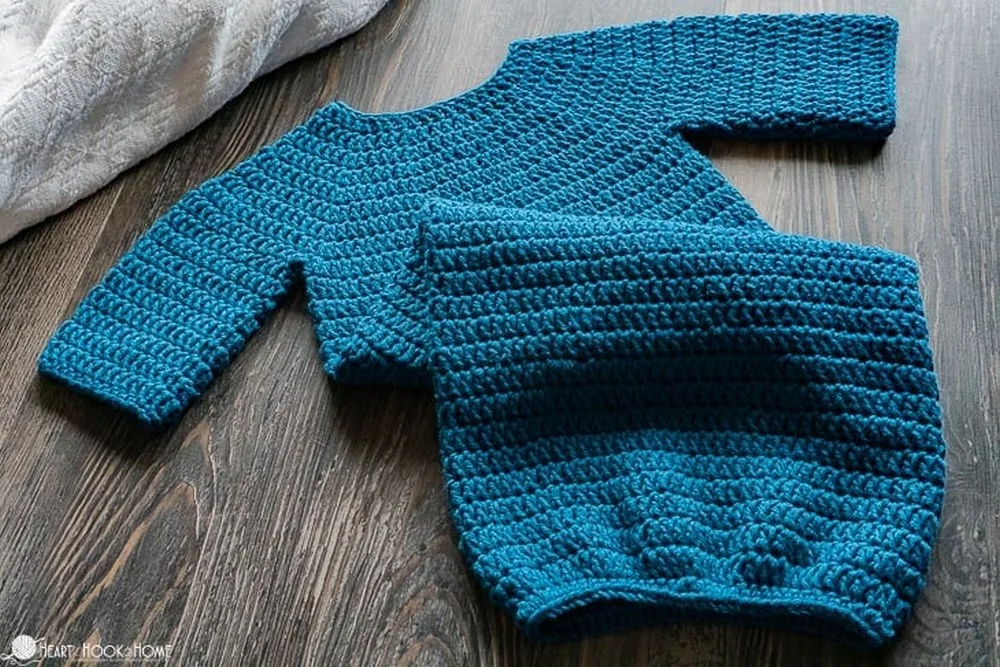
A simple double crochet (UK treble) newborn sleeper sack worked in rounds using US crochet terms, with UK equivalents noted for reference.
- Skill
- Intermediate
- Time
- 4-6 hours
- Yarn weight
- DK
- Hook
- 4 mm

Intermediate
What the original write-up called it. Nothing here is graded again.

DK
What the sample was worked in. Any weight works; the size moves with it.

4-6 hours
What the original page reckoned. Your own pace is the one that matters.
About this pattern
This pattern produces a newborn sleeper sack worked entirely in double crochet (UK treble) rounds without turning, using DK-weight cotton/bamboo yarn and a 4mm hook. The body starts at 48 stitches and increases to 96 before armholes are shaped and sleeves added. A length of eighth-inch elastic tapers the bottom hem. Expect around 380 yards of yarn and several hours of steady, round-by-round work.
This piece is a newborn sleeper sack, a wearable sleep garment built entirely from double crochet (UK treble crochet), the same firm, upright stitch used throughout the body, armhole shaping and sleeves. The fabric this stitch produces is dense and stable, which suits a garment that needs to hold its shape around a baby rather than drape softly. Only one stitch family appears from start to finish, so the piece reads cleanly and sits a step above amigurumi for a maker comfortable working steadily in continuous rounds.
The body begins with a foundation double crochet round of 48 stitches, then widens over the following rounds to 60, 72, 84 and 96 stitches before several rounds work even. At round 9 the armholes are formed by skipping 27 stitches on each side, and the sleeves are added afterwards by rejoining yarn at those skipped stitches and working in rounds without turning. The bottom edge is finished separately with a round of single crochet (UK double crochet) worked around a length of elastic to taper the hem.
The source describes this as a great starting point for a beginner, since it uses only one stitch and works up quickly. The sleeper is designed to be easy to put on and take off, which makes it practical for quick diaper changes.
Materials
Yarn
- Caboo yarn (size 3/DK, cotton/bamboo blend) – approx. 380 yards
Hook
- Crochet hook size G/4mm
Others
- ⅛” elastic
- Needle and thread
The list is the pattern's own wording.
Instructions
Every round is printed as the pattern wrote it, brackets and all. Open the key beside a round to see only the short forms that round uses.
Main Pattern
- Round 1
Fdc-48 (or ch-50, dc in 3rd ch from hook and in each to end) Join to top of the first dc with sl st. (48)
Key5
- sl st
- slip stitch
- fdc
- foundation double crochet
- ch
- chain
- st
- stitch
- dc
- double crochet
- Round 2
Ch-2, * dc in next 3 sts, 2dc in next * repeat between * * around. Join to the top of the first dc with sl st. (60)
Key5
- sl st
- slip stitch
- sts
- stitches
- ch
- chain
- st
- stitch
- dc
- double crochet
- Round 3
Ch-2, * dc in next 4 sts, 2dc in next * repeat between * * around. Join to the top of the first dc with sl st. (72)
Key5
- sl st
- slip stitch
- sts
- stitches
- ch
- chain
- st
- stitch
- dc
- double crochet
- Round 4
Ch-2, * dc in next 5 sts, 2dc in next * repeat between * * around. Join to the top of the first dc with sl st. (84)
Key5
- sl st
- slip stitch
- sts
- stitches
- ch
- chain
- st
- stitch
- dc
- double crochet
- Round 5
Ch-2, * dc in next 6 sts, 2dc in next * repeat between * * around. Join to the top of the first dc with sl st. (96)
Key5
- sl st
- slip stitch
- sts
- stitches
- ch
- chain
- st
- stitch
- dc
- double crochet
- Round 6
Ch-2, * dc in next 7 sts, 2dc in next * repeat between * * around. Join to the top of the first dc with sl st. (108)
Key5
- sl st
- slip stitch
- sts
- stitches
- ch
- chain
- st
- stitch
- dc
- double crochet
- Round 7
Ch-2, * dc in next 8 sts, 2dc in next * repeat between * * around. Join to the top of the first dc with sl st. (120)
Key5
- sl st
- slip stitch
- sts
- stitches
- ch
- chain
- st
- stitch
- dc
- double crochet
- Round 8
Ch-2, * dc in next 9 sts, 2dc in next * repeat between * * around. Join to the top of the first dc with sl st. (132)
Key5
- sl st
- slip stitch
- sts
- stitches
- ch
- chain
- st
- stitch
- dc
- double crochet
Sleeves
Attach yarn at the first skipped stitch of the armhole opening.
- Round 1
Ch-2, Dc in each st around (27 sts), dc2tog 3X over remaining spaces. Join to top of the first dc. (30)
Key5
- dc2tog
- double crochet 2 stitches together (decrease)
- sts
- stitches
- ch
- chain
- st
- stitch
- dc
- double crochet
- Rounds 2–10
Ch-2, do not turn, dc in each st around, join to top of first dc. (30)
Key3
- ch
- chain
- st
- stitch
- dc
- double crochet
- Round 11
Ch-1, do not turn, sc in each st around, join using Invisible Join. (30)
Key3
- ch
- chain
- st
- stitch
- sc
- single crochet
This completes the simple newborn sleeper and i hope you're going to love it.
Armholes
- Round 9
Ch-2, dc in next 3 sts, skip 27 sts, dc in next 39 sts. Skip 27 sts, dc in the remaining 36 sts. Join to the first dc with sl st. (78)
Key5
- sl st
- slip stitch
- sts
- stitches
- ch
- chain
- st
- stitch
- dc
- double crochet
Body
- Round 10
Ch-1, dc in each st around. Do not join, work in a spiral for the remainder of the pattern marking the first st of the row with a stitch marker. (78)
Key3
- ch
- chain
- st
- stitch
- dc
- double crochet
- Rounds 11–39
Dc in each st around. (78)
Key2
- st
- stitch
- dc
- double crochet
Due to working in a spiral and not turning, stitches will migrate to the right.
- Round 40
Dc in next 15 sts, hdc in next 2 sts, sc in next st, sl in next.
Key5
- sts
- stitches
- hdc
- half double crochet
- st
- stitch
- sc
- single crochet
- dc
- double crochet
Making up
- Step 1Ch-1, lay elastic so that you are crocheting around it, sc in each st around.
- Step 2Pull elastic so the bottom of the body tapers. The elastic should be about the same diameter as the sleep sack itself when pulled tight.
- Step 3Overlap the elastic ends by about an inch and secure them with a needle and thread. Sew thoroughly. Fasten off and weave in ends.
Notes from the pattern
- Use a 4mm (US G) hook and check gauge against 18 stitches by 9 rows to a 4 inch square before starting, since every later stitch count in the main pattern depends on this.
- Place a stitch marker at the join point of each round, as rounds are closed with a slip stitch and never turned, which makes it easy to lose the round start once the stitch count climbs past 60.
- Measure the eighth-inch elastic against the finished diameter of the body rather than cutting to a fixed length; the note in the pattern is to pull it until it matches the sack's own width, not tighter.
- Because round 1 can be worked as fdc-48 or as ch-50 plus dc, keep the resulting count at exactly 48 stitches before moving on, since the increase rounds that follow are built on that number.
- This pattern is written using US stitch terms throughout; UK equivalents are given alongside for reference only.
- The chain made at the beginning of a round does not count as a stitch, so do not work into it or include it in the stitch count.
The essentials
- Rounds
- 15
- Parts
- 4
- Level
- Intermediate
- Time
- 4-6 hours
- Hook
- 4 mm
- Yarn
- DK
Stitches you will use
- Foundation double crochet (fdc) Starts round 1 of the main pattern as an alternative to chaining and working back along it; keep stitch height even so the count of 48 stays accurate.
- Even increasing in rounds Rounds 2 to 5 add stitches (2dc in one stitch, repeated) to move the body from 48 to 96 stitches; space increases evenly so the piece lies flat rather than cupping.
- Armhole shaping with skipped stitches Round 9 skips 27 stitches twice to open the armholes before sleeves are picked up there; mark both sections beforehand so the openings match on each side.
Troubleshooting
The sleeper flares instead of sitting
Increases in rounds 2 to 5 have likely drifted out of place or been miscounted; recount stitches after each round against the stated totals of 60, 72, 84 and 96 and unpick back to the last correct total.
The armhole opening gapes or sits crooked on one side.
The two 27-stitch skips in round 9 were not placed symmetrically; mark the centre front and back before working that round so both skipped sections line up evenly.
The elasticated hem puckers unevenly around the bottom.
The elastic was pulled tighter in some sections than others while crocheting over it; gather it in small, even pulls as work progresses rather than all at once at the end, checking it against the body's own diameter as the pattern instructs.
Substituting yarn
- Pure cotton, DK weight
- Produces a firmer, less elastic fabric than the cotton/bamboo blend; a slightly larger hook than 4mm may be needed to match the stated gauge.
- Wool or acrylic blend, worsted weight
- Gives a warmer, more stretchy fabric; keep the 4mm hook as a starting point but swatch, since worsted yarns often run thicker than DK and can change the finished size.
- Cotton/bamboo blend, fingering weight
- Creates a lighter, finer fabric with less structure; drop to a smaller hook, around 3mm, and allow for roughly double the yardage to reach the same measurements.
Washing and care
- Hand wash or use a gentle cold machine cycle and dry flat, since the cotton/bamboo blend has little natural stretch recovery and can lose its shape if hung up while wet.
- Reshape the damp sleeper to its original stitch counts before leaving it to dry, and store it folded flat; avoid high-heat tumble drying, which can shrink or stiffen the bamboo content.
FAQs
Questions
Can this sleeper be made in a different size?
The pattern is written for one newborn size using the stitch counts given, but the stated gauge of 18 stitches by 9 rows to 4 inches allows the increase rounds to be scaled up for a larger size. Keep the same round-by-round structure and adjust the target stitch totals accordingly.
What happens if gauge is off?
Because rounds are worked without turning and stitch counts are fixed at each stage, gauge mainly affects the finished width rather than the length. Swatch with the 4mm hook to the stated 18 by 9 gauge before starting the main 8 rounds.
Is turning required at any point in this pattern?
No, the source notes state the work is never turned throughout, including the 10 plain sleeve rounds. The right side of the fabric faces outward for the whole piece once the first round is joined.
How does the finished sleeper close or fasten?
There is no separate button or zip closure in this pattern. The bottom opening is gathered shut by the elastic worked into the final single crochet round, which tapers the hem closed.
Can the elastic step at the bottom be left out?
The elastic can be omitted, but doing so leaves the bottom hem open rather than tapered shut. Work the final single crochet round without threading elastic through it if a flat, open edge is preferred instead.
These answers came from whoever first published the pattern, kept word for word.