 EVERY CROCHET
 Tops & Garments 11 rounds No account, no download
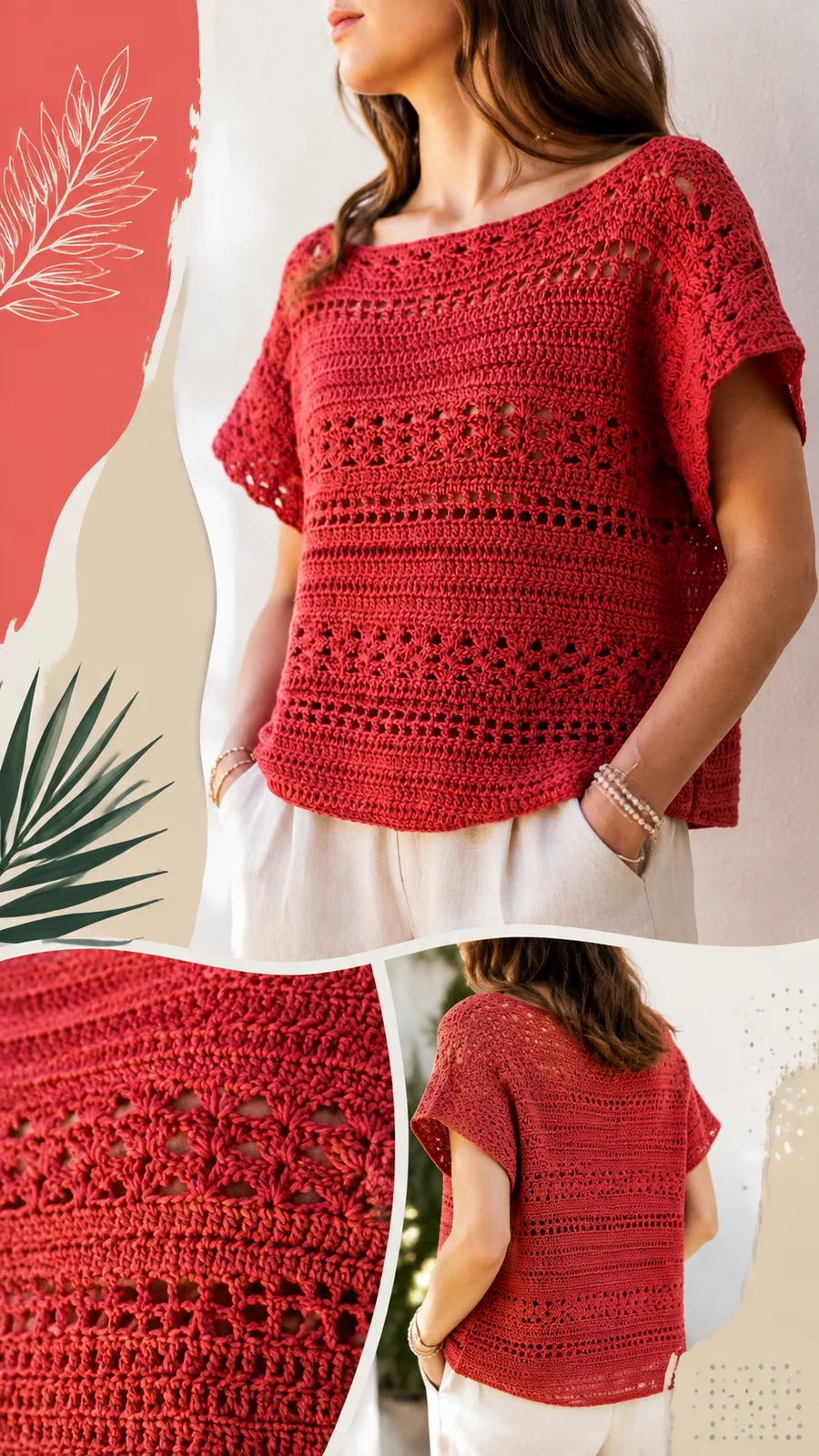
Red boxy double crochet summer top for women
Double crochet (UK: treble) summer top with lace panels and short sleeves. US and UK stitch names both given.
- Skill
- Confident Beginner
- Time
- 6-10 hours
- Yarn weight
- DK (Category 3)
- Hook
- 4.0 mm

Confident Beginner
What the original write-up called it. Nothing here is graded again.

DK (Category 3)
What the sample was worked in. Any weight works; the size moves with it.

6-10 hours
What the original page reckoned. Your own pace is the one that matters.
About this pattern
This is a loose, boxy summer top worked in two identical rectangular panels of double crochet (UK: treble crochet), broken by a chain-space lace band, then seamed at the shoulders and sides. Short sleeves are worked directly into the arm openings. It uses lightweight cotton DK yarn, a 4.0 mm hook, and suits a confident beginner comfortable with basic shaping-free construction.
This red boxy top belongs to the double crochet (UK: treble crochet) family, the tall, open stitch that builds fabric quickly and gives crochet garments their familiar ridged texture. Chain-space lace bands interrupt the solid double crochet rows, adding the floral-inspired openwork that gives the finished piece its textured, airy appearance without altering the overall drape of the cotton fabric.
The top is built from two rectangular panels worked flat from the bottom edge upward, each starting with a foundation chain and continuing in straight rows until a lace band is introduced partway up the piece. Front and back panels are joined afterwards at the shoulders and sides, and short sleeves are added by working rounds directly into the arm openings rather than shaping a separate sleeve piece.
Materials
- Lightweight cotton or cotton-blend DK yarn in red or coral, approximately 1,000 yards (914 meters)
- 4.0 mm US G-6 crochet hook
- Yarn needle for sewing seams and weaving ends
- Scissors
- Measuring tape
- Stitch markers
The list is the pattern's own wording.
Instructions
Every round is printed as the pattern wrote it, brackets and all. Open the key beside a round to see only the short forms that round uses.
Front and Back Panels
The top is made from two identical panels. Each panel measures approximately 20 inches wide x 22 inches long (51 x 56 cm). Adjust length before joining if a longer or cropped style is preferred.
Ch 91.
- Row 1
Dc in 4th ch from hook and in each ch across. Turn. (88 dc)
Key2
- ch
- chain
- dc
- double crochet
- Rows 2–8
Ch 3, dc in each stitch across. Turn. (88 dc)
Key2
- ch
- chain
- dc
- double crochet
- Row 9
Ch 3, dc in first 4 sts, *ch 2, sk 2 sts, dc in next 6 sts, rep from * across, ending with dc in last 4 sts. Turn.
Key4
- rep
- repeat
- ch
- chain
- dc
- double crochet
- sk
- skip
- Row 10
Ch 3, dc across, working 2 dc into each ch-2 space. Turn. (88 dc)
Key2
- ch
- chain
- dc
- double crochet
- Rows 11–18
Ch 3, dc in each stitch across. Turn.
Key2
- ch
- chain
- dc
- double crochet
- Row 19
Ch 3, dc in first 3 sts, *lace shell in next stitch, sk 2 sts, dc in next 3 sts, rep from * across, ending with dc in last 3 sts. Turn.
Key4
- rep
- repeat
- ch
- chain
- dc
- double crochet
- sk
- skip
- Row 20
Ch 3, dc across. Turn.
Key2
- ch
- chain
- dc
- double crochet
- Rows 21–45
Repeat Rows 9-20 twice, then continue with dc rows until the panel measures approximately 22 inches (56 cm).Fasten off and weave in ends.
Key1
- dc
- double crochet
Sleeves
Join yarn at the side edge of the arm opening.
- Round 1
Ch 3, work 2 dc evenly around the arm opening edge. Join with sl st.
Key4
- sl st
- slip stitch
- ch
- chain
- dc
- double crochet
- st
- stitch
- Round 2
Ch 3, dc around. Join with sl st.
Key4
- sl st
- slip stitch
- ch
- chain
- dc
- double crochet
- st
- stitch
- Round 3
Ch 1, sc around. Join and fasten off.
Key2
- ch
- chain
- sc
- single crochet
Project Details
Project Name: Coral Breeze Textured Crochet Top
Description: A relaxed handmade crochet shirt featuring simple double crochet rows, decorative lace bands, and comfortable short sleeves.
Skill Level Confident beginner Finished Size Approximate small/medium: 40 in bust circumference (102 cm)
Garment Ease Recommended 4 to 8 inches (10 to 20 cm) positive ease Yarn Approximately 1,000 yards (914 meters) lightweight cotton yarn, category 3 DK
Hook 4.0 mm US G-6 crochet hook Gauge 18 double crochet stitches x 9 rows = 4 x 4 inches (10 x 10 cm)
Terminology US crochet terms
Special Stitch
Lace Shell: In the indicated chain space, work (dc, ch 2, dc, ch 2, dc) in the same space.
Making up
- Step 1Place front and back panels together with the right sides facing inward.
- Step 2Sew shoulder seams, leaving approximately 9 inches (23 cm) open for the neckline.
- Step 3Sew side seams from the bottom upward, leaving 8 inches (20 cm) open for each sleeve opening.
- Step 4Attach sleeves using slip stitches or a whip stitch seam.
- Step 5Work one final round of sc around the neckline and bottom edge for stability.
- Step 6Gently wash or dampen the finished garment and lay it flat to dry. Shape the neckline, sleeves, and side edges evenly while blocking to create a polished garment shape.
- Step 7After finishing the seams, carefully weave all yarn tails into the fabric using a yarn needle. Cotton crochet garments benefit from gentle washing and flat drying to maintain their shape.
- Step 8Store the finished crochet top folded rather than hanging for long periods, as the weight of the yarn may slightly stretch the shoulders.
Notes from the pattern
- Use a 4.0 mm (US G-6) hook consistently throughout; swapping hooks mid-project can shift the stated gauge of 18 double crochet stitches by 9 rows to 4 x 4 inches (10 x 10 cm).
- Place stitch markers at the start and end of the Row 9 lace repeat to keep the chain-2 spaces aligned, since the 88-stitch count needs to divide evenly for the pattern to stay balanced.
- Check gauge before starting a panel, as cotton has little stretch; tighter tension will make the finished 40 in (102 cm) bust measurement run smaller than the intended 4-8 in (10-20 cm) ease.
- Weave in ends securely and seam firmly at the shoulders, since cotton lacks the memory of wool and the completed top is recommended to be stored folded to avoid shoulder stretch.
- A hook range of 3.75 mm to 4.5 mm can be used depending on personal tension, though the stated gauge of 18 double crochet stitches by 9 rows to 4 x 4 inches (10 x 10 cm) was achieved with the 4.0 mm hook; swatch first if sizing within that range.
The essentials
- Rounds
- 11
- Parts
- 4
- Level
- Confident Beginner
- Time
- 6-10 hours
- Hook
- 4.0 mm
- Yarn
- DK (Category 3)
Stitches you will use
- Double crochet rows (UK: treble crochet) Forms the main panel fabric in Rows 2-8; watch that the stitch count holds steady at 88 across each row.
- Chain-space lace sections Worked in Row 9 with alternating ch-2 spaces and skipped stitches; watch that the sk-2/ch-2 repeat stays even so the openwork band doesn't pull the fabric narrower.
- Panel seaming at shoulders and sides Joins the two finished rectangles into a wearable shape; watch that row counts match on both panels so the seam sits flat rather than puckering.
Troubleshooting
The lace band pulls the fabric narrower
This happens when Row 10 doesn't work 2 dc back into each ch-2 space from Row 9; recount to restore the full 88 dc before continuing.
The two finished panels are different widths.
Tension usually drifts between the two pieces; recheck the foundation chain count and use stitch markers every 10 stitches on the second panel to match the first.
The sleeve edge feels tight across the upper arm.
Too few stitches were worked evenly around the arm opening in Round 1; redistribute or add stitches before Round 2 so the opening isn't constricted.
Substituting yarn
- Cotton-linen blend, DK weight
- Gives a stiffer, more structured drape than pure cotton; hook size stays the same at 4.0 mm.
- Acrylic or acrylic blend, DK weight
- Softer and more budget-friendly with slightly more stretch than cotton, though less breathable for a summer top; same 4.0 mm hook.
- Bamboo or rayon blend, light DK/fingering weight
- Increases drape and sheen so the top hangs closer to the body; dropping to a 3.5 mm hook may be needed to keep the lace holes from opening too wide.
Washing and care
- Hand wash in cool water with a mild detergent; cotton holds its shape well but can lose some elasticity if machine washed on a fast spin.
- Dry flat on a towel away from direct heat or strong sun to protect the red colour and prevent shoulder stretch, reshaping each panel to its original 20 x 22 in (51 x 56 cm) size while still damp.
FAQs
Questions
Can the top be made in a colour other than red?
Yes, the pattern works with any lightweight cotton or cotton-blend DK yarn. Pastels, neutrals or earth tones give the same texture without any change to stitch counts.
How is the top resized for a larger or smaller bust?
Measure the wearer's bust and add 4-8 in (10-20 cm) of positive ease, then adjust the foundation chain in multiples of 6 stitches. This keeps the chain-space lace band balanced across the row.
Can the top be made longer, like a tunic?
Yes, extra double crochet rows can be added to each panel before the shoulders and sides are joined. This lengthens the body without disturbing the placement of the lace band.
How much yarn does this actually take?
The pattern calls for about 1,000 yards (914 metres) of lightweight cotton DK yarn. This covers both identical 20 x 22 in panels plus the short sleeve rounds.
Is this a suitable first garment project?
Yes, the skill level is listed as confident beginner since there is no shaping beyond two straight panels. The Row 9 lace section and the shoulder/side seaming do call for some extra care.
Can the top be cropped for a shorter style?
Yes, reduce the plain double crochet rows between lace sections to shorten the body for a cropped summer version.
Can the neckline be made wider?
Yes, leave a larger opening when joining the shoulder seams to create a wider neckline.
Can the sleeves be made more fitted?
Yes, reduce the number of stitches added during sleeve construction for a more fitted sleeve.
These answers came from whoever first published the pattern, kept word for word.