 EVERY CROCHET
 Bags 4 rounds No account, no download
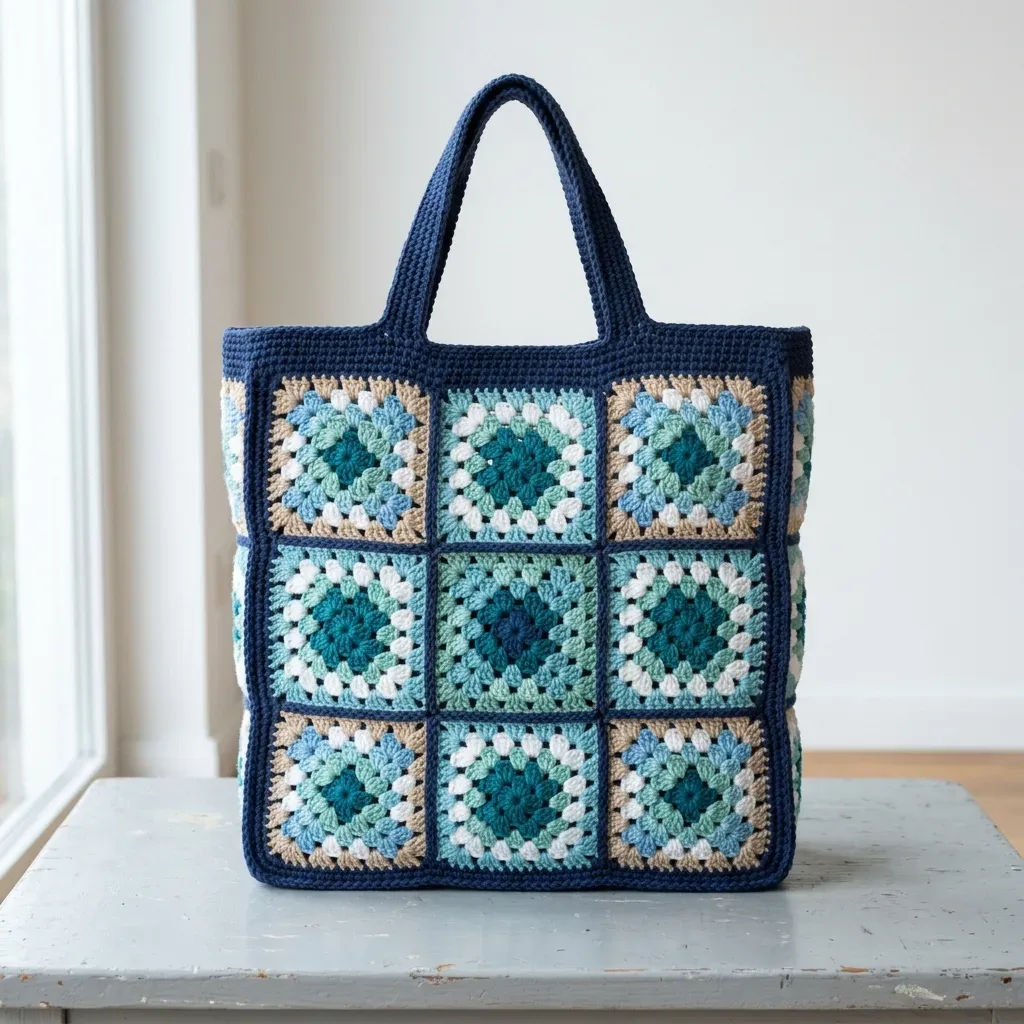
Navy-framed granny square tote in ocean blues
Granny square bag in double crochet (UK: treble). Twenty-seven squares, navy frame, step-by-step for US and UK terms.
- Skill
- Intermediate
- Time
- 4-6 hours
- Yarn weight
- Worsted
- Hook
- 5.0 mm

Intermediate
What the original write-up called it. Nothing here is graded again.

Worsted
What the sample was worked in. Any weight works; the size moves with it.

4-6 hours
What the original page reckoned. Your own pace is the one that matters.
About this pattern
A worsted-weight cotton tote built from twenty-seven four-round granny squares (double crochet, UK: treble crochet) in teal, sea glass, white, and sky blue, joined and framed in navy. The navy also forms the sc top band and two 20 inch (51 cm) straps. Finished size is roughly 12½ x 13 x 4 inches (32 x 33 x 10 cm). A US H/8 (5.0 mm) hook and comfort with basic seaming are all that is required.
The Ocean Blues bag belongs to the granny square family, the classic motif built in rounds of double crochet (UK: treble crochet). Twenty-seven squares in teal, sea glass, white, and sky blue each take four rounds to complete, giving the piece its colourwork without any shaping beyond the standard corner clusters and chain-one spaces that every granny worker already knows.
Construction keeps the decorative work and the structural work separate. The squares are joined edge to edge in navy, which then continues upward as a plain sc top band and outward as two long straps, so all the load-bearing seaming and strapwork sits in one colour while the patchwork of blues stays purely visual.
Materials
Yarn
- Worsted weight (Aran / 10 ply / Category 4) cotton or cotton blend. The amounts below are approximate, and a scrappy approach works beautifully here:
- Navy (squares’ frame, joins, top band, and handles): ~280 yards / 256 meters
- Teal (square centers): ~90 yards / 82 meters
- Sea Glass (round 2): ~120 yards / 110 meters
- White (round 3): ~150 yards / 137 meters
- Sky Blue (round 4 on some squares): ~110 yards / 100 meters
- Sand (round 4 on remaining squares): ~100 yards / 91 meters
Suggested Yarns
- Lily Sugar’n Cream (worsted cotton), Paintbox Yarns Cotton Aran, or Hobbii Rainbow Cotton 8/8. Any sturdy worsted cotton that meets gauge will work perfectly.
Hook
- US H/8 (5.0 mm) crochet hook
Notions
- Tapestry needle, stitch markers, scissors, blocking mat and pins. Optional: fabric for a lining if you want to add one.
The list is the pattern's own wording.
Instructions
Every round is printed as the pattern wrote it, brackets and all. Open the key beside a round to see only the short forms that round uses.
Top Band (Navy)
- Round 1
Join Navy at a top back corner. Sc evenly around the entire opening, working about 1 sc in each st and 1 sc in each ch 1 space around. Join with sl st. (96 sc)
Key3
- sl st
- slip stitch
- ch
- chain
- sc
- single crochet (insert hook, yarn over, pull through, yarn over, pull through both loops)
- Round 2
through 5: Ch 1, sc in each st around, join. (96 sc) Adjust Round 1 to a stitch count close to 96 if your squares differ slightly. The band only needs to be even.
Key2
- ch
- chain
- sc
- single crochet (insert hook, yarn over, pull through, yarn over, pull through both loops)
Handles (Make 2 in Navy)
- Round 1
Ch 8. Sc in 2nd ch from hook and in each ch across, turn. (7 sc)
Key2
- ch
- chain
- sc
- single crochet (insert hook, yarn over, pull through, yarn over, pull through both loops)
- Round 2
to end: Ch 1, sc in BLO of each st across, turn. (7 sc) Repeat until the strap measures about 20 inches (51 cm) , which is roughly 90 rows. Fasten off, leaving a long tail for sewing.
Key3
- BLO
- back loops only
- ch
- chain
- sc
- single crochet (insert hook, yarn over, pull through, yarn over, pull through both loops)
Making up
- Step 1Weave in all remaining ends on the wrong side and trim them close.
- Step 2Give the whole bag a gentle steam or wet block to even out the squares and set the shape.
- Step 3For a more structured tote that holds more weight, cut a piece of plastic canvas or stiff fabric to the base size and tack it inside.
- Step 4Optional lining: Cut fabric to the inside dimensions plus ½ inch seam allowance, sew into a pouch, and hand stitch it to the top band just below the handles.
Notes from the pattern
- A US H/8 (5.0 mm) hook is used throughout; swapping hook size will change the 4 inch (10 cm) square measurement and shift the final 12½ x 13 x 4 inch (32 x 33 x 10 cm) bag size.
- Stitch markers are worth placing in the corner ch 2 spaces of each square while joining, since a missed corner is hard to spot once navy framing covers the edge.
- Colour changes happen at the start of each new round rather than mid-row, so fasten off and rejoin cleanly at a corner space each time to keep tension even across all twenty-seven squares.
- The navy top band relies on a stitch count close to 96 sc; if squares run slightly large or small, adjust Round 1 of the band rather than forcing the later rounds to match.
The essentials
- Rounds
- 4
- Parts
- 2
- Level
- Intermediate
- Time
- 4-6 hours
- Hook
- 5.0 mm
- Yarn
- Worsted
Stitches you will use
- Granny cluster corners Every round of every square turns on a (3 dc, ch 2, 3 dc) corner; keep the ch 2 spaces open and consistent or the squares will finish at different sizes.
- Colour joining into a ring or ch-2 space Each new round starts with a fresh colour joined into a corner space; pull the first stitch snug so the join doesn't leave a visible gap at the corner.
- Back loop only single crochet Used throughout the handles to keep the strap flat and firm; working BLO only on every row after Row 1 is what gives the handle its ridged, sturdy texture.
Troubleshooting
The squares vary noticeably in size once all twenty-seven are finished
Tension usually drifts on the corner clusters; recheck that every corner has a full (3 dc, ch 2, 3 dc) and block the smaller squares slightly more firmly to bring them in line.
The navy frame puckers at the corners where squares meet
This comes from joining into the ch 1 spaces too tightly; work the join stitches with the same tension as the rest of the round rather than cinching them.
The handles twist or curl along their length
BLO single crochet naturally ridges one way; working all strap rows with the same side facing and blocking the finished straps flat before attaching corrects this.
Substituting yarn
- Acrylic worsted (Aran) weight
- Lighter and less structured than cotton, so the finished bag will have more drape and less body; a stiffened base insert becomes more useful to hold the shape.
- Cotton-acrylic blend, worsted weight
- Keeps the crispness of the squares closer to the original while reducing overall weight; hook size and the 4 inch (10 cm) square gauge stay the same.
- Linen-cotton blend, worsted weight
- Adds a slightly stiffer, more textured hand that suits the structured tote shape well, though it may require a touch more blocking to fully even out the stitches.
Washing and care
- Hand wash the finished bag in cool water with a mild detergent, since worsted cotton holds its shape best when not agitated in a machine; lay flat to dry to avoid stretching the straps.
- Reshape gently while still damp and let the bag dry flat on a blocking mat; store stuffed loosely with tissue paper rather than folded, so the granny squares don't crease.
FAQs
Questions
Can the bag be made bigger or smaller?
Adding or removing full granny squares changes the overall size in 4 inch (10 cm) increments per square. The navy top band stitch count should then be adjusted to match the new perimeter rather than kept fixed at 96.
Why does the pattern call double crochet instead of treble?
The pattern is written in US terms, where double crochet matches the UK treble crochet stitch. This is noted once because every cluster and corner in the squares depends on recognising the correct stitch.
Is a lining necessary?
No, the lining is listed as optional in the assembly steps. It is worth adding if the bag will carry heavier or loose items, since it also hides the inside seams.
How much navy yarn is really needed?
Materials list approximately 280 yards (256 metres) for the frame, joins, top band, and both handles combined. Scrappy leftovers work for the coloured squares, but navy should be bought as a single dedicated amount since it carries the structure.
Does the bag need a stiff base to hold its shape?
The granny squares and navy frame alone give a sturdy result, but the assembly steps suggest a plastic canvas or stiff fabric insert at the base for a more structured tote that holds more weight.
These answers came from whoever first published the pattern, kept word for word.