 EVERY CROCHET
 Accessories 11 rounds No account, no download
Flower bouquet keychain charm crochet pattern
A bobble-stitch flower charm using US single crochet (UK double crochet) stitches; both US and UK names are given.
- Skill
- Intermediate
- Time
- 1-2 hours
- Yarn weight
- Worsted
- Hook
- 3.5 mm

Intermediate
What the original write-up called it. Nothing here is graded again.

Worsted
What the sample was worked in. Any weight works; the size moves with it.

1-2 hours
What the original page reckoned. Your own pace is the one that matters.
About this pattern
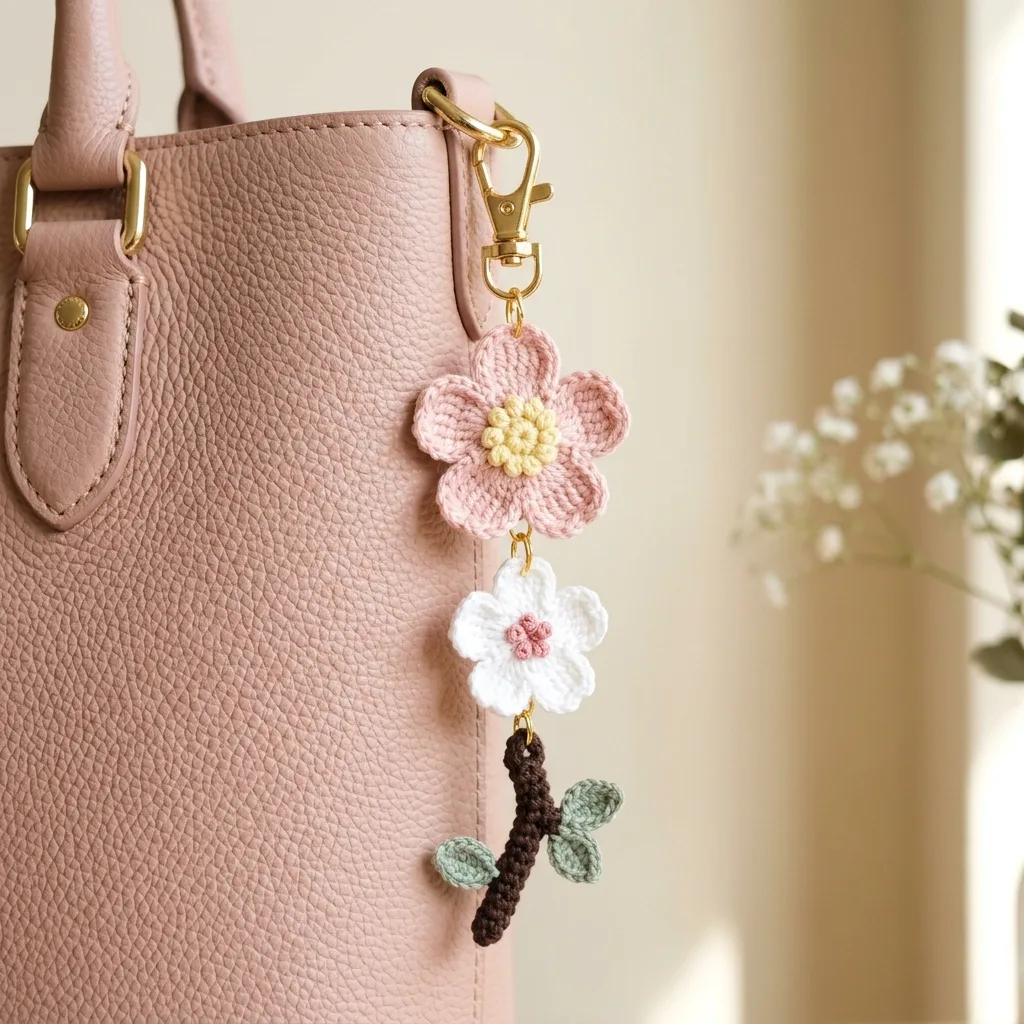
This pattern makes a small floral charm for a keychain or bag, combining a bobble-centred flower, dc petals, a second smaller flower, a crocheted branch and sage green leaves. Materials include worsted weight cotton or cotton-blend yarn in several colours, a 3.5mm hook, a tapestry needle, a lobster clasp and jump rings. The finished pieces are stitched together and linked with jump rings to form the charm.
This small charm combines two flowers, a branch and a pair of leaves into a single keychain piece, built from the single crochet family (called double crochet in the UK) alongside clusters of double crochet and bobble stitches. The bobble stitch gives each flower centre its raised, textured dot, while the petals are shaped with chains and double crochet grouped into scalloped points. Worked at a small worsted weight gauge with a 3.5mm hook, the whole charm stays compact enough to hang from a bag or a set of keys without adding bulk.
Each element is crocheted separately and finished before assembly: the large flower starts with a pale yellow bobble centre, the small flower works up from a five-stitch base in a contrasting centre colour, and the branch and leaves are worked as their own standalone pieces. Once all parts are complete, the pieces are stitched together with a tapestry needle, then linked to a lobster clasp using small jump rings to turn the finished floral cluster into a wearable charm.
Materials
Yarn
- Light pink worsted weight yarn (approximately 15 yards) for the large flower petals
- Pale yellow worsted weight yarn (approximately 5 yards) for the large flower center
- White worsted weight yarn (approximately 10 yards) for the small flower petals
- Yellow or pink worsted weight yarn (approximately 3 yards) for the small flower center
- Dark brown worsted weight yarn (approximately 8 yards) for the branch
- Sage green worsted weight yarn (approximately 5 yards) for the leaves
Tools
- 3.5mm (E/4) crochet hook
- Tapestry needle for weaving ends
- Small gold swivel lobster clasp (approximately 1.5 inches)
- 3 small gold jump rings (6mm to 8mm work well)
- Small jewelry pliers (optional but helpful for opening jump rings)
- Scissors
- Stitch marker (optional)
The list is the pattern's own wording.
Instructions
Every round is printed as the pattern wrote it, brackets and all. Open the key beside a round to see only the short forms that round uses.
Main Pattern
Large Pink Flower Pattern (Make 1)
This flower forms the top of your charm and features five rounded petals with a puffy bobble center. The close up detail shot shows how the petals curve slightly and the bobble center creates that textured, dimensional look.
Flower Center (Yellow)
- Round 1
Using pale yellow yarn, create a magic ring. Ch 1 (does not count as a stitch throughout), work 6 sc into the ring. Pull the ring closed. Sl st to first sc to join. (6 sts)
Key6
- magic ring
- an adjustable starting loop that pulls completely closed; if not comfortable with magic rings, chain 4 and slip stitch to form a ring instead
- sl st
- slip stitch
- sts
- stitches
- ch
- chain
- st
- stitch
- sc
- single crochet
- (6)Round 2
Ch 1, work 1 bobble in each stitch around. To make each bobble: yarn over, insert hook into stitch, yarn over and pull up a loop, yarn over and pull through 2 loops. Repeat this sequence 4 more times in the same stitch (6 loops on hook), then yarn over and pull through all 6 loops. Ch 1 to secure the bobble. Repeat in each stitch around, working a total of 6 bobbles. Sl st to first bobble to join. (6 bobbles)Fasten off and leave a 6 inch tail for sewing.
Key4
- bobble
- a cluster stitch made by working 5 half-closed double crochets into the same stitch, then yarn over and pull through all 6 loops at once to create a puffy, raised texture
- sl st
- slip stitch
- ch
- chain
- st
- stitch
Flower Petals (Pink)
Part 2
- Round 1
Using light pink yarn, create a magic ring. Ch 1, work 5 sc into the ring. Pull the ring closed. Sl st to first sc to join. (5 sts)
Key6
- magic ring
- an adjustable starting loop that pulls completely closed; if not comfortable with magic rings, chain 4 and slip stitch to form a ring instead
- sl st
- slip stitch
- sts
- stitches
- ch
- chain
- st
- stitch
- sc
- single crochet
- Round 2
Ch 1, work 2 sc in each stitch around. Sl st to first sc to join. (10 sts)
Key5
- sl st
- slip stitch
- sts
- stitches
- ch
- chain
- st
- stitch
- sc
- single crochet
- Round 3
Petal Round This is where the petals form. In the first stitch, work: sl st, ch 2, 2 dc, ch 2, sl st. This creates one complete petal. Skip the next stitch. Repeat this petal sequence in every other stitch around, creating 5 petals total. Sl st to first sl st to join.
Key4
- sl st
- slip stitch
- ch
- chain
- st
- stitch
- dc
- double crochet
Note: If your petals are curling or cupping, try using a slightly larger hook. The petals should lay relatively flat with just a gentle curve.
Fasten off and weave in the end.
Assembly
Place the yellow bobble center on top of the pink flower, aligning it in the middle. Using the yarn tail from the center piece, sew the center to the flower with small stitches around the edge. Weave in all ends securely.
Small White Flower Pattern (Make 1)
This smaller flower sits below the pink flower and uses the same construction method, just scaled down slightly.
Flower Center (Yellow or Pink)
Part 3
- Round 1
Using your chosen center color, create a magic ring. Ch 1, work 5 sc into the ring. Pull the ring closed. Sl st to first sc to join. (5 sts)
Key6
- magic ring
- an adjustable starting loop that pulls completely closed; if not comfortable with magic rings, chain 4 and slip stitch to form a ring instead
- sl st
- slip stitch
- sts
- stitches
- ch
- chain
- st
- stitch
- sc
- single crochet
- (5)Round 2
Ch 1, work 1 bobble in each stitch around using the same bobble technique from the large flower. Sl st to first bobble to join. (5 bobbles)Fasten off and leave a tail for sewing.
Key4
- bobble
- a cluster stitch made by working 5 half-closed double crochets into the same stitch, then yarn over and pull through all 6 loops at once to create a puffy, raised texture
- sl st
- slip stitch
- ch
- chain
- st
- stitch
Flower Petals (White)
Part 4
- Round 1
Using white yarn, create a magic ring. Ch 1, work 5 sc into the ring. Pull the ring closed. Sl st to first sc to join. (5 sts)
Key6
- magic ring
- an adjustable starting loop that pulls completely closed; if not comfortable with magic rings, chain 4 and slip stitch to form a ring instead
- sl st
- slip stitch
- sts
- stitches
- ch
- chain
- st
- stitch
- sc
- single crochet
- (5)Round 2
In the first stitch, work: sl st, ch 2, 1 dc, ch 2, sl st. This creates one petal. Work this petal sequence in each stitch around. Sl st to first sl st to join. (5 petals)Fasten off and weave in the end.
Key4
- sl st
- slip stitch
- ch
- chain
- st
- stitch
- dc
- double crochet
Assembly
Sew the center to the flower as you did with the large flower.
Branch and Leaves Pattern
The branch adds such a lovely organic element to this charm. It's essentially a crocheted cord with tiny leaves attached.
Branch (Brown)
Part 5
- Row 1
Using dark brown yarn, ch 15. Starting in the second chain from the hook, sl st in each chain across. (14 sl sts)Fasten off, leaving a 4 inch tail. The branch should be firm but slightly flexible.
Key4
- sl st
- slip stitch
- sts
- stitches
- ch
- chain
- st
- stitch
Leaves (Sage Green)
Make 2 leaves.
- Row 1
Ch 6. Starting in the second chain from the hook: sl st, sc, hdc, sc, sl st.
Key5
- sl st
- slip stitch
- hdc
- half double crochet
- ch
- chain
- st
- stitch
- sc
- single crochet
This creates one pointed leaf shape.
Fasten off, leaving a tail for attaching to the branch.
Tip: For slightly larger leaves, chain 7 and work: sl st, sc, hdc, dc, hdc, sl st.
Attaching the Leaves
Using your tapestry needle, sew one leaf to each side of the branch, positioning them about one third of the way up from the bottom. The leaves should angle outward slightly, as shown in the photos.
Finishing and Assembly
Now comes the fun part where everything comes together.
Step 1: Lay out your pieces to plan placement. You should have one large pink flower, one small white flower, one branch with leaves, and your hardware.
Step 2: Using a jump ring, attach the swivel clasp to the top of the large pink flower. To do this, use your pliers to gently twist the jump ring open (don't pull it apart). Thread it through a stitch at the top of the flower and through the loop on the clasp. Twist the ring closed.
Step 3: Using another jump ring, connect the bottom of the large pink flower to the top of the small white flower.
Step 4: Using the final jump ring, connect the bottom of the small white flower to the top of the branch.
Alternative attachment method: If you don't have jump rings, you can use yarn to create small loops connecting each piece. Simply chain 5 or 6 stitches, form a loop, and sew the ends securely to each component.
Customization Ideas for Your Flower Charm
This basic pattern opens up so many possibilities for personalization.
Color variations: Try a classic white and yellow daisy combination, or go bold with coral and turquoise. Variegated yarn creates an interesting ombre effect in the petals.
Notes from the pattern
- The 3.5mm (E/4) hook keeps the bobble stitches tight enough to hold their shape at this small scale; sizing down slightly can tighten loose bobbles.
- A stitch marker is optional but helpful for tracking the join point on short rounds of only five or six stitches, where the first stitch is easy to lose.
- Each component -- large flower centre, large petals, small flower centre, small petals, branch and leaves -- is worked in a single colour and fastened off before the next begins, so no colour changes happen mid-round.
- Petals that cup rather than lie flat usually point to tension being too tight for the hook size; sizing up slightly lets the petals relax into a gentle curve.
- The finished charm measures approximately 5 inches from the swivel clasp to the bottom of the branch.
- Cotton or a cotton blend yarn with good stitch definition works best for this project; a slightly textured yarn shows off the small, detailed stitches most clearly.
The essentials
- Rounds
- 11
- Parts
- 6
- Level
- Intermediate
- Time
- 1-2 hours
- Hook
- 3.5 mm
- Yarn
- Worsted
Stitches you will use
- Magic ring Starts every flower centre and petal base; pull the tail firmly before the first round so no gap shows at the middle.
- Bobble stitch Forms the raised centre of both the large and small flowers; keep tension even across all five loops so each bobble sits at the same height.
- Petal shaping Builds each petal from a single stitch using sl st, ch 2, 2 dc, ch 2, sl st; skipping alternate stitches keeps the five petals evenly spaced.
Troubleshooting
The petals cup or curl instead of lying flat.
This usually means the double crochet stitches in the petal round are pulled too tight for the hook; move up to a slightly larger hook so the petals relax into a gentle curve rather than a dome.
The bobble stitches look loose or lopsided.
This happens when the five loops of each bobble are pulled through at uneven tension; keep a snug, consistent pull on each yarn-over before closing the bobble so all five sit at the same height.
The flower centre sits off to one side of the petal ring.
An uneven magic ring pull before the first round leaves the centre loose and able to shift; pull the starting tail tight and only weave it in once the centre is positioned and sewn in place.
Substituting yarn
- DK weight cotton or cotton blend
- Produces a smaller, finer charm with tighter bobble definition; drop to a 3mm hook to keep stitches snug at the smaller gauge.
- Worsted weight acrylic
- Keeps the charm at the same size specified and works with the same 3.5mm hook, though the bobbles and petal edges show less stitch definition than cotton.
- Cotton-bamboo blend, worsted weight
- Adds extra drape so the petals fall slightly softer than with pure cotton, while the 3.5mm hook and finished size stay the same.
Washing and care
- Because the materials list calls for cotton or cotton-blend yarn, hand wash the finished charm in cool water if needed and reshape the petals and bobbles with fingers while still damp, then lay flat to dry.
- Store the charm away from sharp jewellery or bag hardware that could snag the petals, and keep the jump rings and clasp dry to prevent tarnishing.
FAQs
Questions
What hook size does this pattern call for?
The pattern uses a 3.5mm (E/4) hook throughout, which keeps the small bobble stitches and petal clusters tight enough to hold their shape at this scale.
Can both flowers be made in the same colour?
Yes; the pattern lists light pink and white as petal colours and pale yellow plus yellow or pink for the centres, but any worsted weight yarn can be swapped in for either flower.
How are the finished pieces joined into a charm?
Each crocheted part is fastened off with a sewing tail, stitched together with a tapestry needle, then linked through small jump rings (6mm to 8mm) to a small gold swivel lobster clasp of about 1.5 inches.
Why does the small flower centre list yellow or pink as options?
Either colour works equally well against the white petals of the small flower; the choice only affects colour balance, not the stitch count or construction.
What kind of yarn gives the best stitch definition for a project this small?
Cotton or a cotton blend worsted weight yarn with a slightly textured finish shows off the bobble stitches and petal edges most clearly, which matters more at this small scale than on a larger piece.
These answers came from whoever first published the pattern, kept word for word.