 EVERY CROCHET
 Scarves 11 rounds No account, no download
Easy Ombre Half Double Crochet Scarf Pattern
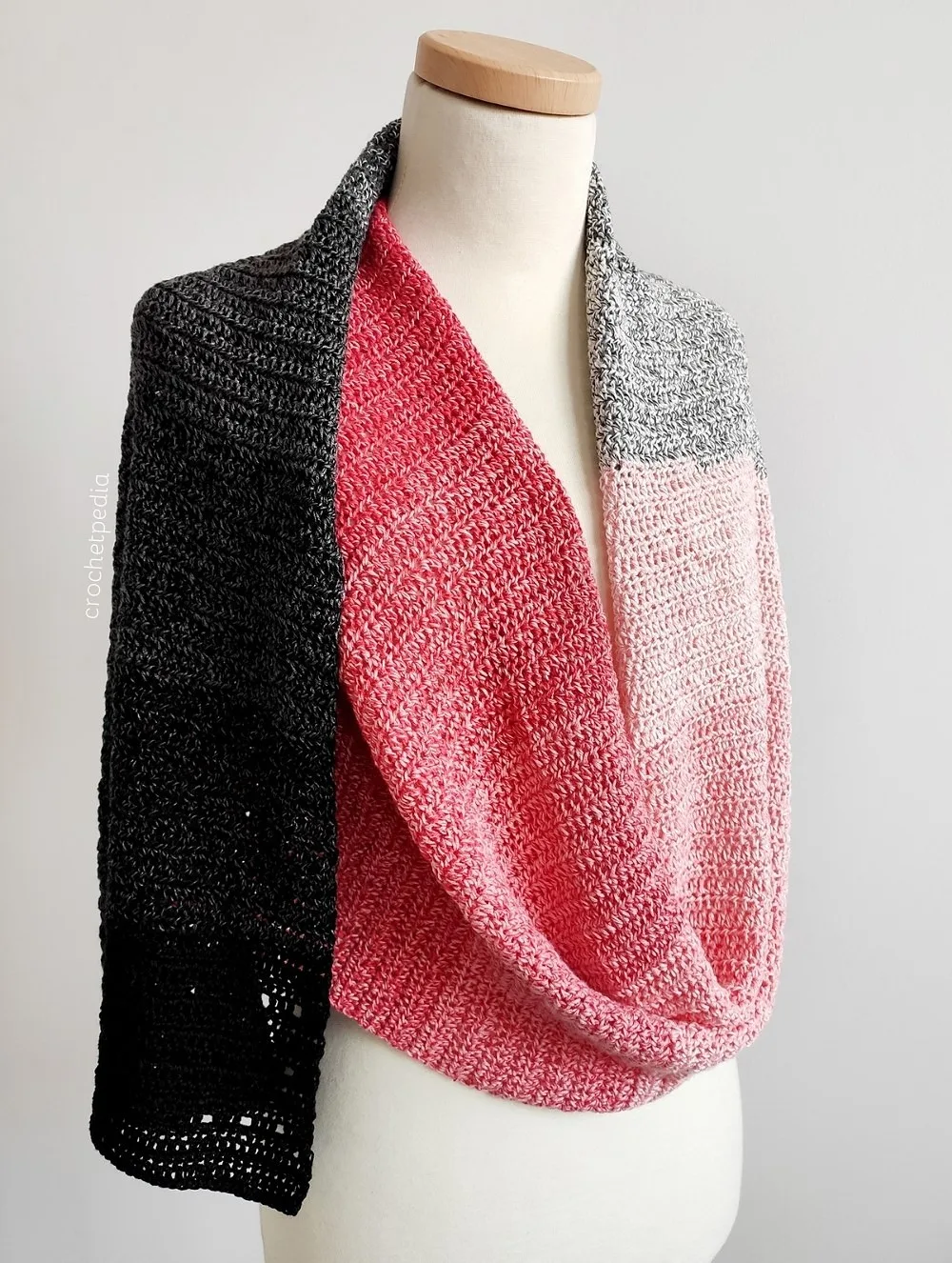
An ombre scarf worked in half double crochet (UK: half treble); both US and UK terms given throughout.
- Skill
- Beginner
- Time
- 4-6 hours
- Yarn weight
- DK (Light)
- Hook
- 3 mm

Beginner
What the original write-up called it. Nothing here is graded again.

DK (Light)
What the sample was worked in. Any weight works; the size moves with it.

4-6 hours
What the original page reckoned. Your own pace is the one that matters.
About this pattern
This is a flat, rectangular scarf worked in half double crochet (UK: half treble) over eleven rows, starting from a 79-stitch foundation chain. It uses a single cake of ombre cotton-acrylic yarn and a 3 mm hook, with one row of eyelet detailing worked into small chain spaces. No colour changes need to be managed by hand, since the yarn itself carries the gradient.
This scarf belongs to the half double crochet family (UK: half treble crochet), a fabric that sits between single crochet and double crochet in height and density. It begins with a foundation chain of 79 stitches, giving the scarf its working width, and builds up through eleven rounds that shift from a firm single-crochet base into a taller, more open half-double-crochet body.
The scarf is worked flat, starting with a row of single crochet (UK: double crochet) to anchor the stitch count, then several rows of straight half double crochet to establish the main fabric. A central eyelet section introduces small chain spaces across the row, which the following row fills back in, adding a light textured band before the plain half-double-crochet rows resume.
Materials
- 1 cake of YarnArt Flowers ombre yarn (45% acrylic, 55% cotton - 250 g, 1000 m)
- 3 mm crochet hook
- Scissors
- Stitch marker (optional)
- Tapestry needle for weaving in ends (optional)
The list is the pattern's own wording.
Instructions
Every round is printed as the pattern wrote it, brackets and all. Open the key beside a round to see only the short forms that round uses.
Making Process
Start: Make a foundation chain of 79 stitches.
- Round 1
Chain 1, implement 1 sc in each stitch.
Key1
- sc
- single crochet
- Round 2
to 4: Chain 2, work 1 hdc in each stitch.
Key1
- hdc
- half double crochet
- Round 5
Chain 2, crochet 3 hdc, then 1 ch, skip one, 3hdc – repeat this sequence 19 times.
Key2
- hdc
- half double crochet
- ch
- chain
- Round 6
Chain 2, work 2 hdc, then 2 hdc into the chain space, 2 hdc – repeat this sequence 19 times, then add 1 hdc at the end.
Key1
- hdc
- half double crochet
- Round 7
to 8: Chain 2, implement 1 hdc in each stitch.Rows 9 to 10: Repeat Rows 5-6.
Key1
- hdc
- half double crochet
- Round 11
to 12: Chain 2, work 1 hdc in each stitch.Rows 13 to 14: Repeat rows 5-6.
Key1
- hdc
- half double crochet
- Round 15
to 194: Chain 2, implement 1 hdc in each stitch.Rows 195 to 196: Repeat rows 5-6.
Key1
- hdc
- half double crochet
- Round 197
to 198: Chain 2, work 1 hdc in each stitch.Rows 199 to 200: Repeat rows 5-6.
Key1
- hdc
- half double crochet
- Round 201
to 202: Chain 2, implement 1 hdc in each stitch.Rows 203 to 204: Repeat Rows 5-6.
Key1
- hdc
- half double crochet
- Round 205
to 207: Chain 2, work 1 hdc in each stitch.
Key1
- hdc
- half double crochet
- Round 208
Chain 1, implement 1 sc in each stitch. Fasten off and weave in ends to finish your ombre crochet scarf!
Key1
- sc
- single crochet
With this quick and easy pattern, you can dazzle everyone with your handmade ombre crochet scarf. ravelry
Notes from the pattern
- A 3 mm hook is specified for this yarn weight; sizing up or down will change both the drape and the final stitch count across the 79-stitch base.
- A stitch marker is optional but useful on the eyelet row, where the 19-times repeat of skip-and-chain is easy to lose track of without a visual anchor.
- No colour changes need to be joined or woven in by hand, since a single cake of ombre yarn produces the gradient automatically across the eleven rows.
- Tension matters most on the plain half-double-crochet rows; working loosely there will make the fabric noticeably looser than the firmer single-crochet starting row.
The essentials
- Rounds
- 11
- Level
- Beginner
- Time
- 4-6 hours
- Hook
- 3 mm
- Yarn
- DK (Light)
Stitches you will use
- Foundation chain counting The scarf starts from a chain of 79 stitches; an inaccurate count here throws off every following row, so checking the total before turning is worth the extra minute.
- Half double crochet (UK: half treble crochet) Used for the bulk of the eleven rows; keep the turning chain height consistent so the fabric doesn't taper or flare along the long edges.
- Working into a chain space The eyelet row skips a stitch and chains one to form small gaps, which the next row fills with two half double crochets; missing a chain space here shifts the repeat out of alignment.
Troubleshooting
The long edges of the scarf ripple or flare instead of lying flat
This usually comes from an inconsistent turning chain height across the half-double-crochet rows; keep the chain-2 turn the same tension throughout and check the stitch count matches the previous row before continuing.
The eyelet row's holes are different sizes across the width
This happens when the skip-one-chain-one sequence isn't repeated evenly; count in sets of the stated repeat rather than eyeballing the spacing, and use a stitch marker at the start of each group.
The fabric feels noticeably stiffer or looser in patches
Tension usually drifts when attention shifts between the plain rows and the more fiddly chain-space rows; slow down slightly on the eyelet and infill rows to match the tension of the surrounding half double crochet.
Substituting yarn
- Cotton-acrylic blend, DK weight
- Closest match to the original; similar drape and stitch definition, with the same 3 mm hook and stitch count producing a scarf of comparable width.
- 100% acrylic, DK weight
- Lighter and springier than the blend, with slightly less drape; the fabric will feel airier and may need a hook a touch smaller to keep the eyelet row from gaping.
- Wool-blend, DK weight
- Adds warmth and softer drape but requires gentler washing; the yarn's natural stretch may loosen the half-double-crochet rows slightly, so a firmer tension helps hold the stitch count.
Washing and care
- Because the yarn is a cotton-acrylic blend, hand washing or a gentle machine cycle in cool water is safest; avoid wringing, since the cotton content holds water and can distort the stitch rows.
- Dry the scarf flat rather than hanging it, easing it back into its original width and length by hand while still damp; store folded rather than on a hanger to prevent the half-double-crochet fabric from stretching out of shape.
FAQs
Questions
Is half double crochet the same as UK half treble crochet?
Yes, this is a naming difference rather than a different stitch. The US term half double crochet and the UK term half treble crochet describe the same technique used throughout this scarf.
Does the yarn's colour change need to be managed manually?
No. The ombre cake produces the colour gradient on its own as the scarf is worked, so there are no joins or colour changes to plan for across the eleven rows.
What does the eyelet row actually create?
It's a single row of small chain spaces worked across the width, formed by skipping a stitch and chaining one in a repeated sequence. The following row fills these spaces with paired half double crochets, leaving a light textured band.
Can a stitch marker help while working this pattern?
It can, particularly on the eyelet row where the skip-and-chain sequence repeats 19 times. Marking the start of each repeat makes it easier to catch a miscount before it affects the following row.
How much yarn does this scarf use?
The pattern is designed around a single 250 g, 1000 m cake of ombre yarn, with no second skein needed. This is what allows the gradual colour shift to run the full length of the scarf without a join.
These answers came from whoever first published the pattern, kept word for word.