 EVERY CROCHET
 Amigurumi 25 rounds No account, no download
How to crochet a sloth plant holder in single crochet
Single crochet (UK: double crochet) sloth plant holder pattern; both US and UK stitch terms given throughout.
- Skill
- Intermediate
- Time
- 4-6 hours
- Yarn weight
- Worsted
- Hook
- 5.5 mm

Intermediate
What the original write-up called it. Nothing here is graded again.

Worsted
What the sample was worked in. Any weight works; the size moves with it.

4-6 hours
What the original page reckoned. Your own pace is the one that matters.
About this pattern
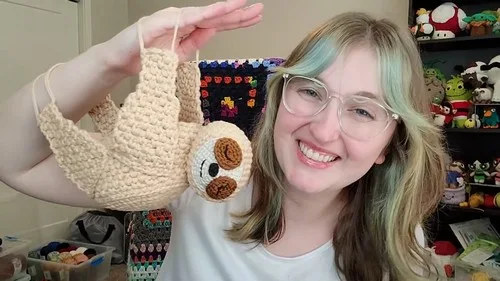
This pattern makes an amigurumi sloth designed to hold a small plant pot, combining a rounded base worked in the round, a stuffed head with face and eye patches in single crochet, and four limbs worked as an open, seventeen-row mesh with chain-one spaces. It calls for a 5.5 mm hook for the main pieces, a smaller 3.25 mm hook for the face details, worsted-weight (4-weight) yarn in beige, brown and white, and polyester filling.
This sloth plant holder is built mainly in single crochet (UK: double crochet), the same stitch that anchors most amigurumi toys. The base, head, face patch, eye patches and nose are all worked in tight single crochet rounds, giving a dense, huggable fabric that keeps its shape once stuffed. The four limbs depart from that solid fabric, using an open, chain-spaced single crochet mesh worked in rows so they can wrap around a plant pot rather than sitting stiff.
Construction happens in separate pieces that are joined at the end. The base is worked in rounds from a magic circle up to 54 stitches to form the bowl-shaped piece that holds the plant pot. Four identical limbs are worked flat in seventeen rows of spaced single crochet mesh, starting from a foundation chain worked into the back bump. The head starts as its own magic circle and increases through six rounds before continuing with decreases to finish the shape, while the face patch and eye patches are worked flat over seven and three rounds in parchment and chocolate brown yarn, then stitched onto the head. A small black nose is chained and single-crocheted before being sewn in place. Finally the eye patches, nose and face are sewn onto the head, and the head is attached to the base.
Materials
- 4-weight yarn in beige, brown, and white
- 5.5 mm (I) crochet hook
- 3.25 mm crochet hook
- Scissors
- Stitch marker
- Polyester filling
The list is the pattern's own wording.
Instructions
Every round is printed as the pattern wrote it, brackets and all. Open the key beside a round to see only the short forms that round uses.
Base of the Plant Holder
- (6)Round 1
Magic circle with 6 single crochets.
- (12)Round 2
Increase single crochet in each stitch (12 stitches).
- (18)Round 3
Repeat 1 single crochet, increase single crochet 5 more times (18 stitches).
- (24)Round 4
1 single crochet, increase; repeat 2 single crochets, increase 4 more times, 1 single crochet (24 stitches).
- (30)Round 5
Repeat 3 single crochets, increase single crochet 5 more times (30 stitches).
- (36)Round 6
2 single crochets, increase; repeat 4 single crochets, increase 4 more times, 2 single crochets (36 stitches).
- (42)Round 7
Repeat 5 single crochets, increase single crochet 5 more times (42 stitches).
- (48)Round 8
3 single crochets, increase; repeat 6 single crochets, increase 4 more times, 3 single crochets (48 stitches).
- (54)Round 9
Repeat 7 single crochets, increase single crochet 5 more times (54 stitches).
- (54)Round 10
3 single crochets, then single crochet in back loops only for the rest of the round (54 stitches).
- (54)Round 11
Back loops only in first 3 stitches, then both loops for the rest of the round (54 stitches).
- (54)Rounds 12–17
Single crochet in each stitch (54 stitches). You can switch to a linen stitch for added texture.
Sloth Limbs (Make 4)
- Row 1
Chain 11, 10 single crochets along the back bumps.
- Row 2
Repeat skip a stitch, single crochet, chain 1 across.
- Rows 3–6
Repeat skip first stitch, single crochet into chain-1 space, chain 1 across.
- Row 7
Skip first stitch, single crochet into chain-1 space, chain 1; repeat single crochet, chain 1 twice more; single crochet into chain space, single crochet into next stitch.
- Rows 8–17
Repeat skip first stitch, single crochet into chain space, chain 1 and single crochet in last stitch.Cut a long tail for sewing.
Sloth Head
- (6)Round 1
Magic circle with 6 single crochets.
- (12)Round 2
Increase single crochet in each stitch (12 stitches).
- (18)Round 3
Repeat 1 single crochet, increase single crochet 5 more times (18 stitches).
- (24)Round 4
1 single crochet, increase; repeat 2 single crochets, increase 4 more times, 1 single crochet (24 stitches).
- (30)Round 5
Repeat 3 single crochets, increase single crochet 5 more times (30 stitches).
- (30)Round 6
Single crochet in each stitch (30 stitches).Continue with decreases as detailed until finishing the head.
Face Patch
Use a 3.25mm crochet hook and parchment-colored yarn.
- Rounds 1–7
Follow the detailed instructions for creating the face patch.
Eye Patches (Make 2)
Use chocolate brown yarn.
- Rounds 1–3
Follow the detailed instructions for creating the eye patches.
Nose
Use black yarn.
Chain 2, single crochet, chain 1, single crochet all in the back bump of the second chain.
Finish with a slip stitch across the next two stitches.
Making up
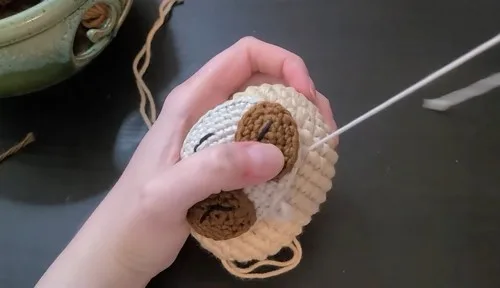
- Step 1Sew the eye patches, nose, and face onto the sloth head.
- Step 2Attach the sloth head to the body.
Notes from the pattern
- Two hook sizes are called for: 5.5 mm for the base, limbs and head, and a smaller 3.25 mm hook for the face patch and eye patches, so keep both to hand before starting.
- A stitch marker is essential for the base and the head, since both are worked in a continuous spiral with no natural round marker built into the stitches.
- Keep tension firm but not tight on the Rows 1-17 limb mesh; each of the four limbs needs to flex around a plant pot without the chain-1 spaces closing up.
- Stuff the base and head with polyester filling as the rounds progress rather than waiting until the last round closes, so the shape stays even and firm all the way through.
- If using regular-weight yarn instead of the specified 4-weight, combine yarn from the center and the outside of the skein to work doubled, and begin with a slip knot.
- Yarn colors can be customized to suit your style; the pattern is shown in beige, brown and white, but any coordinating shades will work.
The essentials
- Rounds
- 25
- Parts
- 6
- Level
- Intermediate
- Time
- 4-6 hours
- Hook
- 5.5 mm
- Yarn
- Worsted
Stitches you will use
- Magic circle Starts the base and head at Round 1 with six single crochets; pull the centre closed firmly so no hole shows once increases begin.
- Working into the back bump of a chain Used for the Row 1 foundation of each limb and for the nose; keep the starting chain slightly loose so the back bumps stay visible and easy to pick up.
- Chain-space mesh (skip stitch, single crochet, chain 1) Repeated through Rows 2-17 of each limb; miscounting which stitch to skip shifts the chain-1 spaces out of line row over row.
Troubleshooting
The face patch or eye patches pucker instead of lying flat
Uneven tension across the flat rounds pulls the centre tight; work the 3.25 mm hook rounds loosely and check the stitch count at the end of each round before continuing.
The limb mesh narrows or curls partway up the rows
This happens when the skip-stitch pattern in Rows 3-6 is applied inconsistently; recount stitches at the start of every row and mark the first stitch if it becomes hard to track.
The head feels soft or sags once the plant pot is added
Insufficient stuffing before the final rounds close is the usual cause; add polyester filling gradually as the head rounds progress instead of stuffing only at the end.
Substituting yarn
- Cotton, worsted (4-weight)
- Gives crisper stitch definition and firmer structural support for the base and limb mesh, which helps with holding a plant pot, though it has less stretch; the same 5.5 mm hook still works.
- Acrylic, worsted (4-weight)
- Closest match to the original weight and drape, with no change needed to hook size or stuffing amount.
- Wool-blend, aran weight
- Adds softer drape and warmth to the finished piece; a slightly larger hook may be needed to match gauge, and less polyester filling is required since the fibre itself has more loft.
Washing and care
- Hand wash in cool water rather than machine washing, since the polyester filling inside the head can shift or clump under agitation and heat; reshape the head and eye patches gently while still damp.
- Dry flat away from direct heat or sunlight to protect the beige, brown and white colourwork, and store the finished piece somewhere it will not be compressed, so the stuffed head keeps its round shape.
The photographs taken while this was being made
Every one was taken by whoever published the pattern, in the order the source listed them.
FAQs
Questions
Can this pattern be made as a plain stuffed sloth without holding a plant?
Yes; the head, face patch, eye patches and nose are worked exactly the same way regardless of use. Simply attach the head to the base as usual and skip inserting a plant pot into it.
What hook sizes does this pattern actually need?
A 5.5 mm hook covers the base, limbs and head, while a smaller 3.25 mm hook is used for the face patch and eye patches. Both sizes are needed for the piece to come together correctly.
How much yarn is required for each colour?
The materials list gives the yarn weight and three colours but no yardage. Because the individual pieces are small, a single skein of each shade is usually enough for a project this size.
What is the difference between the base and the limbs?
The base is worked in rounds from a magic circle up to 54 stitches, forming the bowl-shaped piece that becomes the sloth's body. The four limbs are worked separately and flat, as an open, chain-spaced single crochet mesh over seventeen rows, giving them enough give to wrap around a plant pot.
Why does the pattern use both 'single crochet' and mention a UK term?
The instructions are written in US crochet terms, where single crochet is the shortest stitch. In UK terminology the same stitch is called double crochet, so the two names refer to identical stitches, not different ones.
These answers came from whoever first published the pattern, kept word for word.