 EVERY CROCHET
 Small accessories 14 rounds No account, no download
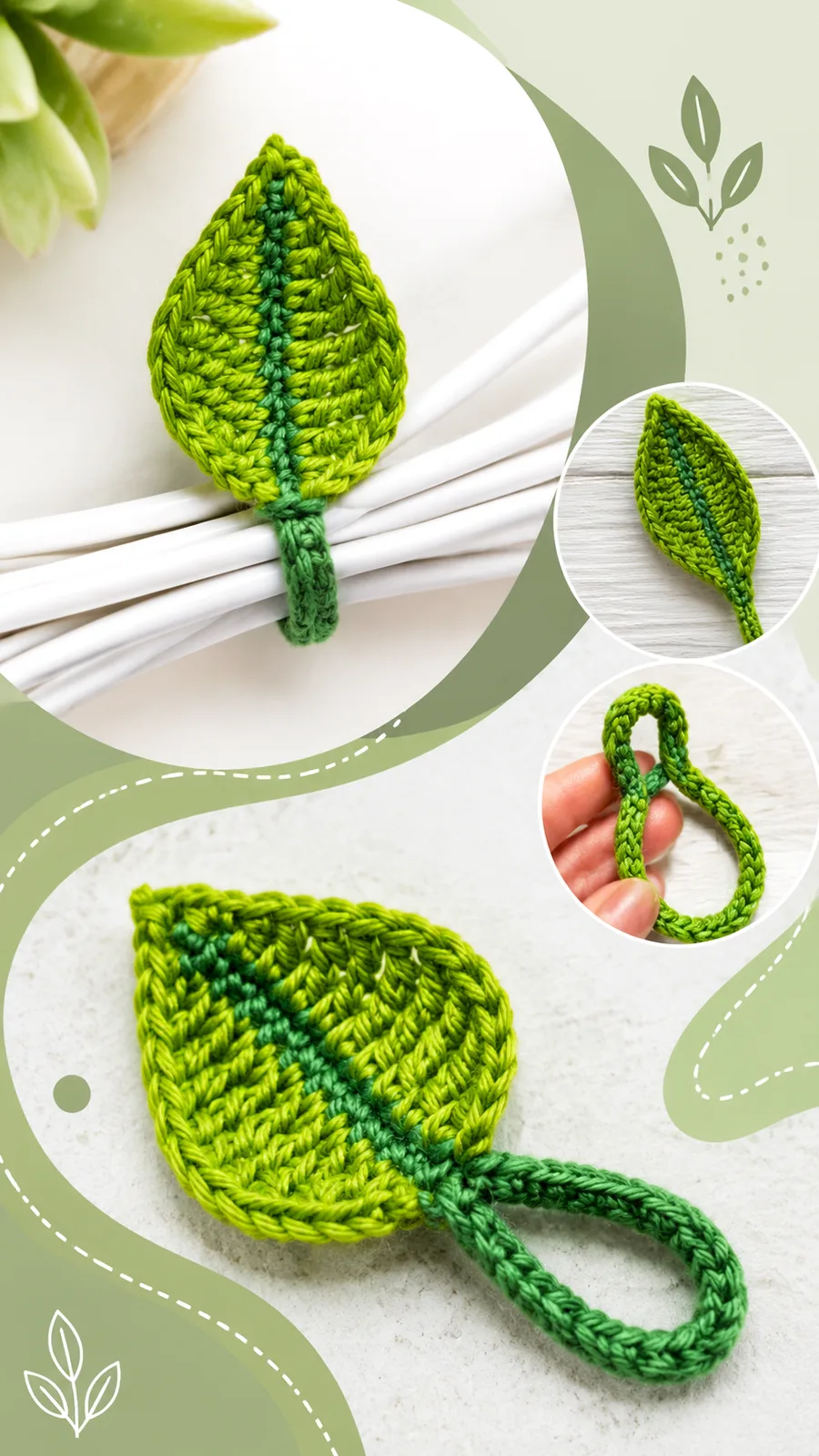
Crochet leaf cable tie for tidy headphone cords
A single crochet leaf-shaped cable tie pattern written in US crochet terms, with full materials list, abbreviations, and step-by-step
- Skill
- Beginner to easy intermediate
- Time
- 1-2 hours
- Yarn weight
- DK
- Hook
- 3.25 mm

Beginner to easy intermediate
What the original write-up called it. Nothing here is graded again.

DK
What the sample was worked in. Any weight works; the size moves with it.

1-2 hours
What the original page reckoned. Your own pace is the one that matters.
About this pattern
This pattern makes a leaf-shaped cable tie: a small single crochet (UK double crochet) applique with a slip-stitched centre vein, attached to a narrow chained-and-slip-stitched strap that loops around a cable. It uses one skein's worth of DK cotton, a 3.25 mm hook, and ten rows of shaping, making it a one-sitting project suited to beginners with some single crochet experience.
This leaf-shaped cable tie belongs to the single crochet (UK double crochet) family of flat, dense fabrics. Rows build the leaf solidly from the base upward, with a handful of half double crochet stitches worked near the widest point to vary the texture before decreases taper the shape to a point. The result is compact and firm rather than drapey, which suits a piece designed to hold a cable rather than hang loose.
The leaf is worked flat in ten rows, shaped with paired increases through the lower rows and paired decreases through the upper ones, then finished with a surface slip stitch vein worked down the centre for a raised line without added bulk. A separate strap is chained and slip-stitched back along itself to form a narrow tie, with a second chain left as a loose loop that slips around a cable before the leaf and strap are sewn together at the base.
Materials
- The original item appears to use a smooth green yarn with good stitch definition. A suggested choice is a lightweight cotton yarn because cotton creates a firm accessory that holds its shape. Acrylic or bamboo blends may also work well.
Skill level
- Beginner to easy intermediate
Pro Tip
- Choose cotton yarn with a little stiffness for the leaf section. Very soft yarn may create a floppy cable tie that does not grip cords as securely.
- DK weight cotton yarn in green or your preferred color, approximately 25 yards (23 meters)
- Small amount of contrasting yarn for the leaf vein detail
- 3.25 mm US D/3 crochet hook
- Yarn needle
- Scissors
- Stitch marker
The list is the pattern's own wording.
Instructions
Every round is printed as the pattern wrote it, brackets and all. Open the key beside a round to see only the short forms that round uses.
Main Pattern
Note The leaf panel is worked flat in rows. Turning chains do not count as stitches.
- Row 1
Ch 2. Work 3 sc in the second chain from hook. Turn. (3 sts)
Key2
- ch
- chain
- sc
- single crochet
- Row 2
Ch 1, 2 sc in first st, sc in next st, 2 sc in last st. Turn. (5 sts)
Key3
- ch
- chain
- sc
- single crochet
- st
- stitch
- Row 3
Ch 1, sc across. Turn. (5 sts)
Key2
- ch
- chain
- sc
- single crochet
- Row 4
Ch 1, 2 sc in first st, sc across until last st, 2 sc in last st. Turn. (7 sts)
Key3
- ch
- chain
- sc
- single crochet
- st
- stitch
- Row 5
Ch 1, sc across. Turn. (7 sts)
Key2
- ch
- chain
- sc
- single crochet
- Row 6
Ch 1, sc in first 2 sts, hdc in next 3 sts, sc in last 2 sts. Turn. (7 sts)
Key3
- hdc
- half double crochet
- ch
- chain
- sc
- single crochet
- Row 7
Ch 1, sc across. Turn. (7 sts)
Key2
- ch
- chain
- sc
- single crochet
- Row 8
Ch 1, sc2tog, sc across until last 2 sts, sc2tog. Turn. (5 sts)
Key2
- ch
- chain
- sc
- single crochet
- Row 9
Ch 1, sc across. Turn. (5 sts)
Key2
- ch
- chain
- sc
- single crochet
- Row 10
Ch 1, sc2tog, sc, sc2tog. Turn. (3 sts)
Key2
- ch
- chain
- sc
- single crochet
- Row 11
Ch 1, sc3tog. Fasten off. (1 st)
Key2
- ch
- chain
- st
- stitch
Cable Strap Instructions
Step 1 Attach yarn at the bottom point of the leaf.
- (18)Step 2
Ch 18 for the strap length.
Key1
- ch
- chain
- (17)Step 3
Starting in the second chain from hook, work 17 sl sts back along the chain.
- (18)Step 4
Ch 18 again for the loop extension.Fasten off, leaving a yarn tail for sewing.
Key1
- ch
- chain
Special Stitch
Surface Slip Stitch: Insert hook through the front surface of the finished crochet fabric, yarn over, and pull a slip stitch through. Continue along the desired line to create decorative raised details.
Making up
- Step 1Place the strap along the bottom edge of the leaf.
- Step 2Sew the strap securely to the back of the leaf using matching yarn.
- Step 3Add a surface slip stitch line from the leaf base to the tip to create the center vein.
- Step 4Weave in all loose ends neatly.
- Step 5Light blocking can help the leaf panel lay flat and improve the overall shape. Place the finished piece under a damp cloth and gently shape the edges before allowing it to dry completely.
- Step 6For best results, hand wash cotton crochet accessories with mild soap and allow them to air dry. Avoid excessive stretching while wet.
Notes from the pattern
- A stitch marker is useful for tracking row counts through the ten rows of shaping, since the increase and decrease pattern changes gradually rather than at an obvious halfway point.
- A slightly tighter tension than usual helps the cable tie keep its shape under daily handling; this matters more here than in draped projects, since a floppy leaf will not grip a cord.
- Only a small amount of contrasting yarn is needed for the vein, so it is a good way to use leftover yarn rather than buying a second full skein.
- The finished leaf and strap measure approximately 4.5 inches x 1.75 inches (11.5 cm x 4.5 cm).
- Gauge is approximately 22 single crochet stitches by 24 rows in 4 inches, using a suggested DK cotton yarn of approximately 25 yards (23 meters).
- Use autumn shades such as orange, brown, and mustard for a seasonal accessory, or create matching sets in different colors for each device cable.
- This pattern is written using US crochet terms throughout (for example, sc is US single crochet, called UK double crochet in British terminology).
The essentials
- Rounds
- 14
- Parts
- 3
- Level
- Beginner to easy intermediate
- Time
- 1-2 hours
- Hook
- 3.25 mm
- Yarn
- DK
Stitches you will use
- Paired increases and decreases Used through all ten rows of the leaf to build the pointed oval outline; keep the increase or decrease at each end of the row so the shape stays symmetrical rather than leaning to one side.
- Surface slip stitch Worked after the leaf is complete to form the centre vein; keep tension even along the line so it lies flat instead of puckering or pulling the leaf out of shape.
- Chained-and-slip-stitched strap The 18-chain strap is slip-stitched back along itself for firmness, then a second 18-chain forms the loose loop; keep the chain loose enough that the slip stitches don't twist it.
Troubleshooting
The leaf cups or curls instead of lying flat
This usually comes from stitches worked too tightly through the increase rows. Light blocking under a damp cloth, shaping the edges by hand before it dries, corrects most of the curl.
The strap twists when the loop end is handled
A twisted strap generally means the starting chain of 18 was worked unevenly. Keep the chain relaxed and work the 17 slip stitches back along it without pulling each one tight.
The centre vein looks lumpy or pulls the leaf out of shape
This happens when the surface slip stitches are worked too tightly against the leaf fabric. Loosen tension slightly on the vein line and keep stitch spacing even along its length.
Leaf shape looks uneven
Count stitches at the end of every row. Uneven increases or skipped stitches can quickly change the pointed leaf shape.
Surface details are hard to see
Choose a contrasting yarn color for the center vein. Small details become more visible when colors have enough contrast.
Substituting yarn
- Mercerised cotton, DK weight
- Adds extra stitch definition and a slight sheen; works with the same 3.25 mm hook and produces a slightly crisper leaf edge.
- Acrylic, worsted weight
- Produces a slightly larger leaf and strap at the same stitch count; move up to a 4 mm hook to keep the fabric from becoming too stiff, and expect a softer, less structured drape.
- Bamboo blend, DK weight
- Keeps the leaf close to its original size but adds more drape and a smoother surface sheen; the 3.25 mm hook still suits this weight.
Washing and care
- Hand wash the finished cotton cable tie with mild soap and lukewarm water, then air dry flat rather than hanging it, since wet cotton stretches under its own weight.
- If the leaf loses its flat shape after washing, re-block it under a damp cloth and gently reshape the edges before it dries; store the piece flat or loosely coiled to avoid creasing the strap.
FAQs
Questions
Can the centre vein be left out?
Yes, the surface slip stitch vein is a decorative addition worked after the leaf shape is finished, so skipping it does not affect the leaf's structure. The leaf will simply read as plainer without the raised line.
How long is the finished strap?
The strap is worked from an 18-chain, slip-stitched back along 17 stitches, with a second 18-chain forming the loop extension. Together these give a slim tie long enough to wrap around a standard cable bundle.
Does this pattern suit a true beginner?
It suits a beginner who is comfortable with single crochet (UK double crochet) and basic increases and decreases, since those are the only stitches used through the main shaping rows. The surface slip stitch vein and strap assembly are straightforward once the leaf is complete.
Can acrylic yarn be used instead of cotton?
Acrylic can be used, but it produces a softer, less structured tie than cotton, which is specifically recommended here for its stiffness and grip. If substituting, choose a firmer acrylic and consider a slightly larger hook to match gauge.
Why does the pattern call for a tighter tension than usual?
A firmer fabric helps the small leaf hold its shape and keeps the strap from stretching out of shape with repeated use around a cable. Looser tension tends to produce a floppier result that grips less securely.
These answers came from whoever first published the pattern, kept word for word.