 EVERY CROCHET
 Garments 6 rounds No account, no download
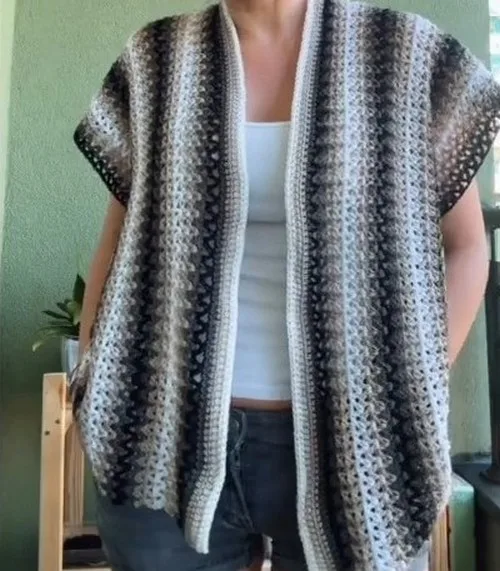
V-stitch summer shirt with panelled colour gradient
V-stitch (US double crochet/UK treble) top pattern with both US and UK stitch terms given throughout.
- Skill
- Intermediate
- Time
- 4-6 hours
- Yarn weight
- Worsted
- Hook
- 4 mm

Intermediate
What the original write-up called it. Nothing here is graded again.

Worsted
What the sample was worked in. Any weight works; the size moves with it.

4-6 hours
What the original page reckoned. Your own pace is the one that matters.
About this pattern
A three-part garment made from two front panels and one wider back panel, each worked flat in V-stitch (double crochet/UK treble pairs) from a foundation chain divisible by three. Panels use up to five yarn colours changed row by row for a gradient effect, a 4 mm hook for the main fabric and a 3 mm hook for seaming. Assembly is by slip-stitched shoulder and side seams; sizing is adjusted by chain length and row count rather than shaping.
This summer shirt is built entirely from the V-stitch, a two-stitch cluster worked from double crochet (UK: treble crochet) separated by a single chain space. The V-stitch's open, airy structure is what gives the finished piece its lightweight drape, making it suited to warm-weather wear rather than dense, close-worked garments. Each panel reads as a simple grid of Vs stacked row on row, which keeps the stitch count predictable once the foundation chain is set.
Construction is panel-based: two identical front panels and one wider back panel, each worked flat from a foundation chain in multiples of three. The panels are joined afterwards rather than worked in one continuous piece, with the shoulders slip-stitched together using a smaller hook and the sides joined working into the back loop of one panel and the front loop of the other. Colour changes happen at the end of each row, so the gradient effect is built into the panel rather than added afterwards.
Materials
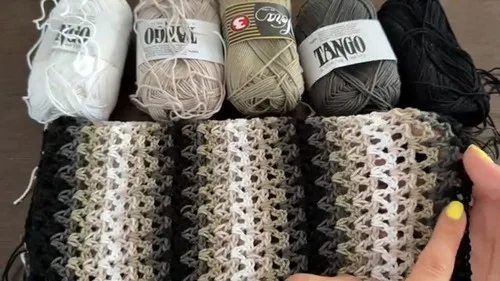
- Yarn in five colors (or as many as desired)
- Crochet hook (size 4 mm recommended for main panels)
- Smaller crochet hook (size 3 mm for seaming)
- Tapestry needle
- Scissors
- Stitch markers (optional)
The list is the pattern's own wording.
Instructions
Every round is printed as the pattern wrote it, brackets and all. Open the key beside a round to see only the short forms that round uses.
Front Panel
Write down your foundation chain count to match both front panels.
At the end of every row, on the final double crochet, stop with two loops on the hook, pull new yarn through the two loops, tighten the tails of old and new yarn, chain three, then cut the old yarn (optionally knot the tails for extra security).
Follow a color gradient or repeat pattern (e.g., black to gray to white to gray to black).
- Round 1
(Foundation Chain): Create a foundation chain that is a multiple of three.
- Round 2
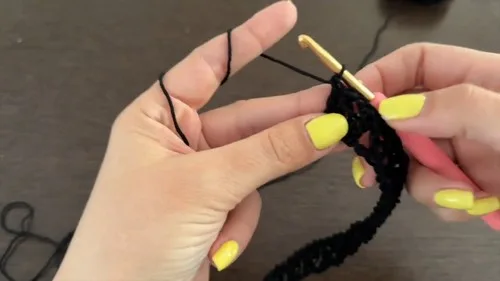
(Row 1 - Main Pattern Start): Dc in the third chain from the hook (work in back bumps for a neater finish); ch 1; dc in the same stitch; skip two stitches; in the next stitch work dc, ch 1, dc (V-stitch); repeat the pattern across the row; at the end, place one dc in the final stitch (no chain or V-stitch).
Key2
- ch
- chain
- dc
- double crochet
- Round 3
(Row 2 and Onward): Turn work; in each chain-one space of the V-stitches work dc, ch 1, dc; continue to the end of the row; end with a single dc; change to the next color as described.
Key2
- ch
- chain
- dc
- double crochet
Back Panel
Same pattern and stitch count as the front panels.
Width equals the width of both front panels plus a neck opening space (e.g., a palm's width).
Use a different starting color to avoid overlap in color joins.
- Round 1
(Foundation Chain): Create a foundation chain that is a multiple of three.
- Round 2
(Row 1 - Main Pattern Start): Dc in the third chain from the hook (work in back bumps for a neater finish); ch 1; dc in the same stitch; skip two stitches; in the next stitch work dc, ch 1, dc (V-stitch); repeat the pattern across the row; at the end, place one dc in the final stitch (no chain or V-stitch).
Key2
- ch
- chain
- dc
- double crochet
- Round 3
(Row 2 and Onward): Turn work; in each chain-one space of the V-stitches work dc, ch 1, dc; continue to the end of the row; end with a single dc; change to the next color as described.
Key2
- ch
- chain
- dc
- double crochet
Making up
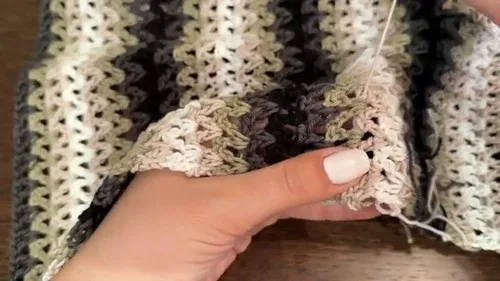
- Step 1Weave in ends: thread the tail through a tapestry needle; weave in a zigzag pattern through loops/stitches; trim excess yarn.
- Step 2Top (Shoulder) Connection: use the smaller hook; line up the corners of the front and back panels; use slip stitch to connect, working two slip stitches per row; don't make stitches too tight to avoid puckering.
- Step 3Side Connection: start from the bottom corners; insert the hook into the back loop of one panel and the front loop of the other; slip stitch up to a stitch marker (armhole length); customize armhole length by trying on the piece.
- Step 4Edging: work around the entire piece (shoulders, neck, and sides) using the same five colors used in the shirt body; make a loop and chain two; place one half double crochet in each stitch all the way around; switch colors each row and repeat, working one row per color and cutting yarn between color changes.
Notes from the pattern
- Record the exact foundation chain count after starting the first front panel so both front panels and the back panel match in width.
- Stitch markers are optional but useful for flagging the start of each V-stitch repeat, since a missed skip of two stitches early in a row shifts every V after it.
- Colour changes are worked at the last double crochet of a row, not mid-row, so plan the colour sequence (for example black to grey to white to grey to black) before beginning the back panel in a different starting colour.
- Measure from the neck down for length.
- Measure from neck to desired arm reach for width.
- Wider panels create a looser fit.
The essentials
- Rounds
- 6
- Parts
- 2
- Level
- Intermediate
- Time
- 4-6 hours
- Hook
- 4 mm
- Yarn
- Worsted
The photographs taken while this was being made
Every one was taken by whoever published the pattern, in the order the source listed them.
FAQs
Questions
What is the difference between US and UK stitch terms in this pattern?
The pattern is written in US terms, where double crochet (dc) and half double crochet (hdc) refer to the two main stitches used. In UK terms, these are called treble crochet and half treble crochet; the stitches themselves are identical, only the names differ.
Why does the back panel need a different starting colour than the front panels?
Starting the back panel on a different colour in the gradient sequence prevents the colour joins on the back from lining up with the same colour joins on the front panels once assembled. This keeps the colour transitions staggered across the finished shirt rather than repeating at the same height.
How is the width of the shirt adjusted?
Width comes from the foundation chain length, since a longer multiple-of-three chain produces a wider panel. The back panel is worked wider than the combined front panels specifically to leave a neck opening, described as roughly a palm's width.
Can stitch markers be skipped entirely?
Yes, stitch markers are listed as optional in the materials. They're most useful for marking the start of each V-stitch repeat while learning the skip-two pattern, but an experienced crocheter can track the repeats by eye.
Why use two different hook sizes?
The 4 mm hook is used for the main V-stitch panels to keep the fabric open and drapey. The 3 mm hook is reserved for seaming the shoulders and sides, since a smaller hook gives more control for slip stitching without stretching the seam.
These answers came from whoever first published the pattern, kept word for word.