 EVERY CROCHET
 Accessories 8 rounds No account, no download
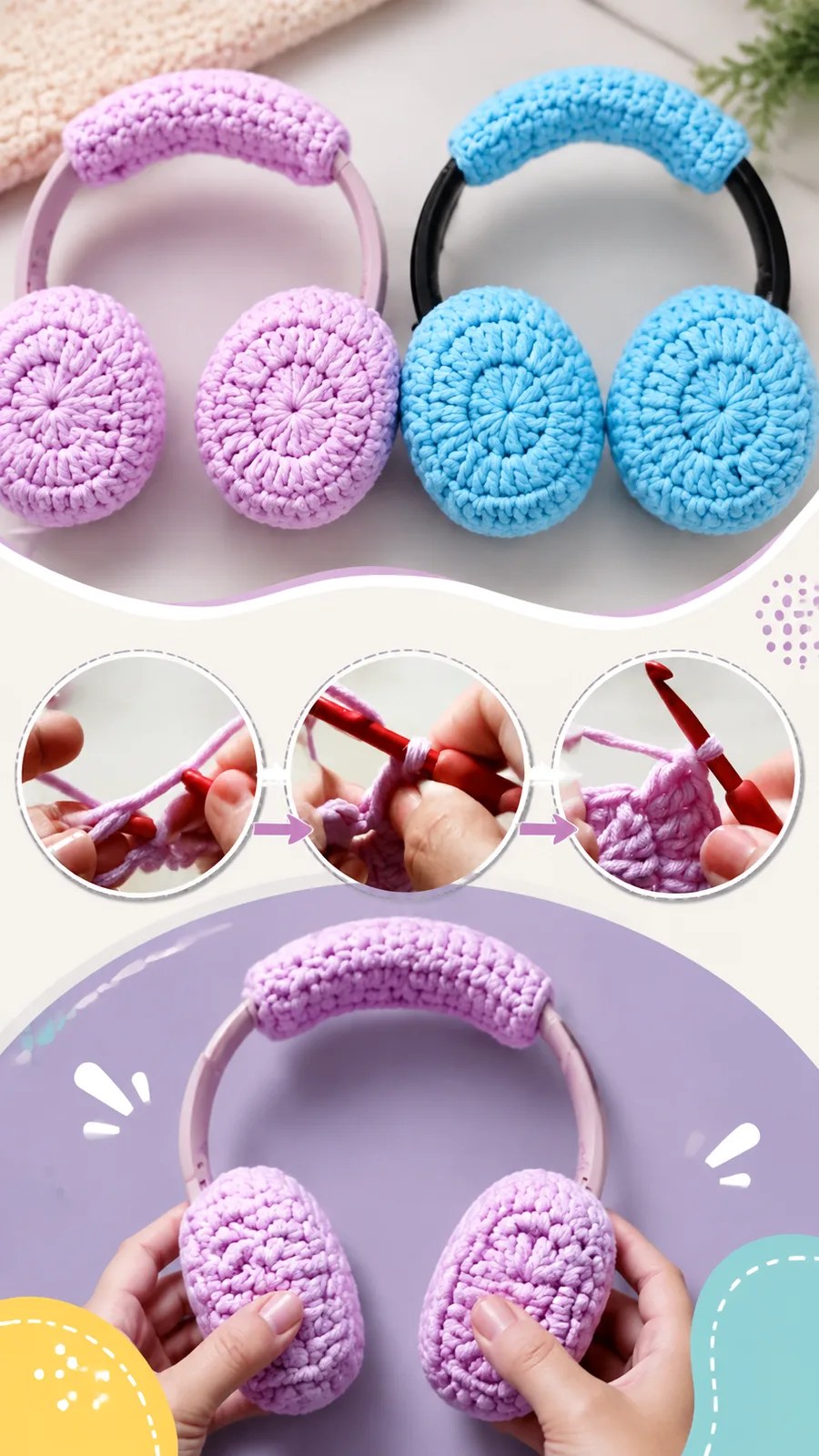
Crochet headphone covers with round ear pads
A half double crochet headphone cover pattern with crocheted ear pads and a matching headband sleeve, written in US crochet terms.
- Skill
- Confident Beginner
- Time
- 3-5 hours
- Yarn weight
- Bulky
- Hook
- 5.5 mm

Confident Beginner
What the original write-up called it. Nothing here is graded again.

Bulky
What the sample was worked in. Any weight works; the size moves with it.

3-5 hours
What the original page reckoned. Your own pace is the one that matters.
About this pattern
This pattern covers existing over-ear headphones with two round crocheted panels per side and a sewn headband sleeve, rather than building new headphone structure. Worked in bulky yarn on a 5.5 mm hook, the ear pieces use joined half double crochet rounds increasing from a magic ring; the sleeve is a flat rectangle sewn on after blocking. Suited to a confident beginner.
The ear covers are worked in half double crochet, the stitch family responsible for their dense, slightly padded texture. Because the increases radiate outward from a central magic ring, the finished circle reads as a flower-like motif rather than a flat disc. Confident beginners who have made circular motifs before will recognise the shaping rhythm; those new to it should expect the increase pattern to feel intuitive by round three.
Each ear cushion is covered by two matching round panels rather than one, giving the fabric enough body to sit over existing padding without stretching thin. The headband sleeve is made separately, as a narrow rectangle worked flat in rows, then sewn around the original headphone band once both pieces are complete. Nothing here replaces the headphone frame itself; the crochet sits as a removable layer over hardware that already provides support.
Materials
- Bulky weight (#5) yarn in main color: approximately 80 yards (73 meters)
- 5.5 mm (US I-9) crochet hook
- Yarn needle
- Stitch marker
- Scissors
- Existing over-ear headphones for sizing reference
The list is the pattern's own wording.
Instructions
Every round is printed as the pattern wrote it, brackets and all. Open the key beside a round to see only the short forms that round uses.
Ear Cover Pattern (Make 4 Circles)
Make 4 circles in total: two matching round panels are worked for each ear, giving each ear cover its padded double-layer construction.
The ear covers are worked in joined rounds. Each round begins with a chain that does not count as a stitch. Join each round with a slip stitch into the first stitch.
- Round 1
Make a magic ring. Ch 1, work 8 hdc into ring. Join with sl st. (8 sts)
Key4
- sl st
- slip stitch
- hdc
- half double crochet
- ch
- chain
- st
- stitch
- Round 2
Ch 1, work 2 hdc in each stitch around. Join. (16 sts)
Key2
- hdc
- half double crochet
- ch
- chain
- Round 3
Ch 1, *1 hdc in next stitch, 2 hdc in next stitch; rep from * around. Join. (24 sts)
Key3
- hdc
- half double crochet
- rep
- repeat
- ch
- chain
- Round 4
Ch 1, *1 hdc in next 2 stitches, 2 hdc in next stitch; rep from * around. Join. (32 sts)
Key3
- hdc
- half double crochet
- rep
- repeat
- ch
- chain
- Round 5
Ch 1, work 1 hdc in each stitch around. Join. (32 sts)
Key2
- hdc
- half double crochet
- ch
- chain
- Round 6
Ch 1, *1 sc in next stitch, 2 sc in next stitch; rep from * around. Join. (48 sts)Fasten off and weave in ends.
Key3
- rep
- repeat
- ch
- chain
- sc
- single crochet
Headband Sleeve Pattern
The headband sleeve is worked flat in rows and sewn around the headphone band.
- Row 1
Ch 11. Hdc in second chain from hook and across. Turn. (10 sts)
Key2
- hdc
- half double crochet
- ch
- chain
- Row 2
Ch 1, hdc across. Turn. (10 sts)Rows 3 to 34: Repeat Row 2 for a total of 34 rows. Fasten off. The finished rectangle should measure approximately 2 inches wide by 7 inches long (5 cm by 18 cm). Adjust the number of rows if your headphone band is longer or shorter.
Key2
- hdc
- half double crochet
- ch
- chain
Project Details
Project Name Cozy Cloud Headphone Covers
Skill Level Confident Beginner
Finished Size Approx. ear cover diameter: 3.5 inches (9 cm)
Yarn Bulky weight (#5) soft yarn, approximately 80 yards (73 meters)
Hook 5.5 mm (US I-9) crochet hook
Gauge Approximately 14 stitches and 12 rounds in 4 inches (10 cm)
Terminology US crochet terms
Special Stitch
Cluster Texture Stitch: Work 2 hdc stitches into the same stitch. This creates a fuller textured surface similar to the plush appearance of the inspiration piece.
Making up
- Step 1Place two ear cover circles together with the textured sides facing outward.
- Step 2Join the edges using a whip stitch, leaving a small opening.
- Step 3Slide the cover over the headphone cushion.
- Step 4Close the remaining opening with small stitches.
- Step 5Wrap the headband sleeve around the top band.
- Step 6Sew the long edges together using matching yarn.
- Step 7Secure all yarn tails and gently shape the covers.
- Step 8Lightly steam block the crochet pieces if needed, keeping the heat away from synthetic fibers. Shape the circles flat with your fingers and allow them to cool completely before attaching them to headphones.
Notes from the pattern
- The 5.5 mm hook is sized to the bulky yarn and produces the dense, padded fabric the design relies on; swapping to a finer hook will shrink the ear panel below the stated 3.5 inch (9 cm) diameter.
- A stitch marker in the first stitch of each round is worth keeping in place throughout, since the chain-1 at the start of a joined round does not count as a stitch and is easy to miscount without one.
- Because the ear covers fit over existing cushions rather than a measured head, working to the stated gauge of 14 stitches and 12 rounds in 4 inches (10 cm) matters more than usual; check panel size against the headphones before fastening off.
- The design is written in a single main colour; pastel shades such as lavender, baby blue, cream, or soft pink are suggested, but the pattern can easily be changed for brighter colors, neutral tones, or seasonal palettes without altering any stitch counts.
- larger ear cups, continue increasing the circular panels by adding another increase round; for smaller headphones, stop after Round 4 and test the fit before finishing.
- Stripes can be added by changing colors at the beginning of any round, and the same stitch texture can be used to create a matching case or cable wrap.
The essentials
- Rounds
- 8
- Parts
- 4
- Level
- Confident Beginner
- Time
- 3-5 hours
- Hook
- 5.5 mm
- Yarn
- Bulky
Stitches you will use
- Magic ring Opens each ear panel in Round 1; keep the ring tail loose enough to pull closed cleanly once eight stitches are worked into it.
- Working increases in joined rounds Rounds 2 to 4 double and then stagger stitch increases to keep the circle flat; a stitch marker in the first stitch of each round prevents the join from drifting out of place.
- Sewing a crocheted sleeve around an existing band The headband rectangle is attached once both pieces are complete; match the sleeve's cast-on edge to the seam line so the join sits against the headphone frame rather than against the head.
Troubleshooting
Ear covers feel too loose
Reduce the final increase round or use a smaller hook size. Crochet fabric naturally stretches, so a snug starting fit usually creates the best result.
Circle edges curl
Curling can happen when tension is tight. Try relaxing your stitches or blocking the circles gently before assembly.
Texture looks uneven
Keep consistent tension throughout each round. Thick yarn can hide small differences, but even stitch height improves the final appearance.
Substituting yarn
- Soft acrylic bulky (#5) yarn
- The suggested default fibre for this pattern; works at the stated gauge with a 5.5-6 mm hook and is simple to spot clean.
- Cotton blend bulky yarn
- Gives a cooler feel than acrylic while staying within the same 5.5-6 mm hook range suggested for this pattern.
- Chenille yarn
- Adds extra plush softness closest to the inspiration piece's texture, and still falls within the suggested 5.5-6 mm hook range.
Washing and care
- Handmade crochet headphone covers should be treated gently; spot cleaning with mild soap and cool water is recommended for most yarn types, and the covers should be allowed to air dry completely before being placed back on the headphones.
- Important: remove the crochet covers before cleaning the electronic headphone parts. Crochet accessories should never be soaked together with electronic devices.
FAQs
Questions
Will these covers fit any pair of over-ear headphones?
The circles are sized to a 3.5 inch (9 cm) diameter and the sleeve to roughly 2 by 7 inches (5 by 18 cm), which suits many standard over-ear cushions. Measuring the existing headphones before starting and adjusting the number of increase or row repeats is recommended for a closer fit.
How much yarn is actually needed for one full set?
The materials list gives approximately 80 yards (73 metres) of bulky weight yarn for the complete set, covering both ear panels and the headband sleeve. Leftover amounts will vary depending on gauge and any adjustments made to the number of rows in the sleeve.
Can the headband sleeve be lengthened without changing the ear panels?
Yes; the sleeve is worked as a flat rectangle, and the single row is simply repeated to reach length, so additional rows can be added independently of the ear panel instructions. The pattern itself notes adjusting the row count to match the actual headphone band length.
Do the ear panels need stuffing or extra structure to hold their shape?
No; the padded look comes from the half double crochet fabric itself and light steam blocking, not from stuffing or an inner layer. The existing headphone cushions provide the structure underneath once the covers are fitted over them.
These answers came from whoever first published the pattern, kept word for word.