 EVERY CROCHET
 Accessories 3 rounds No account, no download
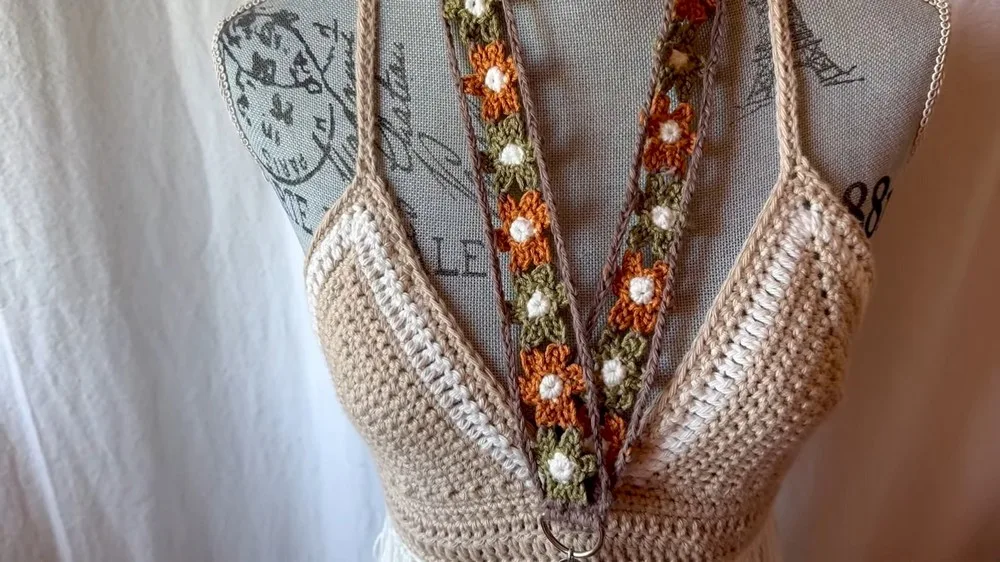
Crochet flower lanyard with joined petal flowers
Crochet flower lanyard pattern made from 23 single crochet flower motifs with chained petals, hand-joined and finished with a crocheted
- Skill
- Intermediate
- Time
- 4-6 hours
- Yarn weight
- Worsted

Intermediate
What the original write-up called it. Nothing here is graded again.

Worsted
What the sample was worked in. Any weight works; the size moves with it.

4-6 hours
What the original page reckoned. Your own pace is the one that matters.
About this pattern
A wearable lanyard made from 23 small crochet flowers, each a magic-ring centre topped with six chained petals in alternating green and amber. The flowers are hand-joined petal to petal, then finished with a one-round brown border that doubles as the cord, plus a D-ring and lanyard keychain hardware. Suitable for intermediate crocheters comfortable with magic rings, petal chains and hand-sewing motifs together.
This lanyard is built from a chain of small crochet flowers, each one a two-round motif worked in single crochet (UK double crochet) with a chained petal layer on top. The motifs belong to the flat flower family common in appliqué and granny-style crochet, where a solid centre supports a looser, decorative outer round. Twenty-three flowers are made in total, then linked edge to edge to form a strip long enough to wear.
Construction starts at the centre of each flower with a magic ring worked into six single crochet stitches, closed and finished with a slip stitch. A second round of chain-and-slip-stitch petals sits on top of that ring, alternating green and amber from flower to flower. Once all 23 flowers are made, they are hand-sewn together through the petal tips, then edged with a single-round border that also forms the cord, before hardware is added to complete the lanyard.
Materials
- Crochet hook (same size throughout)
- White yarn (for flower centres)
- Green yarn (for petals, alternating flower to flower)
- Amber yarn (for petals, alternating flower to flower)
- Brown yarn (for joining, the border, and the lanyard cord)
- Darning or tapestry needle (for joining flowers)
- Scissors (for cutting and sewing in ends)
- D-ring
- Strong jump ring
- Lanyard keychain
- Pliers (for attaching the jump ring)
The list is the pattern's own wording.
Instructions
Every round is printed as the pattern wrote it, brackets and all. Open the key beside a round to see only the short forms that round uses.
Flower
The example alternates green and amber for the petal color.
Cut and sew in ends after the center round and again after the petal round.
Repeat the process to make a total of 23 flowers.
- Round 1
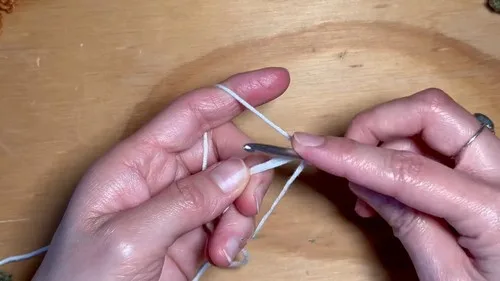
Start with white yarn and make a magic ring; ch 1 and add six sc into the center of the ring; after the last sc, pull the ring closed; sl st to the first sc to end the round. (6 sc)
Key3
- sl st
- slip stitch
- sc
- single crochet
- ch
- chain
- (6)Round 2
Tie yarn onto any stitch of the six base stitches; ch 6, sl st into the same stitch to form the first petal; sl st into the next stitch, ch 6 again, and sl st into the same stitch for the second petal; repeat the process (sl st, ch 6, sl st in same stitch) for each of the six stitches to create a total of six petals; after the last petal, sl st into the first stitch to end the row. (6 petals)
Key2
- sl st
- slip stitch
- ch
- chain
Border
Cut and sew in ends after completing the border.
- Round 1
Using the same color yarn (brown in the example) and same-sized hook, ch 7; starting in the second chain from the hook, add one sc; in the next stitch, go through the top of the flower's bottom petal, and then complete the sc; add sc in the following two stitches; repeat joining sc to petals; to work up the side, ch 4 and sl st in the top of each petal, ch 6 between each sl st; after covering one side, ch 5; work on the opposite end, sl st in the top of the first petal, ch 2, and sl st in the bottom of the next petal; ch 5 and repeat the side pattern on the other side; ch 4 and sl st into the first stitch to complete the border.
Key3
- sl st
- slip stitch
- sc
- single crochet
- ch
- chain
Making up
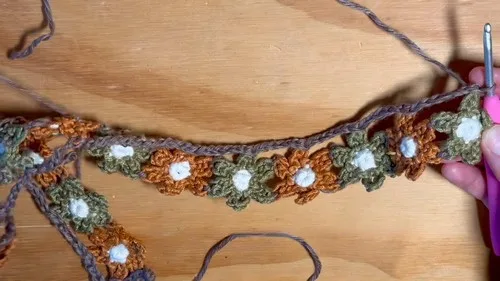
- Step 1Joining Flowers: Place two flowers right sides together.
- Step 2Cut a strand of yarn in your chosen color for joining (brown is used in the example).
- Step 3Use a darning or tapestry needle to join the flowers: sew through the top stitch of the corresponding petals to connect them.
- Step 4Tie a double knot to secure.
- Step 5Work your way up the back of the flower in a U shape to hide the yarn.
- Step 6Join the top stitches of the next two petals similarly.
- Step 7Ensure not to pull too tight.
- Step 8Continue joining flowers in a single line, leaving the left and right petals free—join, free, join, free pattern.
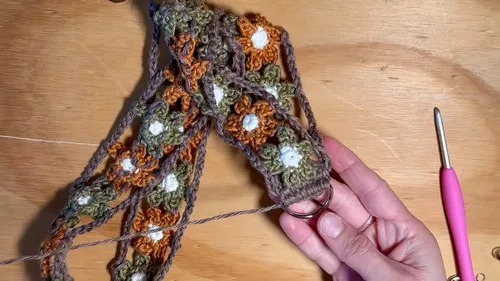
- Step 9Join Lanyard: Ensure no twists in the lanyard and place both right sides facing up.
- Step 10Tie yarn onto the right-hand corner.
- Step 11Single crochet along the flat edge, joining both ends together.
- Step 12Chain 1, turn, and attach a D-ring with single crochets going around the D-ring.
- Step 13Continue until the end of the row, tie off, and sew in the end.
- Step 14Attach Keychain: Use a strong jump ring and a lanyard keychain (with pliers for assistance).
- Step 15Feed the lanyard onto the jump ring along with the D-ring and close the jump ring.
- Step 16Give the lanyard a final check to make sure everything is secure, making any adjustments as necessary.
Notes from the pattern
- Use the same hook size throughout every flower, the border, and the joining work so the 23 motifs and the border stitches sit at matching tension.
- Cut and sew in ends after both the centre round and the petal round of each flower, and again after the border, since loose tails are hard to track once 23 flowers are joined.
- Colour changes happen flower by flower rather than mid-round: alternate green and amber yarn for the petals from one flower to the next, keeping white consistent for every centre.
- When joining, sew through the top stitch of corresponding petals and work up the back of each flower in a U shape to hide the yarn, pulling snug but not tight so the join stays flexible.
- Suitable for intermediate crocheters or ambitious beginners eager to expand their skills.
The essentials
- Rounds
- 3
- Parts
- 2
- Level
- Intermediate
- Time
- 4-6 hours
- Yarn
- Worsted
Stitches you will use
- Magic ring (MR) Used to start each flower centre in Round 1; keep the ring cinched fully closed before working the six single crochet (UK double crochet) stitches so no gap remains at the centre.
- Chain-and-slip-stitch petals Worked in Round 2 to build six loop petals around the centre; keep chain-6 lengths even across all 23 flowers so petals match in size.
- Hand-sewn motif joining Used to connect all 23 flowers through the petal tips; work loosely enough that the join lies flat rather than puckering the petals.
Troubleshooting
Individual flowers cup or dome instead of lying flat
The magic ring was likely pulled closed too tightly or too loosely before the petal round; snug the ring so the six base stitches sit evenly, then check petal chain-6 lengths are consistent.
The joined lanyard strip twists or buckles along its length
This usually comes from joining stitches pulled too tight at the petal tips; ease the tension on the sewn joins so each flower can lie flush with its neighbours.
The brown border pulls the flower chain out of shape
The border chains and slip stitches were worked too tightly against the petals; keep the ch 6 and ch 4 sections of the border relaxed so the edge follows the flowers rather than cinching them.
Substituting yarn
- Cotton, DK weight
- Gives a crisper, flatter petal and centre with less stretch; a smaller hook than the worsted-weight original may be needed to keep the six-stitch centre from gaping.
- Acrylic, worsted weight (as used in the original)
- Matches the pattern's drape and stitch definition directly; no hook change needed, and colours stay vivid for the alternating green and amber petals.
- Wool-blend, aran weight
- Produces a slightly larger, softer flower with more loft in the petals; sizing up the hook by roughly one size keeps the magic ring centre from tightening awkwardly.
Washing and care
- Hand wash the finished lanyard in cool water if the yarn used is acrylic or a wool blend, then lay it flat to dry so the joined flowers and border keep their shape rather than stretching on a hanger.
- Store the lanyard flat or loosely coiled rather than folded at the joins, and gently reshape the petals by hand after washing while still damp, since the chain petals hold their curve best before fully drying.
The photographs taken while this was being made
Every one was taken by whoever published the pattern, in the order the source listed them.
FAQs
Questions
How many flowers does the finished lanyard use?
The pattern calls for 23 flowers in total, each made from the same two-round motif. All 23 are joined in sequence before the border and hardware are added.
Do the flower centres and petals use the same yarn colour?
No. The centre of every flower is worked in white, while the petals alternate between green and amber from flower to flower. Brown yarn is reserved for joining, the border, and the lanyard cord.
What is 'sc' called if working from a UK pattern instead?
Single crochet (sc) in US terms is called double crochet in UK terms. This distinction matters here since the flower centres and the border are both worked primarily in that stitch.
Can the flowers be joined as they are made, rather than all at the end?
The pattern is written to make all 23 flowers first, then join them, which keeps tension consistent across the joins. Joining as each flower is finished is possible but makes it harder to compare petal spacing across the full strip.
What hardware is needed beyond crochet materials?
A D-ring, a strong jump ring, and a lanyard keychain are required to convert the crocheted strip into a wearable lanyard, along with pliers to attach the jump ring securely. These are added after the border is complete.
These answers came from whoever first published the pattern, kept word for word.