 EVERY CROCHET
 Scarves & Wraps 5 rounds No account, no download
Beginner V-Stitch and Shell Scarf With Fringed Edges
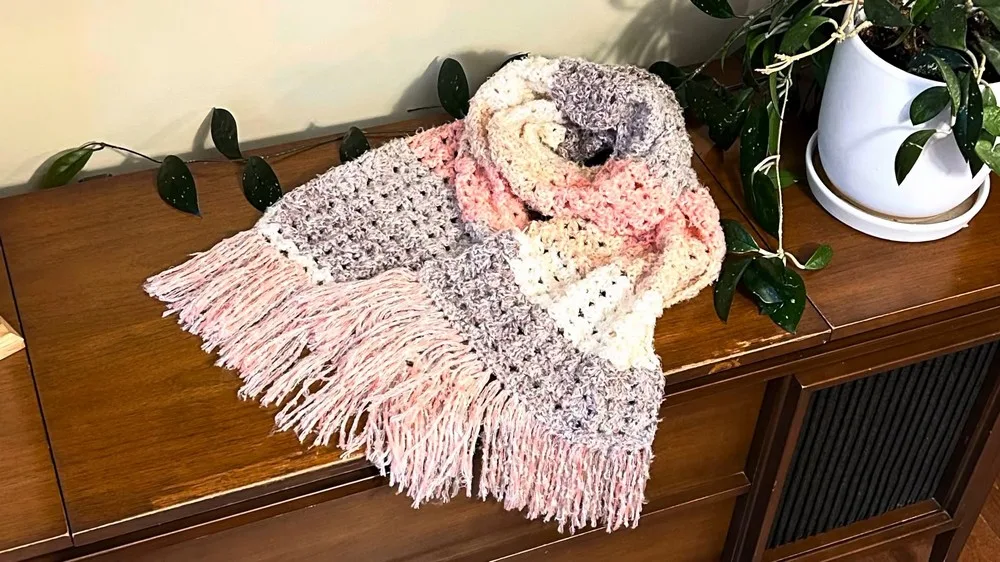
A beginner scarf pattern using double crochet (UK: treble crochet) V-stitches and shell clusters, finished with fringe.
- Skill
- Beginner
- Time
- 6-10 hours
- Yarn weight
- Worsted
- Hook
- 5 mm

Beginner
What the original write-up called it. Nothing here is graded again.

Worsted
What the sample was worked in. Any weight works; the size moves with it.

6-10 hours
What the original page reckoned. Your own pace is the one that matters.
About this pattern
This is a beginner scarf worked in double crochet using an alternating V-stitch and shell pattern that builds a row of raised clusters down its length. It starts from a 48-chain foundation, repeats two rows until the fabric reaches the desired length, and finishes with a single crochet edge and cardboard-wrapped fringe tied along both short ends. A 5mm hook and basic chain skills are the main requirements.
This scarf belongs to the shell-and-V-stitch family, built almost entirely from double crochet (UK: treble crochet) worked into chain-1 spaces rather than individual stitches. Two rows repeat throughout: one opens a five-stitch shell that reads as a small raised cluster, often called a blossom, and the other bridges those clusters with a two-stitch, chain-one, two-stitch group. The result is an open, textured fabric that drapes rather than stiffens, making it a practical first project for anyone comfortable with basic chains and turning.
Construction starts with a foundation chain of 48, followed by a setup row that spaces V-stitch groups evenly across its length. From there, two rows alternate: one fills each chain-1 gap with a five-stitch shell, and the next centres a new V-stitch into the top of each shell's middle stitch, staggering the clusters row by row. This repeats until the scarf reaches the desired length, after which a row of single crochet neatens the last edge before fringe, cut from cardboard-wrapped yarn, is knotted along both short ends.
Materials
Yarn
- Mainstays Lollipop Yarn in the color Cottage (Alternative: Karen Latte Cakes or your favorite yarn)
Crochet Hook
- 5mm (or suitable for your yarn choice)
- Needle (for weaving in ends)
- Cardboard (for fringe, 6 inches wide recommended)
Tools
- Scissors
- Stitch Marker (optional)
The list is the pattern's own wording.
Instructions
Every round is printed as the pattern wrote it, brackets and all. Open the key beside a round to see only the short forms that round uses.
Main Pattern
- Round 1
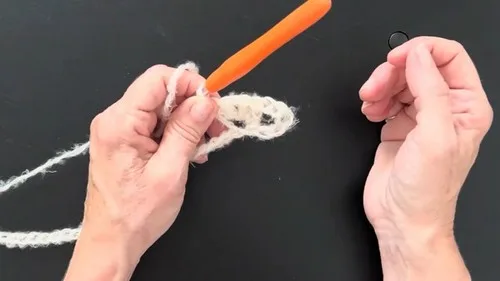
Create a slip knot and place it on your hook; chain 48 stitches.
- Round 2 (Setup Row)
Turn your foundation chain around; counting from the hook, skip 3 chains (these count as your first double crochet); in the 7th chain from the hook, work 2 double crochets, chain 1, and then 2 more double crochets into the same chain; skip 3 chains; repeat the step of 2 double crochets, chain 1, and 2 double crochets into the same chain space; continue this pattern across the row; you should finish with one chain left, double crochet into this last chain.
- Round 3
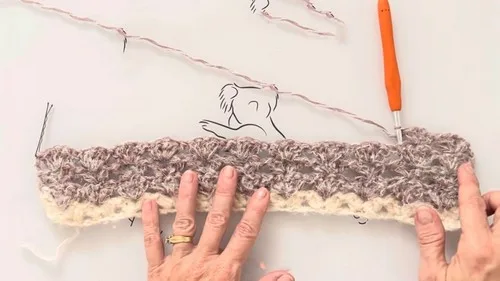
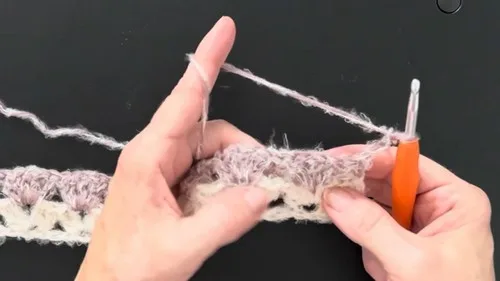
Chain 3 and turn your work; work 5 double crochets into each space created by the chain 1 in the previous row; continue across. This row creates what looks like little blossoms or clusters.
- Round 4
Chain 3 and turn your work; into the top of the 3rd double crochet of the next 'blossom' from the previous row, work 2 double crochets, chain 1, and 2 double crochets; continue the pattern across the row.
- Round 5
Repeat the last two rows (Round 3 and Round 4) for the pattern, alternating between the clusters and the 2 double crochets - chain 1 - 2 double crochets pattern; continue until the scarf reaches your desired length.
Making up
- Step 1When finished, work a row of single crochets across the last row of the scarf for a neat edge.
- Step 2Weave in all ends with your needle.
- Step 3Wrap yarn around cardboard piece to desired length.
- Step 4Cut one end to release the yarn strands.
- Step 5Fold strands in half, and using a crochet hook, pull the looped end through the edge of the scarf from wrong side to right, feed the cut ends through the loop, and tighten to attach the fringe evenly across both ends of the scarf.
Notes from the pattern
- A 5mm hook suits the given yarn weight; sizing up or down changes both stitch definition and finished scarf width.
- An optional stitch marker helps beginners track which chain-1 space belongs to the shell row and which belongs to the V-stitch row, since the two rows look similar mid-round.
- Even tension matters more in the cluster rows than the V-stitch rows, since five stitches packed into one space will visibly pull if worked too tightly or too loosely.
- Swapping the stated yarn colour or texture only affects appearance, not stitch count, so colour changes can be made freely without altering the pattern.
- Be mindful of your tension to ensure even stitches.
- Use stitch markers if you are a beginner to help identify stitch placements.
- Customize the scarf with different yarn colors or textures to make it uniquely yours.
The essentials
- Rounds
- 5
- Level
- Beginner
- Time
- 6-10 hours
- Hook
- 5 mm
- Yarn
- Worsted
Stitches you will use
- V-stitch (two double crochet, chain 1, two double crochet) Used in the setup row and every alternate row to bridge clusters; keep the chain-1 space consistent so the next row's shell centres correctly.
- Shell/cluster stitch (five double crochet in one space) Forms the 'blossom' texture in the cluster rows; work all five stitches into the same chain-1 space without splitting them across neighbouring stitches.
- Fringe attachment from cardboard-wrapped yarn Used in the final assembly step; keep loops even in length when wrapping the cardboard so the finished fringe hangs level.
Troubleshooting
The scarf develops a wavy or rippled
This usually comes from uneven stitch counts in the shell rows; recount the five double crochets in each cluster and check that the turning chain-3 is consistently treated as the first stitch.
The blossom clusters look flattened rather than raised.
Tight tension on the five-stitch shell compresses the cluster; work those stitches slightly looser than the surrounding V-stitches so they can puff up.
The fringe strands slip loose after a few wears.
The looped end was not pulled tight enough when the cut ends were fed through it; retighten each knot firmly against the edge and trim only after all fringe is attached.
Substituting yarn
- Cotton, worsted weight
- Produces a firmer, less stretchy fabric with crisper stitch definition; the same 5mm hook still works, but the scarf will hold its shape rather than drape.
- Acrylic, DK (double knit) weight
- Gives a lighter, thinner scarf; a smaller hook, around 4mm, keeps the V-stitch and shell pattern from becoming loose and open.
- Wool-blend, Aran weight
- Adds warmth and body; the fabric grows faster per round, so fewer rows may be needed to reach the same finished length.
Washing and care
- Mainstays Lollipop yarn is a synthetic fibre, so the finished scarf can generally be machine washed on a gentle, cool cycle and should not need blocking to open out the stitch pattern.
- Dry the scarf flat rather than hanging it, since the weight of the fringe can stretch the last row out of shape; reshape the shell clusters by hand while damp and store flat or loosely folded.
The photographs taken while this was being made
Every one was taken by whoever published the pattern, in the order the source listed them.
FAQs
Questions
How long should the foundation chain be to change the scarf's width?
The pattern's 48-chain foundation sets the working width; adding or removing chains in multiples of four keeps the V-stitch repeat aligned across the row.
Is a stitch marker necessary for this pattern?
No, it is listed as optional, but placing one in the first stitch of each row helps beginners tell the shell row apart from the V-stitch row at a glance.
How is the length of the scarf decided?
Rounds 3 and 4 repeat as long as needed; the pattern simply continues alternating the two rows until the fabric measures the length wanted, so no fixed round count applies.
Why does the pattern call for double crochet rather than another stitch?
Double crochet is tall enough to let the chain-1 spaces open up, which is what gives the shell clusters their raised, blossom-like look.
What is the cardboard used for at the end?
Yarn is wrapped around a cardboard piece, cut along one edge, then folded and pulled through the scarf's edge to create even fringe strands along both short ends.
These answers came from whoever first published the pattern, kept word for word.