 EVERY CROCHET
 Accessories 4 rounds No account, no download
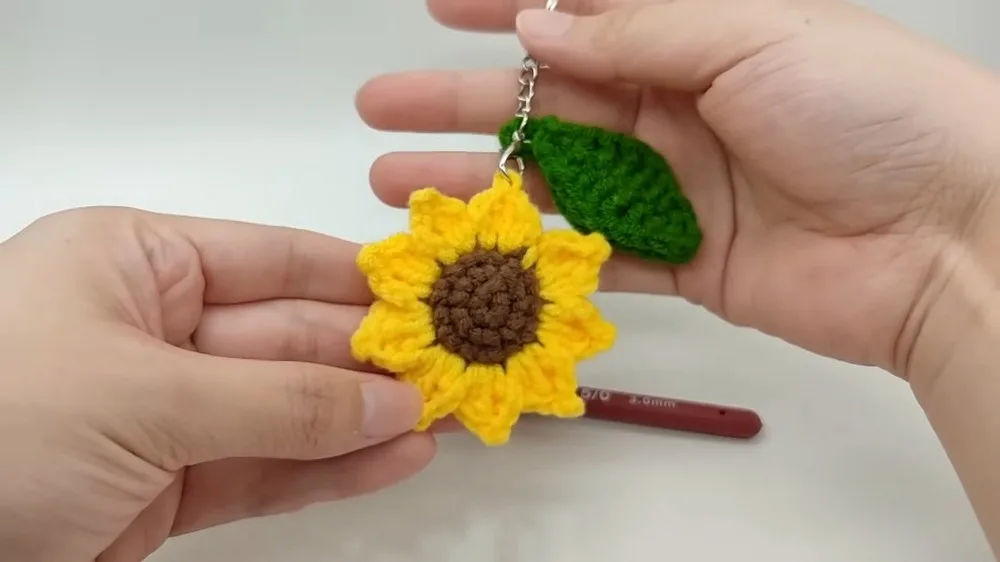
Crochet sunflower keychain pattern with petal and leaf shaping
A small crochet sunflower keychain pattern using double crochet (UK: treble) petals, with US and UK stitch terms given.
- Skill
- Beginner
- Time
- 1-2 hours
- Yarn weight
- DK/Worsted

Beginner
What the original write-up called it. Nothing here is graded again.

DK/Worsted
What the sample was worked in. Any weight works; the size moves with it.

1-2 hours
What the original page reckoned. Your own pace is the one that matters.
About this pattern
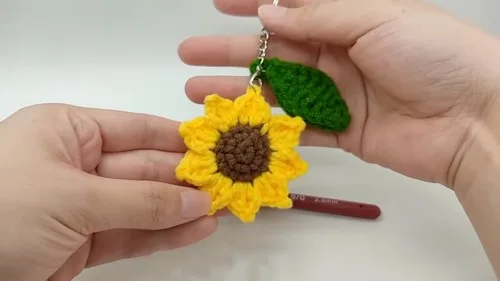
A brown single crochet disc of three rounds forms the sunflower's centre, ringed by nine yellow petals built directly into its edge from double crochet and triple crochet stitches with chain-2 picot tips. A chained green leaf and a secure keyring loop complete the charm. The whole piece is small, flat, and finished with simple repeat shaping rather than three-dimensional stuffing.
This sunflower keychain belongs to the small flower-motif family of crochet appliqués, worked as a flat disc with a ring of pointed petals rather than as a three-dimensional bloom. The main stitch used in the petals is the double crochet (UK: treble), paired with triple crochet for height and chain-2 picots that shape each pointed tip. The scale is small enough to finish in one sitting, which is why pieces like this usually end up on keys or bag zips rather than as standalone decor.
Construction starts with a brown disc worked in three rounds of increasing single crochet, forming the flat centre the petals attach to directly. Yellow petals are then built one at a time around the disc's edge: a double crochet and triple crochet share a base stitch, a chain-2 loop shapes the petal point, the stitch count tapers back down, and a slip stitch locks the petal to the next base stitch before the sequence repeats. This happens nine times to ring the disc completely, after which a chained green leaf and a secured keyring loop finish the piece.
Materials
- Brown yarn
- Yellow yarn
- Green yarn
- Crochet hook
- Scissors
- Keyring
The list is the pattern's own wording.
Instructions
Every round is printed as the pattern wrote it, brackets and all. Open the key beside a round to see only the short forms that round uses.
Disc Floret (Brown Center)
- Round 1
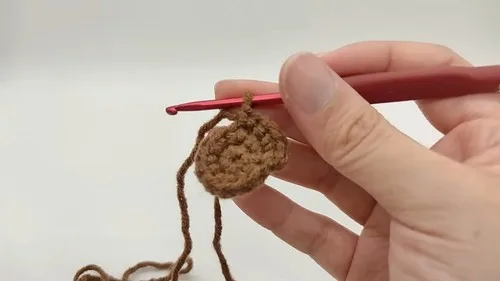
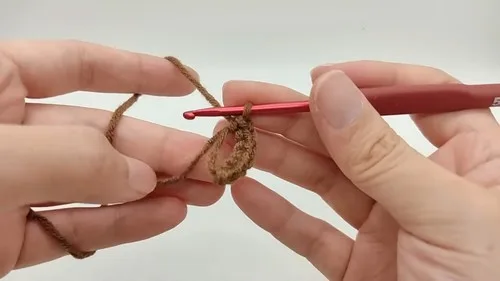
Start with brown yarn. Make 6 single crochet stitches in a magic ring.
- Round 2
Make six increases (2 single crochet stitches in each stitch around).
- Round 3
1 single crochet, 1 increase - repeat around.
Petals (Yellow)
Switch to yellow yarn.
- Petals (1-9)
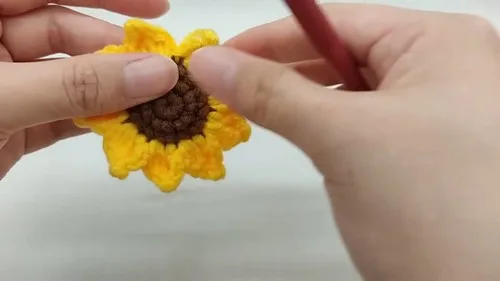
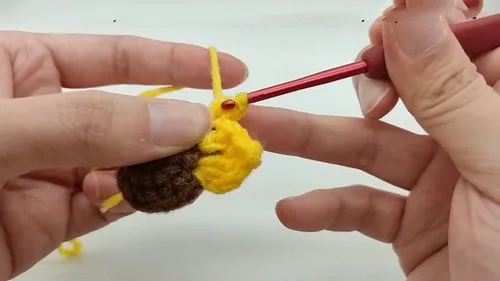
For each petal, start by chaining 2. Make a double crochet and a triple crochet in the same stitch. Chain 2 at the top of the triple crochet, then slip stitch into the base stitch. Make a triple crochet in the next stitch, then a double crochet in the same stitch. Chain 1 and slip stitch in the next stitch. Repeat this petal pattern a total of 9 times around the center disc.
Leaves (Green)
Switch to green yarn.
Chain 11.
Skip the first stitch and slip stitch into the second stitch.
Follow with single crochet, half double crochet, double crochet, 2 triple crochets, and then decrease the stitches in reverse order on the other side (double crochet, half double crochet, single crochet).
At the tip of the leaf, make a slip stitch, chain 1 and slip stitch once more.
Mirror the stitches on the other side.
Make two leaf pieces and sew them together.
Making up
- Step 1Attach the leaves to the back of the brown center.
- Step 2Attach the completed sunflower to a keyring.
- Step 3Weave in all loose ends securely.
- Step 4Make sure the keychain attachment is secure.
Notes from the pattern
- No hook size is listed in the materials, so choose one that suits the yarn weight in hand and check that the disc's first round sits flat before continuing — this keeps the finished keychain at a workable, pocket-sized scale.
- Three yarn colours are used in sequence (brown, then yellow, then green); weave in each colour's ends before starting the next part so joins don't show through the thin petal and leaf layers.
- No stitch markers are specified, but placing one at the start of round 2 and round 3 on the disc makes it easier to track where each increase falls and avoid drifting the stitch count.
- The keyring carries the full weight of the finished piece on keys or a bag, so the attachment step deserves extra fastening rather than a single loose stitch.
The essentials
- Rounds
- 4
- Parts
- 3
- Level
- Beginner
- Time
- 1-2 hours
- Yarn
- DK/Worsted
Stitches you will use
- Magic ring Opens round 1 of the brown disc; keep the tail pulled snug so the centre doesn't leave a visible gap once the ring closes.
- Even increase rounds Round 2 doubles the disc's stitch count and round 3 spaces further increases between plain stitches; uneven spacing here is the main cause of a disc that won't lie flat.
- Picot petal shaping Each of the nine petals combines double crochet, triple crochet, and a chain-2 picot in one short sequence; working the picots at matching tension keeps all nine petals the same size.
Troubleshooting
The brown disc cups or curls instead of lying flat.
This usually means the six increases in round 2 or the repeats in round 3 weren't spaced evenly; count stitches between increases and keep tension consistent with round 1.
Some petals look shorter or the points
Inconsistent tension on the chain-2 picot or on the triple crochet is the usual cause; work each petal's picot and triple crochet at the same tension and recount the stitch sequence per petal.
The keyring pulls loose or the
A weak join between the leaf, the disc, and the keyring loop is to blame; reinforce the attachment with extra stitching through all layers rather than relying on the woven-in ends alone.
Substituting yarn
- Cotton, DK or worsted weight
- Gives crisper stitch definition, so the petal points and picots hold their shape more distinctly; a slightly smaller hook than usual keeps the disc from loosening.
- Acrylic, worsted weight
- Closest match to a typical keychain yarn — easy to source in matching brown, yellow, and green, with the same drape and standard worsted hook sizing.
- Mercerised cotton, 4-ply/fingering weight
- Produces a smaller, denser version of the same disc-and-petal shape; needs a smaller hook to keep stitches tight enough for the keychain to hold its form.
Washing and care
- The materials list names yarn by colour rather than fibre, so treat the finished piece as a small handled accessory: hand wash in cool water with a mild soap only if it's visibly soiled, and avoid wringing the petals.
- Lay the sunflower flat to dry, gently easing the petals and leaf back into shape while damp, and store it away from direct sunlight to help the yellow and brown colours stay bright.
The photographs taken while this was being made
Every one was taken by whoever published the pattern, in the order the source listed them.
FAQs
Questions
How many petals does the sunflower need?
Nine petals are worked in sequence directly around the edge of the brown disc, each built from the same double crochet, triple crochet, and chain-2 picot repeat. No extra petals are added once that count is reached.
Can the number of petals be changed?
The disc's final round sets the stitch count the nine petals divide evenly around, so changing the petal count means recalculating how the petal repeat fits that same edge. It isn't a simple add-or-remove swap.
Does the sunflower need any stuffing or wire to hold its shape?
No. The piece stays flat and is held in shape by its own stitch structure — the increase rounds on the disc and the picot shaping on the petals — rather than by stuffing or support wire.
What actually holds the sunflower onto a keyring?
The keyring attaches to the back of the piece once the leaf has been attached to the brown centre, so both joins are stitched through the same back layer. Weaving ends in tightly at that point matters more than anywhere else on the piece.
Is the leaf worked as part of the flower or separately?
The leaf is worked separately in green yarn from a chain foundation, with stitches increasing then decreasing along its length to form the leaf shape. It's attached to the back of the brown centre only after both pieces are finished.
These answers came from whoever first published the pattern, kept word for word.