 EVERY CROCHET
 Amigurumi 4 rounds No account, no download
Amigurumi kitten plush pattern in single crochet
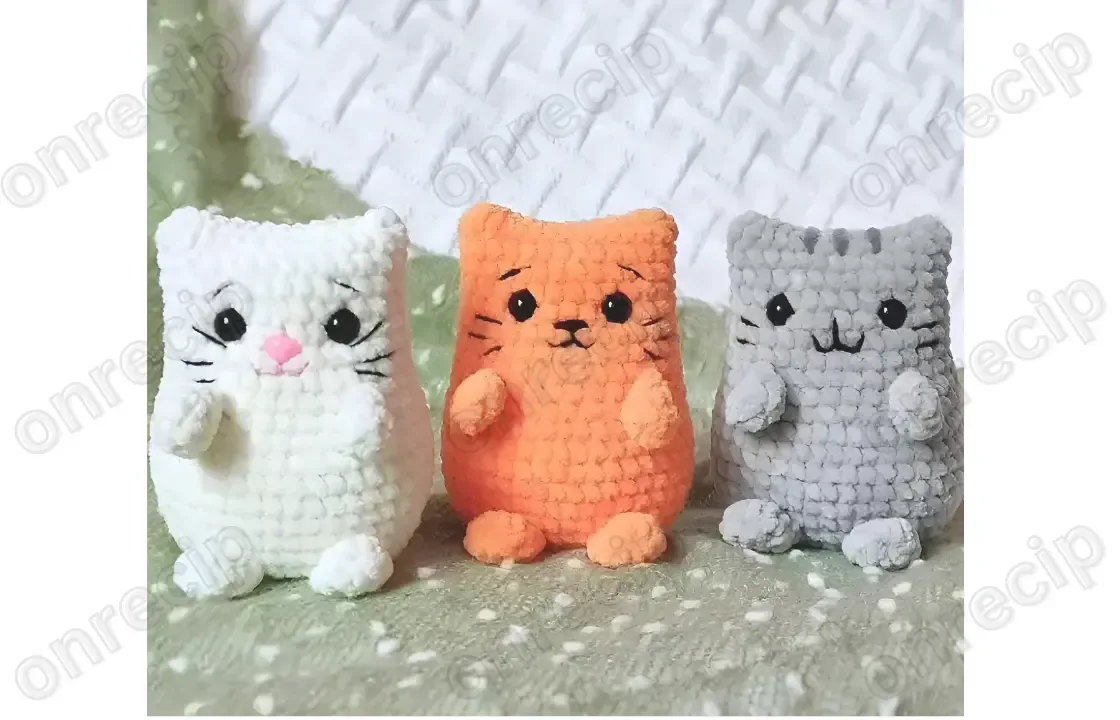
A single crochet (UK double crochet) amigurumi kitten with jointed legs, arms, tail and a two-colour body.
- Skill
- Intermediate
- Time
- 4-6 hours
- Yarn weight
- Fingering
- Hook
- 2.5 mm

Intermediate
What the original write-up called it. Nothing here is graded again.

Fingering
What the sample was worked in. Any weight works; the size moves with it.

4-6 hours
What the original page reckoned. Your own pace is the one that matters.
About this pattern
This is a single crochet (UK double crochet) amigurumi kitten made from a stuffed, two-colour body with four flat, unstuffed limbs and a tail sewn on afterwards. It uses fine baby yarn on a 2.5 mm hook, safety eyes, an optional safety nose, fiberfill and a stitch marker to track the spiral rounds. Expect several hours across body, legs, arms, tail and assembly.
This plush kitten belongs to the amigurumi family, built almost entirely from single crochet (UK: double crochet) worked in a continuous spiral. The dense, even fabric that this stitch produces is what holds fiberfill in place and keeps safety eyes and nose from pulling through, which is why amigurumi designs lean on it so consistently rather than mixing in taller stitches.
Materials
- Ayaz Babyfine yarn (180 m/100 g): grey #1195, dark grey #1130
- YarnArt Dolce Baby (85 m/50 g): orange #852 or milk #745
- 2.5 mm crochet hook
- 8 mm safety eyes
- 6×8 mm safety nose (optional)
- Stitch marker
- Tapestry needle
- Scissors
- Fiberfill
The list is the pattern's own wording.
Instructions
Every round is printed as the pattern wrote it, brackets and all. Open the key beside a round to see only the short forms that round uses.
R 2-3
- Round 4
only 1 sc Do not stuff the leg. Fold the top opening flat and 3 sc through both sides.Cut the yarn and fasten off.
Key1
- sc
- single crochet
R 2-3
- Round 4
only 1 sc Do not stuff the arm. Fold the top opening flat and 3 sc through both sides.Fasten off and leave a long tail for sewing.
Key1
- sc
- single crochet
Ready to Learn More? Open the next page for Further Guidance!
Pages: 1 2
R 5-6
8 sc (2 rows) Change to grey yarn:
- Rounds 7–8
8 sc (2 rows) Change to dark grey yarn: Cut the grey yarn and fasten off.
Key1
- sc
- single crochet
R 9
- Round 10
only 1 sc Do not stuff the tail. Fold the top opening flat and 4 sc through both sides.Cut the yarn and fasten off.
Key1
- sc
- single crochet
Tail
With dark grey yarn:
R 1
8 sc in magic ring [8]
R 2
8 sc Change to grey yarn:
R 3-4
8 sc (2 rows) Change to dark grey yarn:
Legs (make 2)
With grey yarn:
R 1
7 sc in magic ring [7]
Arms (make 2)
With grey yarn:
R 1
6 sc in magic ring [6]
Notes from the pattern
- The 2.5 mm hook paired with fine baby yarn is deliberately small to produce a tight, opaque fabric that hides fiberfill and holds the safety eye and nose posts firmly; sizing up the hook will loosen the gauge more than this design wants.
- A stitch marker is needed from round 1, since the body, legs, arms and tail are all worked in continuous spiral rounds with no joining slip stitch to show where a round begins.
- Legs and arms are not stuffed at all; only the body and head take fiberfill, so resist the urge to pad the limbs before closing the flattened top opening at round 4.
- The grey-to-dark-grey change happens mid-pattern across rounds 6-7-8; cut the grey yarn only after the dark grey is anchored, and weave the join tail in along the inside of the round rather than across the front.
The essentials
- Rounds
- 4
- Parts
- 12
- Level
- Intermediate
- Time
- 4-6 hours
- Hook
- 2.5 mm
- Yarn
- Fingering
Stitches you will use
- Continuous spiral rounds Used throughout the body, legs, arms and tail; a stitch marker is essential since there is no slip-stitched round join to mark the start.
- Flat-closing an unstuffed limb round 4 of the legs and arms, the top opening is folded flat and closed with 3 single crochet through both sides instead of being stuffed; keep tension even so the fold sits flush rather than gaping.
Troubleshooting
The legs and arms look flat rather than rounded
This is by design: the pattern leaves these pieces unstuffed and closes the top opening by folding it flat and working 3 sc through both layers, so a flat limb means the step was followed correctly.
The safety eyes or nose feel loose once pushed through
this fine gauge the holes made by the hook or scissors are often slightly larger than the post; check the fabric tension is tight enough around the insertion point and add a small washer or dab of fabric glue on the inside if the post still moves.
Substituting yarn
- DK-weight acrylic or cotton blend
- Produces a noticeably larger kitten, needs a 3.5-4 mm hook and more fiberfill to keep the fabric opaque, and gives softer, looser stitch definition than the original fine yarn.
- 4-ply (fingering) mercerised cotton
- Keeps the finished size close to the original since it matches the weight of the baby fine yarn, but adds sheen and crisper stitch edges; drop to a 2 mm hook if the fabric feels loose.
- Brushed or plush polyester yarn for the contrast sections
- Softens the texture of whichever parts use the orange or milk shade, adds a fluffier contrast against the smooth grey body, and may need a slightly larger hook just for that colour to stop the fabric stiffening.
Washing and care
- Hand wash the finished kitten in cool water using a mild detergent, since the fine acrylic-type yarn and plush contrast yarn both respond better to gentle washing than a machine cycle, which can mat the softer fibre.
- Reshape the piece while still damp, smoothing the body, legs and tail into position, then dry flat away from direct heat; store the finished toy loosely rather than compressed, so the stuffed body keeps its shape between uses.
FAQs
Questions
Can the safety nose be left out?
Yes, the 6x8 mm safety nose is listed as optional. An embroidered nose in a contrasting colour works as a straightforward substitute if safety hardware is not wanted or not available.
Why are the legs and arms left unstuffed?
The pattern closes each limb by folding the top opening flat and working 3 sc through both layers rather than stuffing it. This keeps the limbs slim and flat, which suits how they are sewn flush against the rounded, stuffed body.
What does 'sc' mean in UK terms?
The pattern is written using the US term single crochet, which is called double crochet in UK pattern language. It is the only stitch used across the body, legs, arms and tail.
Can the orange and milk shades of the contrast yarn be swapped or combined?
Either shade works as given, since both are offered as alternatives rather than a two-colour requirement. Milk gives a paler, softer contrast against the grey body, while orange reads as a bolder accent.
These answers came from whoever first published the pattern, kept word for word.