 EVERY CROCHET
 Amigurumi 41 rounds No account, no download
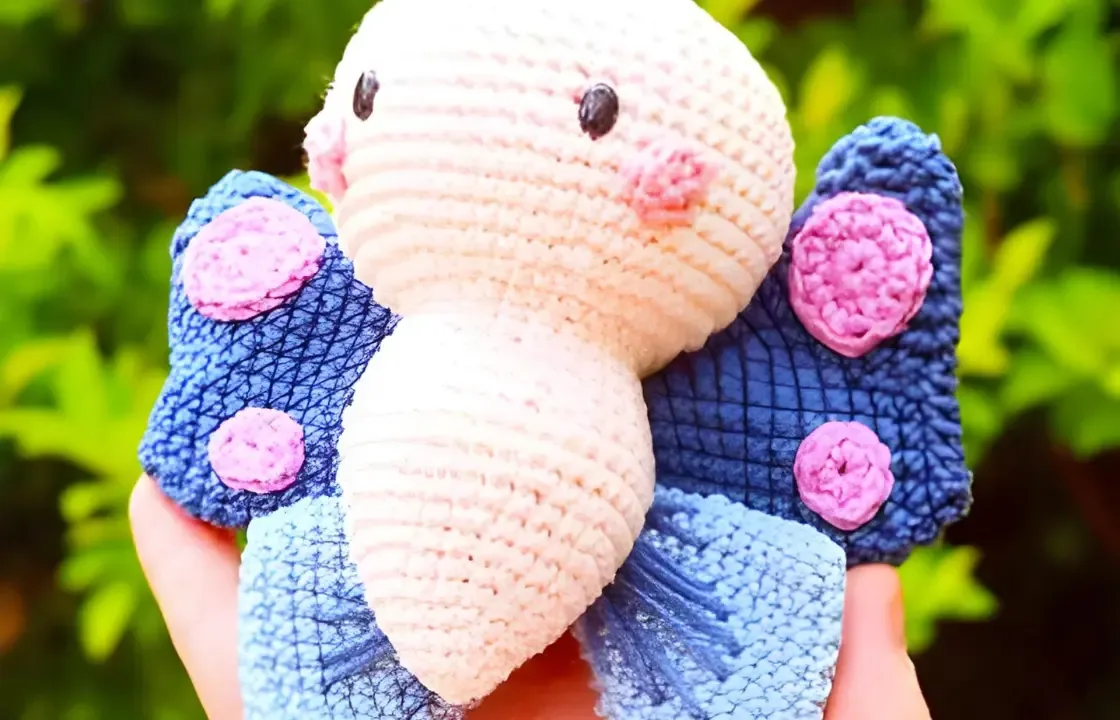
Amigurumi butterfly crochet pattern with decorative wings
Amigurumi butterfly worked in single crochet (UK double crochet), with US and UK terms given for the shaping rounds.
- Skill
- Intermediate
- Time
- 4-6 hours
- Yarn weight
- DK
- Hook
- 2.5 mm

Intermediate
What the original write-up called it. Nothing here is graded again.

DK
What the sample was worked in. Any weight works; the size moves with it.

4-6 hours
What the original page reckoned. Your own pace is the one that matters.
About this pattern
A small amigurumi butterfly worked mainly in single crochet (UK double crochet) using a 2.5mm hook and 100% cotton yarn, finishing at approximately 14cm. The body and head form one continuous 36-round piece, shaped by regular increase and decrease rounds and stuffed as work progresses. Wings and antennae are separate pieces worked with the same hook. Oval safety eyes (6 x 8mm or 5mm) and embroidery thread complete the face and wing details.
This amigurumi butterfly is built from single crochet (UK double crochet), the dense stitch family that gives toy crochet its firm, stuffable fabric. The body and head are worked as one continuous piece over 36 rounds, with decreases shaping the tapered ends. Finished, the insect measures approximately 14cm, a size that suits oval safety eyes at 6 x 8mm or the smaller 5mm option, plus embroidery thread for facial and wing detail.
Construction runs in a continuous spiral rather than joined rounds, which is standard for amigurumi and keeps the surface seamless. Decrease rounds late in the sequence, such as those working ms and dim in repeated groups, pull the body inward and require even stuffing as the maker goes rather than stuffing all at once at the end. The wings and antennae are worked as separate pieces using the same 2.5mm hook and attached once the body is complete.
Materials
- 2.5mm crochet hook (used for the body, the wings and the antennae)
- 100% cotton yarn
- Embroidery thread for details
- Oval safety eyes of 6 × 8 mm ( or 5 mm )
- Using these materials, insects will measure approx. 14cm
- The thread used is just a suggestion and you can adapt it to everything you have at home.
The list is the pattern's own wording.
Instructions
Every round is printed as the pattern wrote it, brackets and all. Open the key beside a round to see only the short forms that round uses.
Body and head
The base of the body and head is worked the same way for both the bee and the butterfly. For the bee, change colors as indicated in the pattern; for the butterfly, use the same color throughout the whole piece.
- Round 1
6 ms in MR ( 6 )
Key1
- MR
- magic ring
- Round 2
( 1ms, augm ) * 3 ( 9 )
- Round 3
( 2ms, augm ) * 3 ( 12 )
- Round 4
( 1ms, augm ) * 6 ( 18 )
- Round 5
ms around ( 18 )
- Round 6
1ms, augm, ( 2ms, augm ) * 5, 1sc ( 24 )
- Round 7
ms around ( 24 )
- Round 8
( 3ms, augm ) * 6 ( 30 )
- Round 9
ms around ( 30 )
- Round 10
2ms, augm, ( 4ms, augm ) * 5, 2 ms ( 36 )
- Rounds 11–12
ms around ( 36 )
- Round 13
2 ms, 1 dim, ( 4ms, dim ) * 5, 2 ms ( 30 )
- Round 14
ms around ( 30 )
- Round 15
( 3ms, dim ) * 6 ( 24 )
- Round 16
ms around ( 24 )
- Round 17
1 ms, dim, ( 2ms, dim ) * 5, 1sc ( 18 )
- Round 18
augm around ( 36 )
- Round 19
( 2ms, augm ) * 12 ( 48 )
- Round 20
( 7ms, augm ) * 6 ( 54 )
- Rounds 21–28
ms around ( 54 )
- Round 29
( 7ms, dim ) * 6 ( 48 )
- Round 30
3ms, dim, ( 6ms, dim ) * 5, 3 ms ( 42 )
If you plan to use safety eyes, insert them between rounds 24 and 25, at eight stitches apart.
Fill the body and continue to stuff while you work.
- Round 31
( 5ms, dim ) * 6 ( 36 )
- Round 32
2 ms, dim, ( 4ms, dim ) * 5, 2 ms ( 30 )
- Round 33
( 3ms, dim ) * 6 ( 24 )
- Round 34
1 ms, dim, ( 2ms, dim ) * 5, 1 ms ( 18 )
- Round 35
( 1ms, dim ) * 6 ( 12 )
- Round 36
dim aroundFasten off (F.o.) and close the opening.
Key1
- F.o.
- fasten off
Butterfly wings
Make two of each wing piece (repeat each part 2 times).
Lower wing The rounds below are for the lower wing.
- Round 1
Channel 12, jump 1 chain, 9ms, augm, turn, continue on the other side of the chain, 10 ms ( 22 )
- Round 2
augm, 8ms, augm, ms, augm, 8ms, augm, ms ( 26 )
- Round 3
ms around ( 26 )
- Round 4
12ms, dim, 12 ms ( 25 )
- Round 5
11ms, dim, 12ms ( 24 )
- Round 6
10ms, 2dim, 10ms ( 22 )
- Round 7
9ms, 2dim, 9ms ( 20 )
- Round 8
8ms, 2dim, 8ms ( 18 )
- Round 9
7ms, 2dim, 7ms ( 16 )
- Round 10
6ms, 2dim, 6ms ( 14 )
- Round 11
5ms, 2dim, 5ms ( 12 )
- Round 12
( 2ms, dim ) * 3 ( 9 )
- Round 13
( 1ms, dim ) * 3 ( 6 )Do not fill. Fasten off (F.o.) and leave a long tail for sewing.
Key1
- F.o.
- fasten off
Notes from the pattern
- Use the 2.5mm hook specified for the body, wings and antennae throughout; a larger hook will loosen the fabric and let stuffing show through.
- Place a stitch marker at the start of each round, since the body works in a continuous spiral with no slip-stitch join to mark the boundary.
- Keep tension tight and consistent, particularly through the decrease rounds (round 29 onward), as loose stitches there create visible gaps once safety eyes and stuffing add weight.
- Stuff the body gradually as rounds are completed rather than at the end; the decreasing rounds close the opening quickly, and firm, even filling gives the finished shape its clean curve.
- If using safety eyes, insert them between rounds 24 and 25, spaced eight stitches apart, before stuffing narrows the opening.
- This pattern's body and head base is shared with a matching bee pattern; for the butterfly, work the whole piece in a single color rather than changing colors partway through.
The essentials
- Rounds
- 41
- Parts
- 2
- Level
- Intermediate
- Time
- 4-6 hours
- Hook
- 2.5 mm
- Yarn
- DK
Stitches you will use
- Continuous spiral single crochet (UK double crochet) Used throughout the 36-round body and head; keep tension even so the decrease rounds sit flush rather than puckering.
- Invisible decreasing (dim) Appears repeatedly from round 29 onward in patterns like (7ms, dim) x6 and (5ms, dim) x6; work these evenly so the shaping curves smoothly rather than forming a point.
- Progressive stuffing Needed as the body narrows toward the head; add fibrefill in small amounts each round rather than packing it in at the finish, since access shrinks fast once decreases begin.
Troubleshooting
The body looks lumpy or uneven through the middle
This usually means stuffing was added unevenly or too late; add small amounts continuously as each round is worked, smoothing it before closing further.
The decrease rounds leave visible holes or a stepped edge
This points to inconsistent tension on the dim (invisible decrease) stitches; work them at the same tightness as surrounding single crochet stitches and check the stitch count against the number given at the end of each round.
The head or body twists rather than sitting straight
A missed or shifted round marker is the likely cause; reposition the marker at the true start of each round and recount stitches against the pattern's bracketed totals before continuing.
Substituting yarn
- 100% mercerised cotton, DK weight
- Closest match to the original; produces the same crisp stitch definition and firm hold with the same 2.5mm hook, and the finished size stays near 14cm.
- Acrylic, DK weight
- Softer drape and lighter feel; may need a slightly smaller hook to keep stitches tight enough to hide stuffing, as acrylic is less structured than cotton.
- Cotton blend, 4-ply/fingering weight
- Produces a noticeably smaller butterfly than 14cm; pair with a smaller hook (around 2mm) and use less stuffing per round to match the finer gauge.
Washing and care
- Hand wash the finished piece in cool water with a mild detergent, since 100% cotton holds its shape well but can felt slightly if agitated or washed hot.
- Reshape while damp and dry flat away from direct heat; cotton amigurumi keeps its firmness best when stored unstuffed of moisture and kept away from prolonged sunlight, which can dull the colour.
FAQs
Questions
What size will the finished butterfly be?
Using the materials listed, including the 2.5mm hook and cotton yarn, the finished insect measures approximately 14cm. Substituting a finer yarn and smaller hook will produce a smaller result.
Can the smaller safety eyes be used instead of the larger pair?
Yes, the pattern lists both 6 x 8mm and 5mm oval safety eyes as acceptable options. The smaller size suits a more delicate face on the same 14cm body.
Why does the pattern say 'ms' and 'dim' instead of familiar stitch names?
These are the pattern's own abbreviations for its stitches and decreases, distinct from the general US/UK single crochet versus double crochet naming used elsewhere in this article. Refer to the abbreviations list in this article for their exact meaning.
Does the whole body need to be stuffed before starting the decrease rounds?
No, stuffing should happen gradually as the rounds are worked. Waiting until the decreases begin makes it difficult to fill the body evenly, since the opening narrows quickly.
Is embroidery thread necessary, or can regular yarn be used for the details?
The source notes that the thread is only a suggestion and can be adapted to whatever is on hand. A finer embroidery thread gives cleaner detail lines than standard yarn, particularly for the wing markings.
These answers came from whoever first published the pattern, kept word for word.