 EVERY CROCHET
 Home Decor 4 rounds No account, no download
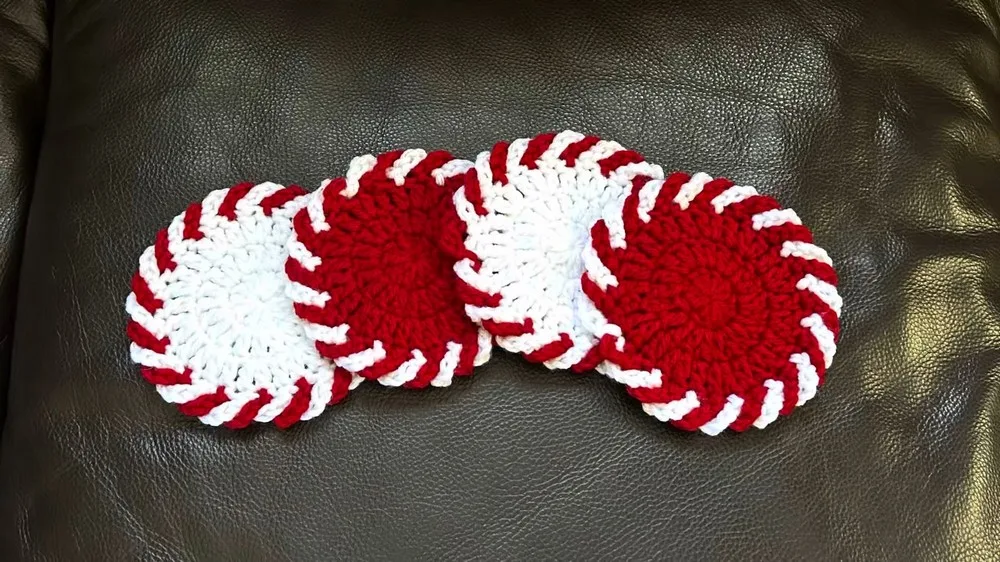
Peppermint stripe coaster worked in double crochet rounds
A flat round coaster in double crochet (UK: treble), finished with a two-colour peppermint stripe chain-loop edge.
- Skill
- Beginner-friendly
- Time
- 1-2 hours
- Yarn weight
- Worsted
- Hook
- 5 mm

Beginner-friendly
What the original write-up called it. Nothing here is graded again.

Worsted
What the sample was worked in. Any weight works; the size moves with it.

1-2 hours
What the original page reckoned. Your own pace is the one that matters.
About this pattern
This pattern makes a single flat coaster worked in double crochet (UK: treble crochet) over four rounds, starting from a ten-stitch ring and increasing to thirty stitches before a chain-5 loop border in two alternating colours finishes the edge. It needs a 5mm hook, yarn in two colours, a stitch marker and a yarn needle, and suits confident beginners comfortable with basic increases.
This coaster is a small, flat piece worked entirely in double crochet (UK: treble crochet), the taller of the two most common single-height crochet stitches and the usual choice for firm, fast-growing round motifs. Built up from a tight foundation ring, the fabric grows in concentric rounds until it reaches a full circle, before a final round breaks from solid stitching to form a decorative looped border. The result is a dense, table-ready mat rather than a lacy one, since the body of the piece relies on stitch density rather than open patterning.
Construction starts with a chain-4 ring worked into to create ten double crochets, which is then doubled to twenty stitches in round two and increased again to thirty in round three by alternating single and paired stitches. Round four changes technique entirely: instead of continuing the solid disc, it works thirty chain-5 loops around the edge, swapping between two colours as it goes to create the alternating peppermint stripe border. The tail is fastened off and woven in once the final loop is complete.
Materials
- 5mm crochet hook
- Yarn (suggested "Big Twist" yarn in deep red and white, but color is customizable)
- Stitch marker (bobby pin can be used)
- Yarn needle (for weaving in ends)
The list is the pattern's own wording.
Instructions
Every round is printed as the pattern wrote it, brackets and all. Open the key beside a round to see only the short forms that round uses.
Main Pattern
- (10)Round 1
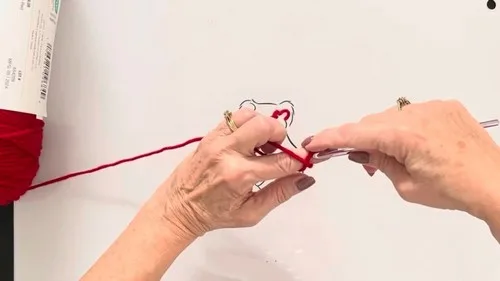
Place a slip knot on your hook; make 4 chains, this counts as your first stitch and chain space; work 10 double crochets into the fourth chain from the hook (the first chain you made), this will form a circle; after completing the 10 double crochets, join to the top of the beginning chain-3 with a slip stitch to close the circle.
- (20)Round 2
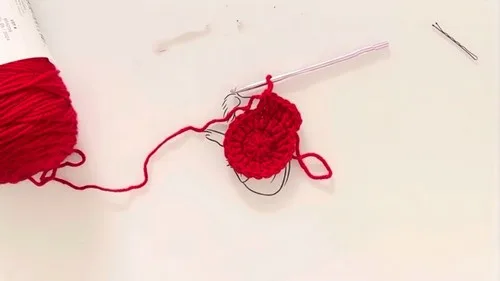
Chain 2 (does NOT count as a stitch), then make 2 double crochets in each stitch around. Slip stitch to the first double crochet (not the chain 2) to join. You should have 20 double crochets.
- (30)Round 3
Chain 2, in the base of the same stitch (first stitch of the previous round), make 2 double crochets. In the next stitch, make 1 double crochet. Repeat this pattern around ([2 dc in next stitch, 1 dc in next] around). Join with a slip stitch to the first double crochet. You should have 30 double crochets.
Key1
- dc
- double crochet
- Round 4
Chain 5, this begins your peppermint stripe edging; attach your second color with a slip stitch in the next stitch from where you left off; chain 5 and continue this process, alternating colors each time to create the peppermint stripe effect; continue the pattern around. You will end up with 30 chain-5 loops that create the peppermint border.Pull up a loop and secure it so it does not unravel when changing colors.
Making up
- Step 1Once completing the final loop, cut the yarn leaving a tail. Pull this tail through the loop on your hook and fasten it off. Use a yarn needle to weave in all ends securely.
- Step 2Depending on your tension, your coaster may curl a bit. Flatten it out gently with your hands.
Notes from the pattern
- The pattern is worked throughout with a single 5mm hook, so no hook changes are needed between rounds.
- A stitch marker (or a bobby pin) is useful for flagging the start of each round, since rounds 2 and 3 join in different places — round 2 joins to the first double crochet, not the chain-2.
- Keep tension consistent across rounds 1 to 3; loose stitches in the early rounds are the most common reason a finished coaster domes rather than lying flat.
- Round 4 depends on clean colour changes — pull up each new loop and secure it before continuing so the two-colour stripe effect stays even around all thirty loops.
The essentials
- Rounds
- 4
- Level
- Beginner-friendly
- Time
- 1-2 hours
- Hook
- 5 mm
- Yarn
- Worsted
Stitches you will use
- Working a foundation ring Appears in round 1, where a chain-4 loop is closed and ten double crochets are worked into it; keep the starting chain snug so the centre hole doesn't gape once the tail is woven in.
- Even double crochet increases Used in rounds 2 and 3 to grow the disc from 10 to 20 to 30 stitches; work each increase into the correct stitch so the coaster stays flat rather than rippling or cupping.
- Changing colour mid-round Needed throughout round 4, where the yarn alternates every chain-5 loop; secure each new colour with a snug slip stitch and manage the strands so tails don't tangle before weaving in.
Troubleshooting
The coaster cups or domes instead of lying flat.
This usually means stitches were added or missed during the increase rounds, throwing off the 10/20/30 stitch counts; recount each round against the pattern and, if the fabric still domes, flatten it gently by hand as noted in the assembly steps.
The centre ring gapes open after round 1.
The chain-4 loop wasn't pulled snug before the ten double crochets were worked into it; tighten the starting tail as far as it will go before weaving it in at the end.
The peppermint stripe loops look uneven around the edge.
Chain-5 loops made at inconsistent tension, or the new colour wasn't secured firmly when it was joined; keep chain counts even and pull each colour change snug before continuing to the next loop.
Substituting yarn
- Cotton, worsted weight
- Gives crisper stitch definition and a firmer, flatter coaster that holds its shape without blocking; the same 5mm hook still suits this weight.
- Acrylic, DK weight
- Produces a lighter, more pliable coaster with softer drape; stitches may need to be worked a little tighter, or a smaller hook substituted, to keep the fabric dense enough for a coaster.
- Wool blend, worsted weight
- Adds warmth and a softer hand to the finished piece, but wool absorbs moisture readily, so it suits decorative display more than everyday drink coasters.
Washing and care
- Since the materials list doesn't specify fibre content, treat the finished coaster as delicate: hand wash in cool water only if the yarn is known to be washable, and avoid soaking a piece intended for everyday drink use.
- Reshape the coaster flat while damp — useful if it curled during the assembly step — and dry it lying flat on a towel rather than hanging, then store it flat so the peppermint edge doesn't crush.
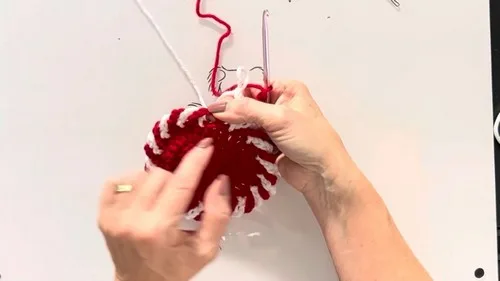
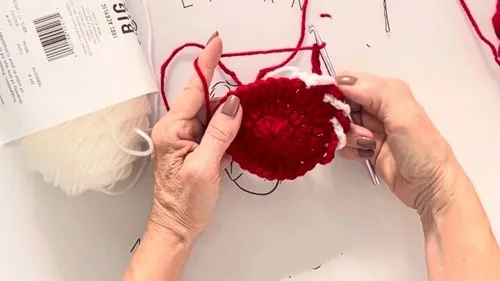
The photographs taken while this was being made
Every one was taken by whoever published the pattern, in the order the source listed them.
FAQs
Questions
What hook size does this coaster use?
The whole piece is worked with a single 5mm hook, from the foundation ring through to the peppermint stripe edging in round 4.
Can the coaster be made in just one colour?
Yes — the pattern names deep red and white as a suggestion, but colour is customisable, and the same construction works with a single colour throughout if the alternating stripe effect isn't wanted.
Is a stitch marker essential?
Not strictly, since the pattern gives clear join points for each round, but a marker or a bobby pin makes it easier to track where round 4's thirty chain-5 loops begin and end.
How many rounds make up the coaster?
Four rounds in total: three build the solid double crochet disc from 10 to 30 stitches, and the fourth adds the two-colour chain-5 loop border.
Why does the coaster curl instead of lying flat?
This is usually a tension issue rather than a mistake in the stitch count; the assembly step notes that gently flattening the finished piece by hand corrects mild curling.
These answers came from whoever first published the pattern, kept word for word.