 EVERY CROCHET
Bags & Totes 14 rounds No account, no download
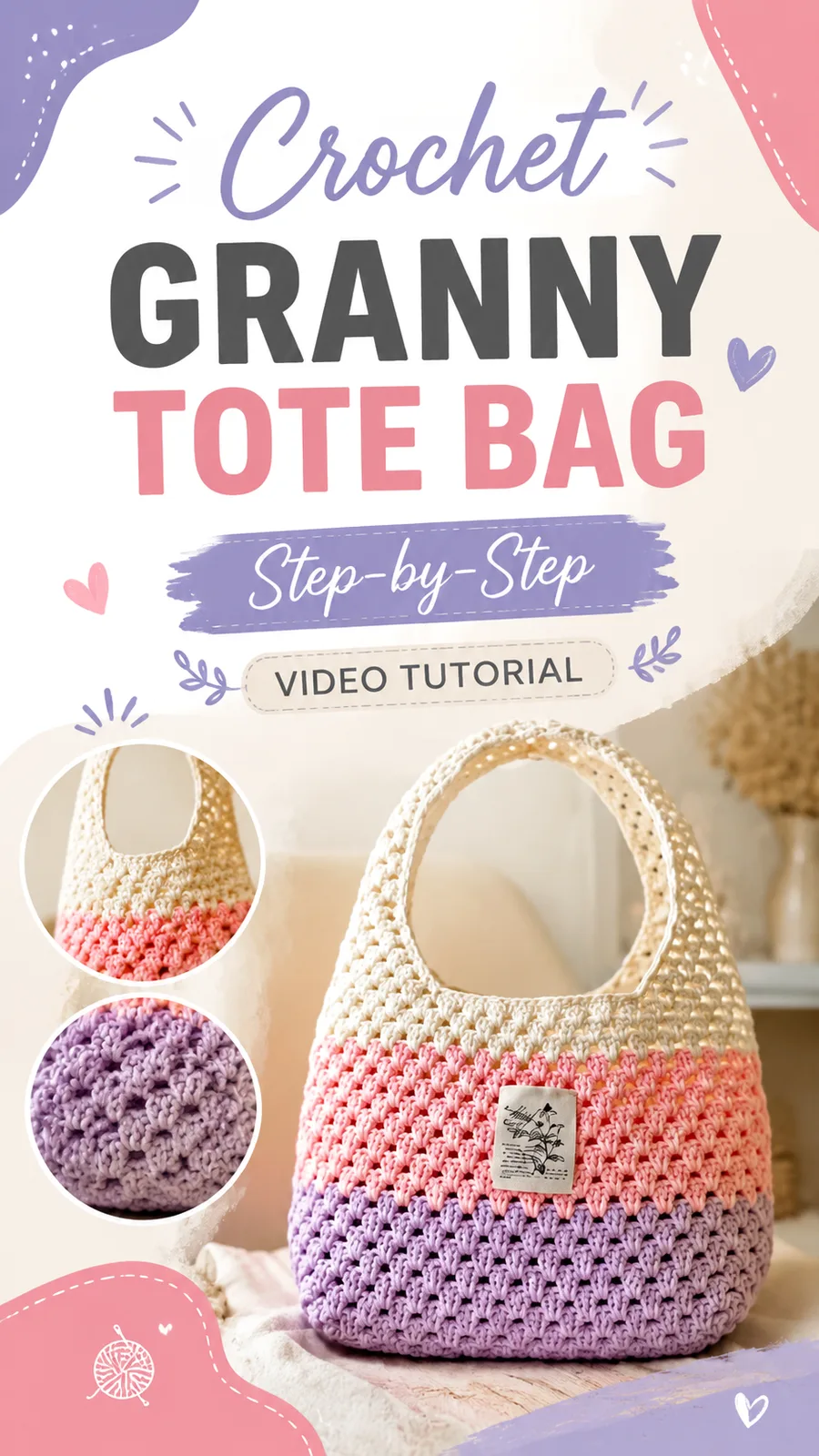
Pastel granny cluster tote bag crochet pattern
A pastel granny tote worked in double crochet (UK treble) clusters; both US and UK stitch names are given throughout.
- Skill
- Intermediate
- Time
- 6-8 hours
- Yarn weight
- Worsted / Aran
- Hook
- 5 mm

Intermediate
What the original write-up called it. Nothing here is graded again.
Worsted / Aran
What the sample was worked in. Any weight works; the size moves with it.

6-8 hours
What the original page reckoned. Your own pace is the one that matters.
About this pattern
This pattern makes a pastel granny-style tote with a flat oval base, a textured cluster body in three colour bands of cream, soft pink, and lavender, and a reinforced top edge with a built-in handle. It uses a 5 mm (US H-8) hook, worked in joined rounds from the base up, and suits a confident beginner comfortable with basic shaping and colour changes.
This pastel tote belongs to the granny cluster family of crochet stitches, built from groups of US double crochet (UK treble crochet) worked into chain-one spaces to create the open, textured shells associated with traditional granny squares. Here the shells are worked in continuous rounds rather than joined motifs, producing a seamless, rounded body that still carries the familiar granny texture through its three colour bands.
Construction begins at the base, where an oval is worked bottom-up in three joined rounds to create a flat foundation with rounded corners. The body then rises through textured cluster rounds across the cream, pink, and lavender sections before settling into five simpler single crochet rounds that reinforce the top edge, form chain spaces for the handle, and finish with sturdy rounds around the strap.
Materials
Color A
- Cream, approximately 180 yards (165 meters)
Color B
- Soft pink, approximately 170 yards (155 meters)
Color C
- Lavender, approximately 200 yards (183 meters)
- 5 mm (US H-8) crochet hook
- Yarn needle
- Stitch marker
- Scissors
The list is the pattern's own wording.
Instructions
Every round is printed as the pattern wrote it, brackets and all. Open the key beside a round to see only the short forms that round uses.
Bag Base
With Color C, ch 31.
- Round 1
2 sc in second ch from hook, sc across to last chain, 3 sc in last ch. Working along opposite side of foundation chain, sc across. Join with sl st. (64 sts)
Key4
- sl st
- slip stitch
- ch
- chain
- sc
- single crochet
- st
- stitch
- Round 2
Ch 1, 2 sc in first st, sc in next 28 sts, 2 sc in next 3 sts, sc in next 28 sts, 2 sc in last 2 sts. Join. (70 sts)
Key3
- ch
- chain
- sc
- single crochet
- st
- stitch
- Round 3
Ch 1, sc around evenly, placing 2 sc in each of the four oval end stitches. Join. (78 sts)
Key2
- ch
- chain
- sc
- single crochet
Textured Bag Body
- Round 4
Ch 2, dc in each stitch around. Join. (78 sts)
Key2
- ch
- chain
- dc
- double crochet
- (26)Round 5
Ch 3, skip 2 sts, 3 dc in next st, ch 1. Repeat around. Join in top of beginning chain. (26 clusters)
Key3
- ch
- chain
- dc
- double crochet
- st
- stitch
- (26)Round 6
Sl st into next two dc, ch 3, 3 dc in same space, ch 1. Work 3 dc in each ch-1 space around. Join. (26 clusters)
Key4
- sl st
- slip stitch
- ch
- chain
- dc
- double crochet
- st
- stitch
- Rounds 7–15
Rounds 7-15: Repeat Round 6. Change to Color B after Round 9.
- Rounds 16–21
Rounds 16-21: Continue granny clusters with Color B. Change to Color A at the end of Round 21.
- Rounds 22–26
Rounds 22-26: Work granny clusters with Color A.
Top Edge and Handle Preparation
- Round 27
Ch 1, sc in every stitch around. Join. (78 sts)
Key2
- ch
- chain
- sc
- single crochet
- Round 28
Sc around again to strengthen the upper edge. Join.
Key1
- sc
- single crochet
- Round 29
Sc 18 sts, ch 32, skip 21 sts, sc 18 sts, ch 32, skip 21 sts, join. (78 sts including chains)
Key2
- ch
- chain
- sc
- single crochet
- Round 30
Sc around, working 32 sc over each chain section. Join.
Key1
- sc
- single crochet
- Rounds 31–34
Sc around. Fasten off and weave in ends.
Key1
- sc
- single crochet
Special Stitch
Granny Cluster: Work 3 dc into the same stitch or chain space. A chain-1 space separates clusters throughout the textured rounds.
Making up
- Step 1Secure all yarn ends using a yarn needle.
- Step 2Blocking helps relax the stitches and improves the final shape of the tote. Lightly mist the finished bag with water, reshape the base and handle, and allow it to dry flat.
- Step 3Allow the bag to dry completely before use.
- Step 4For best care, hand wash the bag gently in cool water and reshape while damp. Cotton fibers may soften with washing, so storing the bag flat can help maintain its shape.
- Step 5Optional: Add a fabric lining for extra support.
Notes from the pattern
- Use the stated 5 mm (US H-8) hook rather than substituting a smaller or larger size, since the 78-stitch body count and the cluster repeat both depend on it for a clean fit.
- Place a stitch marker in the first stitch of each round, since the bag is worked in joined rounds rather than a spiral and losing track of the join makes the slip-stitch start of each granny cluster round harder to find.
- Work the base and body firmly rather than loosely; this style relies on a tight gauge to hold its rounded oval shape, and a soft tension will let the finished tote stretch and lose its silhouette with use.
- Blocked, the finished tote measures approximately 12 inches wide x 10 inches tall (30.5 x 25.5 cm), excluding the handle.
- Gauge: 16 double crochet stitches x 8 rows = 4 inches (10 cm). Check gauge before starting, since the stitch counts throughout the pattern depend on this tension to reach the stated finished size.
- The bag is worked in joined rounds. The turning chain does not count as a stitch. Join each round with a slip stitch into the first stitch unless instructed otherwise.
The essentials
- Rounds
- 14
- Parts
- 4
- Level
- Intermediate
- Time
- 6-8 hours
- Hook
- 5 mm
- Yarn
- Worsted / Aran
Stitches you will use
- Oval base shaping Used across Rounds 1-3 of the Bag Base; watch the stitch counts closely as they rise to 64, then 70, then 78, since the increases at the four oval end stitches are what keep the base flat.
- Granny cluster shells Forms the Textured Bag Body from Round 5 onward, with 3-dc groups worked into chain-one spaces rather than into stitches; misplacing a cluster shifts the whole 26-cluster repeat out of line.
- Handle chain spaces with reinforcement Created in Round 29, where 32 chains are worked on each side and then covered with 32 single crochet in Round 30; keep the chain tension even so the strap does not gape once Rounds 31-34 are added.
Troubleshooting
The base cups or bows instead of lying flat.
This usually comes from loose tension or a missed increase in Round 2 or 3; check that the stitch count reaches 70 after Round 2 and 78 after Round 3 before starting the textured body.
The granny clusters drift out of
This happens when clusters land in a stitch instead of a chain-one space, or the round starts in the wrong place; always slip stitch into the next two double crochet stitches before beginning the next cluster round, as the pattern directs.
The handle feels floppy or the opening gapes.
Loose tension across the chain-32 sections in Round 29, or skipping the reinforcing Rounds 31-34, both leave the strap underbuilt; keep the chain even and work all four edging rounds for a sturdy handle.
Substituting yarn
- Cotton, DK to worsted weight
- Stays closest to the pattern's original drape and structure for the cream, pink, and lavender sections; the 5 mm hook can be kept as stated.
- Acrylic, worsted weight
- A lighter, more affordable option that produces a softer, less firm fabric; dropping to a 4.5 mm hook helps recover some of the tightness needed for the base to sit flat.
- Cotton-linen blend, bulky weight
- Adds body to the clusters without any stuffing; expect to size up to a 5.5-6 mm hook and to use noticeably less than the 180, 170, and 200 yard amounts given for the three colours.
Washing and care
- Hand wash gently in cool water, since the cotton yarns used for the cream, pink, and lavender sections may soften with repeated washing; press out excess water in a towel rather than wringing the fabric.
- Reshape the base and handle while the tote is still damp, then dry flat to help the oval base and curved strap hold their shape; store the finished bag flat rather than folded to keep the handle from losing its curve.
FAQs
Questions
What hook size does this tote use, and can it be adjusted?
The pattern calls for a 5 mm (US H-8) hook throughout. A smaller hook can tighten the fabric for a sturdier bag, but the resulting stitch count should still match the 78 stitches given for the body before committing to a full project.
How much yarn is needed for the three colours?
The pattern uses roughly 180 yards (165 m) of cream, 170 yards (155 m) of soft pink, and 200 yards (183 m) of lavender. Buying a little extra of each colour allows for differences in individual tension.
Why does the pattern use joined rounds instead of a continuous spiral?
Joined rounds, closed with a slip stitch at the end of each one, keep the colour blocking between the three pastel sections level and crisp. A stitch marker in the first stitch makes the join point easy to find round after round.
How is the handle built into the bag?
The handle starts in Round 29, where 18 stitches are worked, 32 chains are made, and 21 stitches are skipped on each side. Round 30 covers each chain with 32 single crochet, and Rounds 31-34 add reinforcing rounds around the strap.
Can the proportions of the three colour sections be changed?
Since Colour B begins after Round 9 and Colour A after Round 21, resizing the bands means recalculating how many granny cluster rounds are worked in each colour before reaching the Top Edge and Handle Preparation section.
These answers came from whoever first published the pattern, kept word for word.