 EVERY CROCHET
Home Decor 7 rounds No account, no download
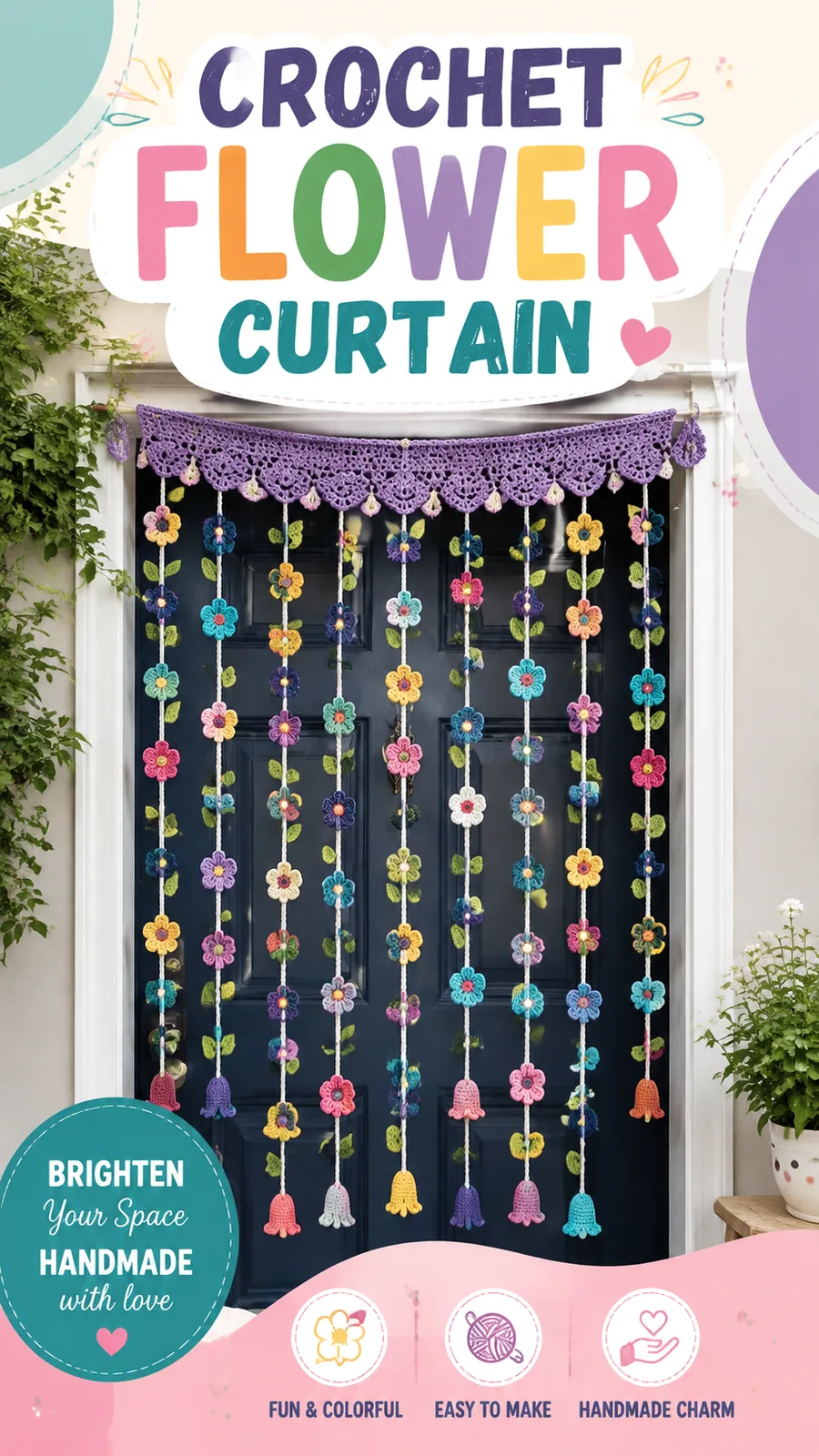
Lacy crochet flower curtain with hanging floral strands
A lacy double crochet (UK treble) panel curtain with crochet flowers; both US and UK stitch terms given.
- Skill
- Confident Beginner
- Time
- 6-10 hours
- Yarn weight
- DK
- Hook
- 3.5 mm

Confident Beginner
What the original write-up called it. Nothing here is graded again.
DK
What the sample was worked in. Any weight works; the size moves with it.
6-10 hours
What the original page reckoned. Your own pace is the one that matters.
About this pattern
This is a three-part hanging curtain: a lacy double crochet header panel worked in rows, 35 to 45 separate flower motifs made in joined rounds, and plain chain strands that connect the two. It takes DK cotton, a 3.5 mm hook, and a yarn needle for assembly, and suits a confident beginner comfortable with basic shaping and sewing pieces together by hand.
This hanging curtain belongs to the shell stitch family, built from paired double crochet (UK treble crochet) groups separated by small chain spaces. The open, lattice-like structure gives the top panel its lace-like drift, while the same stitch repeats across the width to keep the fabric light enough to hang without pulling out of shape.
Construction happens in three separate stages rather than one continuous piece. The wide header panel is worked first in turned rows, the floral motifs are made individually afterwards using leftover yarn in any number of colours, and chain strands are attached across the panel last so their spacing can be checked before the flowers are sewn into place at varying heights.
Materials
- DK weight cotton yarn in light green, plus assorted flower colors
- 3.5 mm crochet hook (US E-4)
- Yarn needle for sewing pieces together
- Scissors
- Stitch markers
- Optional blocking mat and pins
The list is the pattern's own wording.
Instructions
Every round is printed as the pattern wrote it, brackets and all. Open the key beside a round to see only the short forms that round uses.
Top Curtain Panel
Foundation: Ch 111.
- Row 1
Dc in 4th ch from hook and in each ch across. Turn. (108 dc)
Key2
- ch
- chain
- dc
- double crochet
- (36)Row 2
Ch 3, dc in same st, *ch 2, sk next 2 sts, 2 dc in next st. Repeat from * across. End with 2 dc in last st. Turn. (36 groups)
Key4
- ch
- chain
- dc
- double crochet
- sk
- skip
- st
- stitch
- Row 3
Ch 3, dc in same st. Work 2 dc in each ch-2 space across. End with 2 dc in last stitch. Turn. (108 dc)
Key3
- ch
- chain
- dc
- double crochet
- st
- stitch
- Row 4
Ch 3, dc in same st, *ch 2, sk next 2 sts, 2 dc in next st. Repeat across. Turn.
Key4
- ch
- chain
- dc
- double crochet
- sk
- skip
- st
- stitch
- Rows 5–8
Repeat Rows 3-4 twice.Fasten off and weave in ends.
Crochet Flower Motifs
Make 35 to 45 flowers depending on desired fullness.
Center: Using flower color, make a magic ring.
- Round 1
Ch 1, work 10 sc into ring. Join with sl st to first sc. (10 sc)
Key4
- sl st
- slip stitch
- ch
- chain
- sc
- single crochet
- st
- stitch
- (5)Round 2
Ch 1, *sc in next st, 3 dc in next st, sc in next st. Repeat from * around. Join with sl st. (5 petals)Fasten off, leaving a long tail for attaching.
Key5
- sl st
- slip stitch
- ch
- chain
- sc
- single crochet
- dc
- double crochet
- st
- stitch
Project Name: Garden Bloom Hanging Flower Curtain
Project Description: This original crochet pattern creates a decorative hanging curtain featuring a lacy crochet header, vertical strands, and colorful layered flowers. The design is inspired by floral crochet decor and can be customized for different widths and lengths.
Skill Level Confident Beginner Finished Size Approximately 24 inches wide x 48 inches long (61 cm x 122 cm)
Yarn Suggested DK weight cotton yarn, approximately 900 yards (823 meters) total Hook Recommended 3.5 mm crochet hook (US E-4)
Gauge Approximately 18 double crochet stitches x 8 rows = 4 inches (10 cm)
Terminology US crochet terms
Special Stitch
Flower Petal Cluster: In the same stitch, work (dc, ch 1, dc, ch 1, dc). This creates a small textured petal section.
Hanging Strands
Make 15 strands.
Each Strand: Attach green yarn to the bottom edge of the top panel.
Ch 90 for a medium-length strand, or adjust length as desired.
Work 1 sl st into each chain back toward the panel.
Fasten off and repeat for remaining strands, spacing them approximately 1.5 inches (4 cm) apart.
Making up
- Step 1Lay the top panel flat and arrange the hanging strands evenly.
- Step 2Sew or crochet each strand securely onto the bottom edge of the panel.
- Step 3Arrange flowers at different heights along the strands.
- Step 4Use the yarn tails to sew each flower firmly into place.
- Step 5Add extra flowers around the panel edge if desired.
- Step 6Block the completed curtain lightly to relax the stitches and create an even shape. Avoid stretching the strands too aggressively because the decorative chains should maintain a natural hanging movement.
- Step 7Secure all yarn ends by weaving them through several stitches on the wrong side. Trim only after the ends are firmly hidden.
Notes from the pattern
- Use the 3.5 mm (US E-4) hook consistently across both the panel and the flower motifs so the dense dc groups and the open flower petals sit at a comparable scale.
- Place stitch markers along the panel's bottom edge before attaching chain strands; this keeps the spacing even across all 108 stitches before any sewing begins.
- Check gauge against 18 dc x 8 rows = 4 inches (10 cm) before starting the panel, since a tighter or looser tension will change the finished 24-inch width.
- Flower colours can change freely between motifs since each one is worked and fastened off separately; no colour carrying or joining mid-round is needed.
- Keep the curtain base and the flower strands in one consistent yarn weight, but feel free to use different colours for the flowers themselves; a coordinated rainbow palette or a seasonal colour theme can completely change the finished look.
The essentials
- Rounds
- 7
- Parts
- 5
- Level
- Confident Beginner
- Time
- 6-10 hours
- Hook
- 3.5 mm
- Yarn
- DK
Stitches you will use
- Shell stitch panel (ch-2 space, 2-dc group) Worked across Rows 2 to 4 of the top panel; keep the chain-2 spaces and stitch skips consistent or the groups drift off alignment row to row.
- Magic ring motif construction Each flower centre starts in a magic ring before Round 1's 10 sc; pull the ring closed fully before working the first round so the centre doesn't gap.
- Multi-piece assembly and sewing The panel, strands, and flowers are made separately then joined with a yarn needle; mark strand positions before sewing flowers so heights stay staggered rather than lining up in a row.
Troubleshooting
The top panel ruffles or flares along
This usually comes from an uneven stitch count carried forward from Row 1's 108 dc; recount after the foundation row and adjust the shell repeats in Row 2 before continuing.
The flower motifs lie flat instead of
Loose tension in Round 2's 3-dc petal groups flattens the shape; work the 3 dc slightly firmer, or drop to a slightly smaller hook for the flowers only.
Hanging strands twist or sit at uneven lengths once attached
This points to inconsistent chain counts when making the strands; measure each chain against the first before attaching, and block lightly as noted in the assembly steps rather than stretching them straight.
Substituting yarn
- Mercerised cotton, DK weight
- Gives crisper definition to the shell groups and petals with the same drape; no hook change needed from the 3.5 mm called for.
- Cotton-acrylic blend, DK weight
- Softer, lighter drape for the strands and panel; may need a 4 mm hook to match the stated gauge if the blend is loftier than pure cotton.
- Linen-blend, fingering weight
- Produces a finer, airier curtain overall; drop to roughly a 3 mm hook and expect to use more total yardage than the 900 yards (823 m) given for DK.
Washing and care
- Hand wash the finished curtain in cool water since it is worked in cotton; lay it flat to dry rather than hanging it wet, as the weight of damp chains and flowers can stretch the strands unevenly.
- Reshape the panel and strands while still damp, pinning lightly on a blocking mat if needed, and store the curtain flat or loosely rolled rather than folded to avoid creasing the shell stitch panel.
FAQs
Questions
How many flowers does the curtain actually need?
Between 35 and 45 motifs depending on how full the finished curtain should look. Each flower is small and uses minimal yarn, so leftover scraps work well.
Can the curtain be made wider or narrower than the sample?
Yes, the starting chain can be increased in multiples of three stitches for a wider panel, with additional hanging strands added to match. For a narrower piece, the same logic applies in reverse.
Does the pattern use US or UK crochet terms?
The pattern is written in US terminology throughout. Readers working from UK terms should note that the panel's US double crochet is a UK treble crochet, and the flower's US single crochet is a UK double crochet.
Is this suitable for a beginner?
It suits a confident beginner rather than a complete novice, since it combines basic shell stitching with separate motif-making and hand sewing. None of the individual steps are advanced, but managing three components takes some patience.
How is the curtain finished once all the pieces are joined?
The completed curtain is blocked lightly to even out the stitches without pulling the strands straight, then all yarn ends are woven in securely on the wrong side before trimming.
These answers came from whoever first published the pattern, kept word for word.