 EVERY CROCHET
Crochet garments 8 rounds No account, no download
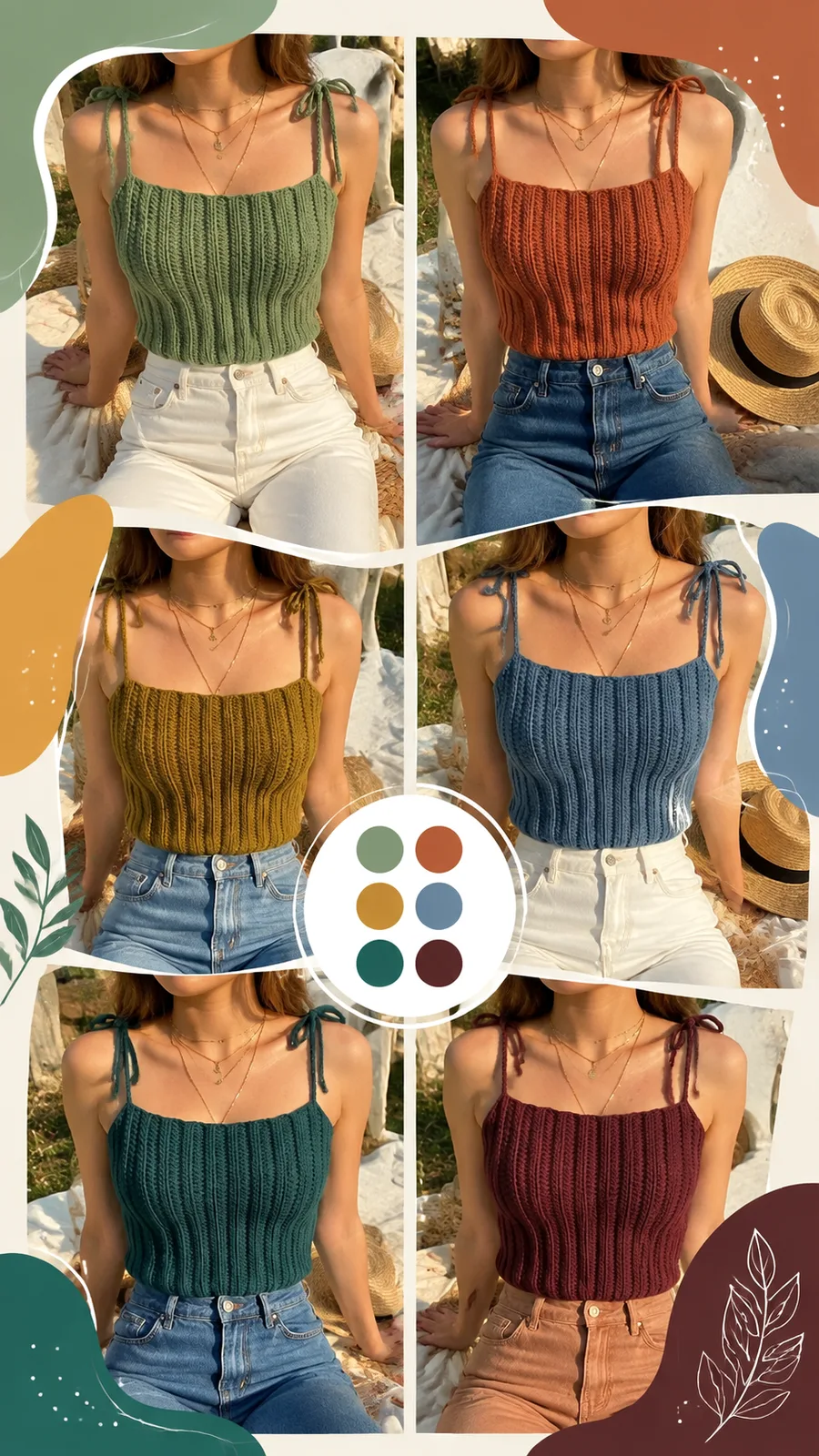
Crochet tank top with front loop ribbed texture
Two-panel cotton tank in front loop half double crochet (UK half treble); both US and UK stitch names given.
- Skill
- Confident beginner
- Time
- 4-6 hours
- Yarn weight
- DK
- Hook
- 4 mm

Confident beginner
What the original write-up called it. Nothing here is graded again.
DK
What the sample was worked in. Any weight works; the size moves with it.
4-6 hours
What the original page reckoned. Your own pace is the one that matters.
About this pattern
This is a cropped, close-fitting crochet tank top made from two flat rectangular panels worked bottom to top in front loop half double crochet (UK half treble crochet), which produces a vertical ribbed texture. DK weight cotton and a 4 mm hook are used throughout. Panels are seamed at the sides, the top edge is finished, and four crocheted tie straps are added for an adjustable shoulder fit. The project suits a confident beginner comfortable with turning rows and simple seaming.
This tank top belongs to the half double crochet (UK half treble crochet) family, worked through the front loop only to leave a raised, rib-like line on the surface of each stitch. Because the fabric is built row by row in a single direction, the loops stack into clean vertical columns rather than the usual horizontal grid, giving the finished piece the look of knitted ribbing without any of the stretch problems that plain crochet fabric can have.
The garment is made from two identical rectangular panels, each worked from the bottom edge upward in one long piece until it reaches its full height. Once both panels are finished, they are joined at the sides, the top edge is finished, and four separately crocheted tie straps are attached at the front and back corners, giving the wearer control over fit and strap length at the shoulder.
Materials
- 650 yards (594 meters) DK weight cotton yarn
- 4 mm crochet hook (US G/6)
- Yarn needle for sewing
- Stitch markers
- Measuring tape
- Scissors
The list is the pattern's own wording.
Instructions
Every round is printed as the pattern wrote it, brackets and all. Open the key beside a round to see only the short forms that round uses.
Front Panel
Make 1 panel.
Ch 81.
- Round 1
Hdc in the second ch from hook and across. Turn. (80 sts)
Key2
- hdc
- half double crochet
- ch
- chain
- Round 2
Ch 1, work FLO hdc across. Turn. (80 sts)Rows 3-40: Repeat Row 2. Each row has 80 sts. The completed panel should measure approximately 18 inches (46 cm) wide and 13 inches (33 cm) tall.
Key3
- hdc
- half double crochet
- FLO
- front loop only
- ch
- chain
Back Panel
Make 1 panel using the same instructions as the front panel.
Ch 81.
- Round 1
Hdc in second ch from hook and across. Turn. (80 sts)
Key2
- hdc
- half double crochet
- ch
- chain
- Round 2
40 Ch 1, FLO hdc across. Turn. (80 sts)
Key3
- hdc
- half double crochet
- FLO
- front loop only
- ch
- chain
Shoulder Straps
Make 4 straps.
Ch 45.
- Round 1
Sc in second ch from hook and across. Turn. (44 sts)
Key2
- ch
- chain
- sc
- single crochet
- Round 2
Ch 1, sc across. Fasten off. Attach two straps to the front corners and two straps directly behind them on the back corners. Tie securely to create adjustable shoulder openings.
Key2
- ch
- chain
- sc
- single crochet
Project Details
Skill Level Confident beginner Finished Size Approx. Small: 18 inches (46 cm) bust width, 13 inches (33 cm) length Sizes
Small base size with adjustment notes included Yarn Suggested DK weight cotton yarn, approximately 650 yards (594 meters)
Hook 4 mm crochet hook (US G/6)
Gauge 18 stitches and 12 rows in 4 inches (10 cm) using front loop only half double crochet Terminology US crochet terms
Special Stitch
FLO hdc: Work a half double crochet stitch only into the front loop of the stitch from the previous row. This creates the raised rib texture used throughout the top.
Neckline and Top Edge Finish
Join yarn at the top edge.
- Round 1
Work one round of sc evenly around the neckline and arm openings.
Key1
- sc
- single crochet
- Round 2
Join with a sl st and fasten off.Weave in all remaining ends.
Key2
- sl st
- slip stitch
- st
- stitch
Blocking
Gently wet block each panel before assembly or block the completed garment. Shape the fabric carefully to the desired measurements and allow it to dry completely.
Making up
- Step 1For the best results, choose gentle washing methods because cotton crochet garments benefit from careful handling. Hand washing and air drying can help maintain the shape and texture of the ribbed stitches.
- Step 2Store folded to prevent stretching.
- Step 3Avoid hanging the garment for long periods.
- Step 4Refresh the shape with light blocking when needed.
Notes from the pattern
- The 4 mm hook (US G/6) paired with DK cotton is what keeps the front loop rib defined; a smaller hook on this yarn will tighten the fabric and reduce the ribbed effect.
- Each panel runs to 40 rows and should measure about 18 inches (46 cm) wide and 13 inches (33 cm) tall; a stitch marker on the first row helps track progress across that many repeats.
- Hold tension evenly on the front loop rows in particular, since working loosely there flattens the ridge and working tightly narrows the panel below the stated 80-stitch count.
The essentials
- Rounds
- 8
- Parts
- 7
- Level
- Confident beginner
- Time
- 4-6 hours
- Hook
- 4 mm
- Yarn
- DK
Stitches you will use
- Front loop only half double crochet Used for every row of both panels; working into the back loop by mistake flattens the rib, so check the loop before each stitch.
- Vertical row orientation Each panel is turned so rows run up the body rather than across it, which is what produces the ribbed columns; keep turning chains consistent so the rows stack evenly.
- Seaming panels and attaching tie straps The front and back panels are joined at the side edges and the four straps are sewn to the corners afterward; placement at matching front and back corners keeps the straps symmetrical.
Troubleshooting
The panel curls or cups instead of lying flat
This usually comes from tension that tightens gradually through the front loop rows; relax the hook tension slightly and check that all 80 stitches are present at the end of each row.
The vertical ribs look flat rather than raised
This happens when stitches are worked under both loops instead of the front loop only; recheck the first few rows and pick back to the row where the rib disappears.
The straps feel too tight or too loose once tied
The straps are deliberately made as separate tie pieces rather than fixed lengths, so retie them at the front corners to adjust shoulder depth before trimming any excess.
Substituting yarn
- Cotton-bamboo blend, DK weight
- Keeps the same hook size and stitch count but softens the drape slightly, giving a less structured rib than pure cotton.
- Linen-cotton blend, DK weight
- Produces a crisper fabric with more visible stitch definition on the front loop rows, though it softens with washing and wear.
- Mercerised cotton, light worsted weight
- A touch heavier than DK; moving up to a 4.5 mm hook keeps the stated stitch counts but adds a small amount of width and length to each panel.
Washing and care
- Hand wash the finished tank in cool water and lay it flat to air dry, since cotton holds shape best without machine washing or tumble heat, which can distort the front loop ribbing.
- Store the garment folded rather than hung, as hanging stretches the vertical rib over time; a light blocking refreshes the rib lines if the piece loses shape between wears.
FAQs
Questions
Why is front loop only used instead of regular half double crochet?
Working through the front loop only leaves the back loop standing up as a visible ridge, which is what creates the vertical rib. Regular half double crochet worked through both loops produces flat fabric without this texture.
Why are the rows worked vertically instead of across the body?
Turning the panel so rows run from hem to shoulder lines up the ribbed loops in vertical columns rather than horizontal bands. This is the detail that gives the finished tank its ribbed-knit appearance.
Can the straps be made longer or shorter than the pattern states?
The straps are worked to a fixed length of 44 stitches per row, but since they are tied rather than sewn into a fixed loop, the tied length can be adjusted at the corners after fastening off.
Is 650 yards of DK cotton enough for every size?
That amount covers the two 18 by 13 inch panels and four straps as written; it does not account for resizing the chain length or row count for a larger or smaller body.
Is this pattern suitable for a first-time garment maker?
It is listed as confident beginner level because the stitches themselves are simple, but the long repeated rows and front loop only placement reward some prior crochet experience. A maker comfortable with turning chains and basic seaming should manage it without difficulty.
These answers came from whoever first published the pattern, kept word for word.