 EVERY CROCHET
 Amigurumi 12 rounds No account, no download
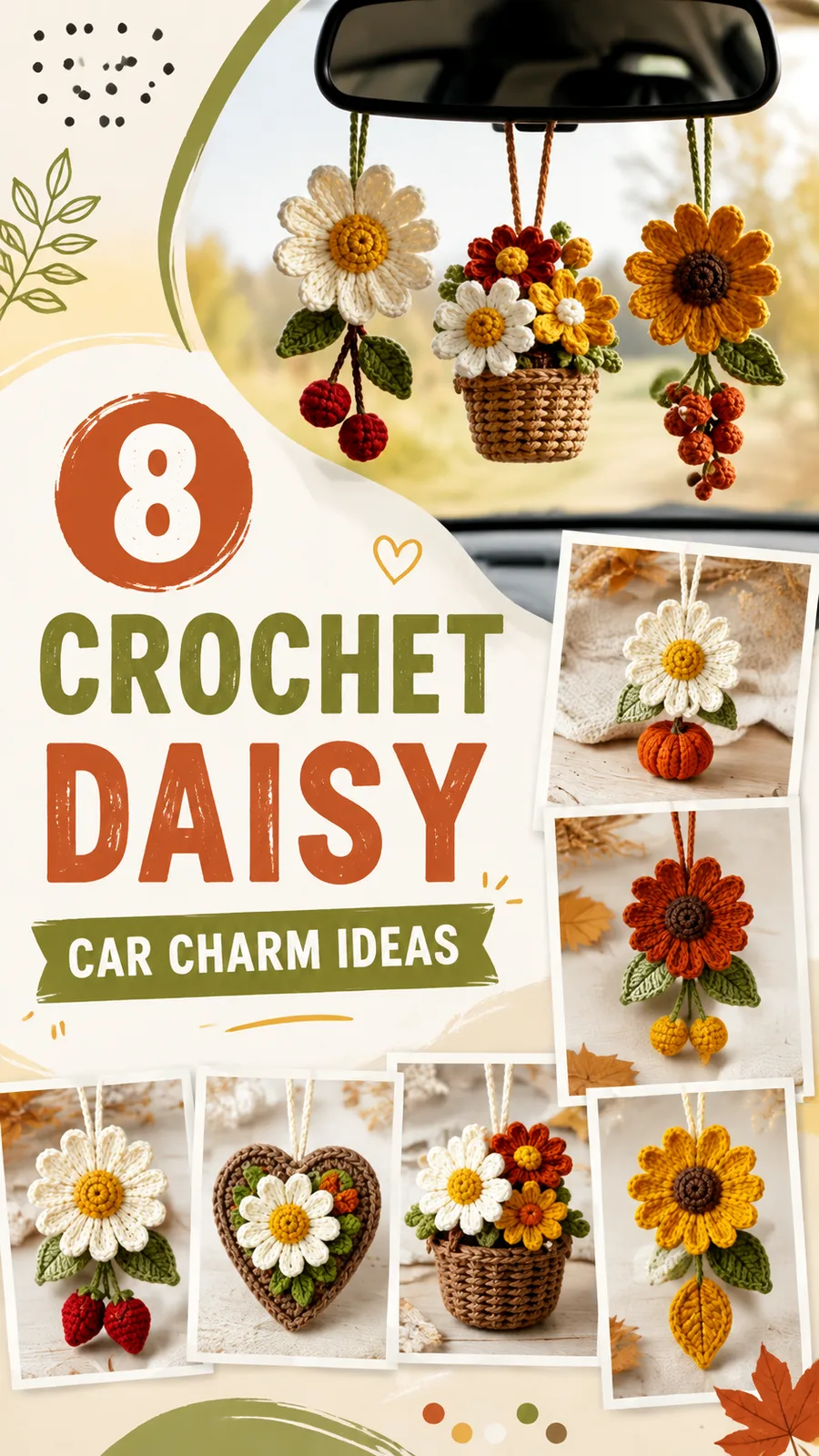
Crochet flower basket mirror charm for autumn
A single crochet (UK double crochet) mirror charm with daisy petals, a leaf, berries, and a basket; both US and UK terms given.
- Skill
- Intermediate
- Time
- 4-6 hours
- Yarn weight
- Worsted
- Hook
- 3.0 mm

Intermediate
What the original write-up called it. Nothing here is graded again.

Worsted
What the sample was worked in. Any weight works; the size moves with it.

4-6 hours
What the original page reckoned. Your own pace is the one that matters.
About this pattern
This pattern makes a small hanging charm for a car mirror, combining a crocheted basket, a daisy-style flower with petals in a contrasting colour, a pointed leaf shaped with increases and decreases, and a lightly stuffed berry, all joined with a chained hanging loop. Worked in worsted-weight cotton with a 3.0 mm hook (US C/2), it suits a maker who already knows single crochet, UK double crochet, half double crochet, double crochet, increasing, decreasing and sewing pieces together.
This miniature mirror charm is worked largely in single crochet (UK: double crochet), the short, firm stitch that gives the little basket its structure and the berries their rounded, stuffed shape. The daisy-style flowers introduce half double crochet and double crochet petals worked around a small centre circle, while the leaf uses the same petal shaping logic with added increases and decreases for a pointed, natural curve. Together the pieces sit within the wider amigurumi and flower-motif tradition of small crocheted ornaments.
Materials
- Worsted-weight cotton yarn in cream, mustard, orange, rust, brown, green, and red (approximately 60 yards / 55 meters total).
- 3.0 mm crochet hook (US C/2).
- Fiber filling for berries if desired.
- Yarn needle.
- Scissors.
- Stitch marker for continuous rounds.
- Small amount of cord or yarn for hanging loop.
The list is the pattern's own wording.
Instructions
Every round is printed as the pattern wrote it, brackets and all. Open the key beside a round to see only the short forms that round uses.
Basket
The basket is worked in joined rounds. The turning chain does not count as a stitch.
- Round 1
With brown yarn, make a magic ring. Ch 1, work 6 sc into ring. Join with sl st. (6 sts)
Key5
- sl st
- slip stitch
- sts
- stitches
- ch
- chain
- sc
- single crochet
- st
- stitch
- Round 2
Ch 1, 2 sc in each stitch around. Join. (12 sts)
Key3
- sts
- stitches
- ch
- chain
- sc
- single crochet
- Round 3
Ch 1, sc in next stitch, 2 sc in next stitch. Repeat around. Join. (18 sts)
Key3
- sts
- stitches
- ch
- chain
- sc
- single crochet
- Round 4
Ch 1, sc in each stitch around using back loops only. Join. (18 sts)
Key3
- sts
- stitches
- ch
- chain
- sc
- single crochet
- Rounds 5–7
Ch 1, sc in each stitch around. Join after each round. (18 sts)Fasten off and weave in ends.
Key3
- sts
- stitches
- ch
- chain
- sc
- single crochet
Flower
Make three to five flowers in different colors.
- Round 1
With flower center color, make a magic ring. Ch 1, 8 sc into ring. Join. (8 sts)
Key3
- sts
- stitches
- ch
- chain
- sc
- single crochet
- (8)Round 2
Change to petal color. Ch 2, hdc in same stitch, dc in next stitch, hdc in same stitch, sl st in next stitch. Repeat this petal sequence around. Join. (8 petals)Fasten off and weave in ends.
Key5
- sl st
- slip stitch
- hdc
- half double crochet
- ch
- chain
- dc
- double crochet
- st
- stitch
Leaf
The leaf is crocheted as a small pointed shape worked outward from a starting chain, with increases and decreases built into the stitch sequence to give it a natural, pointed curve on both sides.
- Leaf
Ch 8. Starting in second chain from hook, sc, hdc, dc, dc, hdc, sc. Work 3 sc into the end chain. Continue along the opposite side of the chain with sc, hdc, dc, dc, hdc, sc. Sl st to join. Fasten off.
Key6
- sl st
- slip stitch
- hdc
- half double crochet
- ch
- chain
- sc
- single crochet
- dc
- double crochet
- st
- stitch
Berry
- Round 1
With red yarn, make magic ring. Work 6 sc into ring. (6 sts)
Key2
- sts
- stitches
- sc
- single crochet
- Round 2
2 sc in each stitch around. (12 sts)
Key2
- sts
- stitches
- sc
- single crochet
- Rounds 3–4
Sc around. (12 sts)
Key2
- sts
- stitches
- sc
- single crochet
- Round 5
Sc2tog around. (6 sts)Add a small amount of stuffing. Fasten off and close opening.
Key1
- sts
- stitches
Making up
- Step 1Sew flowers together in a small cluster.
- Step 2Attach leaves behind flowers using matching yarn.
- Step 3Arrange flowers inside the top edge of the crochet basket.
- Step 4Sew berries onto hanging strands below the basket or beside flowers.
- Step 5Create a hanging loop by chaining 35 stitches with brown yarn and attaching both ends securely.(35)
- Step 6Attach the loop firmly to the back of the arrangement.
- Step 7Secure all yarn tails by weaving them through several stitches on the back of each piece. Lightly steam block petals and leaves if needed, keeping the yarn fibers protected from direct heat.
Notes from the pattern
- A 3.0 mm hook (US C/2) is specified for worsted-weight cotton; moving up or down a size will change the firmness of the basket and the neatness of the petal edges.
- A stitch marker is essential for tracking the start of each continuous round, since none of the rounds are joined with a turning chain before the next begins.
- Keep stitches slightly tighter than usual on the basket and berry rounds so the fibre filling does not show through gaps once stuffed.
- The flower changes from centre colour to petal colour partway through; carry or cut the first colour neatly so the join sits at the back of the piece once assembled.
- The finished charm measures approximately 7 inches (18 cm) including the hanging loop, using approximately 60 yards (55 meters) of worsted-weight cotton yarn in total.
- Gauge is approximately 20 single crochet stitches per 4 inches (10 cm). A recommended hook range of about 2.75 mm to 3.5 mm can be used depending on yarn thickness and desired firmness, though the written pattern uses a 3.0 mm (US C/2) hook.
- Suggested colours are cream, mustard, orange, rust, brown, green, and red for an autumn palette; pastel shades can be used for a spring version, and a single bold colour works well for a minimalist look.
The essentials
- Rounds
- 12
- Parts
- 4
- Level
- Intermediate
- Time
- 4-6 hours
- Hook
- 3.0 mm
- Yarn
- Worsted
Stitches you will use
- Magic ring starts Used to begin the basket, the flower centre and the berry; pull the tail firmly closed so no gap shows at the centre of each piece.
- Back loop only (BLO) stitching Appears on the basket's fourth round to mark where the base meets the sides; work carefully into the back loop only so the ridge sits where expected.
- Shaping a pointed leaf from a starting chain The leaf is worked along both sides of a chain-8 base, stepping stitch heights from sc up to dc and back down to sc with extra stitches at the tip, to form a natural pointed curve.
Troubleshooting
The basket sides flare outward instead of sitting upright.
This usually means a stitch was added by mistake on one of the straight rounds; recount stitches after each round and work the back-loop-only round firmly to set the shape.
The flower petals look uneven or floppy
Loose tension on the hdc/dc combination lets petals splay; pull each stitch snug and check that the same petal sequence is repeated the same number of times around, beginning each petal in the same stitch spacing.
The berry loses its round shape after stuffing.
This points to stitches worked too loosely on the straight rounds; add a little more filling and close the decrease round tightly so the fibre filling stays contained.
Substituting yarn
- DK-weight cotton
- Produces a smaller, more delicate charm overall; pair with a smaller hook, around 2.5 mm, to keep stitches firm enough to hold the flower and basket shapes.
- Worsted-weight acrylic
- Keeps the same finished size and hook as the cotton version but gives softer stitch definition and a slightly shinier finish, useful if cotton is not available.
- Sport-weight cotton-acrylic blend
- Gives a lighter, more flexible drape suited to a smaller charm; needs a smaller hook than 3.0 mm and slightly less fibre filling in the berries.
Washing and care
- Hand wash the finished charm gently in cool water, since the piece is worked in cotton, then reshape the petals, leaves and basket while still damp.
- Lay the charm flat to dry completely before hanging it again, and store it without heavy items resting on top so the three-dimensional flower shapes are not flattened.
FAQs
Questions
Does the hook size matter for this pattern?
Yes, the 3.0 mm hook (US C/2) is matched to worsted-weight cotton to keep stitches firm enough for the basket and berries to hold their shape. A different hook size will change the overall scale of the finished charm.
Can the berries be left unstuffed?
They can, though the pattern recommends a small amount of fibre filling so the berries keep a rounded, three-dimensional look. Leaving them unstuffed will give a flatter, softer berry shape instead.
What is the difference between US and UK stitch names in this pattern?
The pattern is written in US terms, where single crochet is the short, dense stitch used for the basket and berries; in UK terms this same stitch is called double crochet. No other stitch conversion is needed for this piece.
Is a stitch marker really necessary?
Yes, since every round in this pattern is worked continuously rather than joined before starting the next one. Without a marker it becomes easy to lose track of where a round begins and ends.
Is this pattern suitable for a beginner?
It suits a confident beginner or improver who already knows single crochet, half double crochet, double crochet, increasing, decreasing and basic sewing together. The combination of several small pieces makes it more time-consuming than technically difficult.
These answers came from whoever first published the pattern, kept word for word.