 EVERY CROCHET
Garments 6 rounds No account, no download
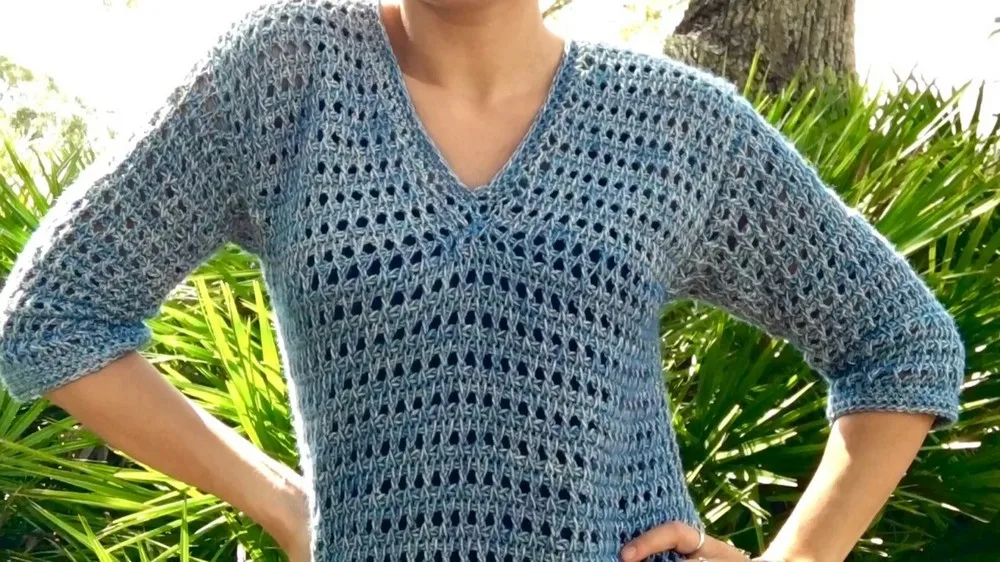
Tunisian simple stitch breezy top for beginners
Beginner Tunisian crochet top in simple stitch (UK: Tunisian knit stitch); both US and UK stitch names given.
- Skill
- Beginner
- Time
- 4-6 hours
- Yarn weight
- DK
- Hook
- 4 mm

Beginner
What the original write-up called it. Nothing here is graded again.

DK
What the sample was worked in. Any weight works; the size moves with it.

4-6 hours
What the original page reckoned. Your own pace is the one that matters.
About this pattern
This is a beginner Tunisian crochet top made from three flat panels — a back, a front, and sleeves — each worked in Tunisian simple stitch and Tunisian reverse stitch from a chain multiple of four plus one. It needs DK weight yarn, a 3-4mm hook, and basic seaming; no shaping beyond simple increases is used, with length judged by eye against the body.
This breezy top belongs to the Tunisian crochet family, worked with a hook that holds several loops at once before a return pass, producing a dense, knit-like fabric even in a lightweight DK yarn. The main stitches used throughout are Tunisian simple stitch and Tunisian reverse stitch, with standard double crochet (UK: treble crochet) kept for shaping and finishing details. The result sits between crochet and knitting in both look and drape, making it a practical introduction to Tunisian technique for anyone who already knows basic crochet terms.
Construction is panel-based: a back panel, a front panel, and a pair of sleeves are each worked flat from a starting chain and built up in two repeating rows until they reach the desired length. The pieces are then joined — sleeves to the back panel at the underarms, front to back at the shoulders, and the sides seamed together — rather than shaped through increases and decreases within one continuous piece. This keeps the project modular, so each panel can be checked for length against the body before assembly begins.
Materials
- DK weight yarn, 2-3 skeins
- 3-4 mm hook
- Measuring tape
- Scissors
- Marker
The list is the pattern's own wording.
Instructions
Every round is printed as the pattern wrote it, brackets and all. Open the key beside a round to see only the short forms that round uses.
Back Panel
Ch a multiple of 4 + 1.
- Row 1
TSS in the 2nd ch from the hook, * TSS in the next st, inc *, repeat from * to * to the end of the row.
Key4
- Inc
- Increase
- TSS
- Tunisian simple stitch
- Ch
- Chain
- St
- Stitch
- Row 2
TRS all sts.Repeat rows 1 and 2 until the back panel is the desired length.
Key1
- TRS
- Tunisian reverse stitch
Front Panel
Ch a multiple of 4 + 1.
- Row 1
TSS in the 2nd ch from the hook, * TSS in the next st, inc *, repeat from * to * to the end of the row.
Key4
- Inc
- Increase
- TSS
- Tunisian simple stitch
- Ch
- Chain
- St
- Stitch
- Row 2
TRS all sts.
Key1
- TRS
- Tunisian reverse stitch
From rows 1 and 2 until the front panel is the desired length.
Sleeves
Ch a multiple of 4 + 1.
- Row 1
TSS in the 2nd ch from the hook, * TSS in the next st, inc *, repeat from * to * to the end of the row.
Key4
- Inc
- Increase
- TSS
- Tunisian simple stitch
- Ch
- Chain
- St
- Stitch
- Row 2
TRS all sts.Repeat rows 1 and 2 until the sleeves are the desired length.
Key1
- TRS
- Tunisian reverse stitch
Making up
- Step 1Join the sleeves to the back panel at the underarms.
- Step 2Join the front panel to the back panel at the shoulders.
- Step 3Join the sides of the top together.
- Step 4Weave in any loose ends.
- Step 5Attach a label to the inside seam of the back panel.
- Step 6Steam the top to set the stitches and shape the fabric.
Notes from the pattern
- Choose a hook within the 3-4mm range based on a swatch rather than defaulting to one end; a smaller hook tightens the Tunisian fabric and reduces curling along the edges.
- Place a marker at the start of each row to track the forward and return passes, since Tunisian crochet does not turn the work at the end of every row the way standard crochet does.
- Tunisian fabric curls along its vertical edges until pressed flat; keep forward-pass loops relaxed rather than tight, and expect the curl to settle once the piece is steamed.
- The finishing steps call for steaming rather than wet blocking, so press the panels gently to set the shape rather than stretching them, and attach the back-panel label before the final seam is closed.
The essentials
- Rounds
- 6
- Parts
- 3
- Level
- Beginner
- Time
- 4-6 hours
- Hook
- 4 mm
- Yarn
- DK
Stitches you will use
- Tunisian simple stitch (TSS) Used for row 1 of every panel; watch for picking up the correct chain loop and keeping the forward-pass loops even so the row doesn't flare.
- Tunisian reverse stitch (TRS) Used for row 2 of every panel; watch for consistent loop height on the return pass so the fabric doesn't pull to one side.
- Seaming panels together Used across all six assembly steps joining sleeves, front, back, and sides; watch that panel edges match in length before stitching the underarm and shoulder seams.
Troubleshooting
The edges of a panel curl inward instead of lying flat.
Tunisian simple stitch rolls naturally because the forward pass isn't turned; steaming the finished panel, as the pattern directs, relaxes the curl before seaming.
The stitch count creeps higher than
This usually comes from extra increases worked outside the repeat; check that the *TSS, inc* sequence is worked consistently across the whole row, not just near the edges.
The back, front, and sleeve panels come
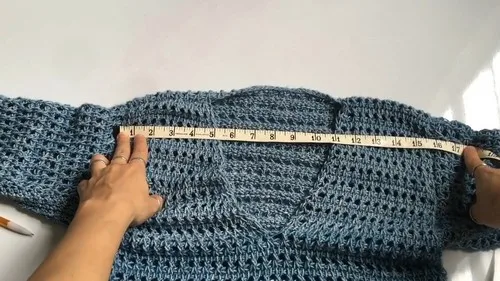
Tunisian rows stretch unevenly, so counting rows alone is unreliable; measure each panel against the target length with a tape rather than relying on a row count.
Substituting yarn
- Cotton, DK weight
- Gives sharper stitch definition and less drape, so the finished top may sit slightly looser; a 3mm hook, at the firmer end of the stated range, helps control this.
- Wool-blend, DK weight
- Adds elasticity and warmth, and the Tunisian fabric relaxes more noticeably after steaming; the stated 3-4mm hook still applies.
- Acrylic, DK weight
- The most economical option and holds its shape well but drapes stiffer; using the 4mm end of the hook range softens the fabric slightly.
Washing and care
- Hand wash in cool water and lay flat to dry, since the dense Tunisian fabric holds water longer than an ordinary double crochet fabric would.
- Reshape while still damp by gently steaming or pressing the panels to the intended measurements, then store the top folded flat rather than hung, to avoid stretching the shoulder seams.
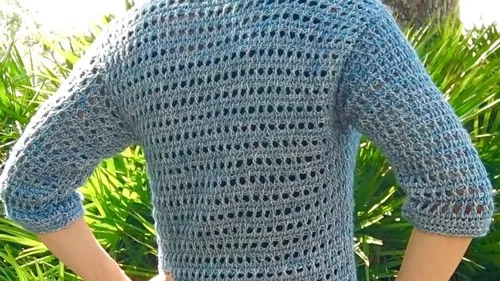
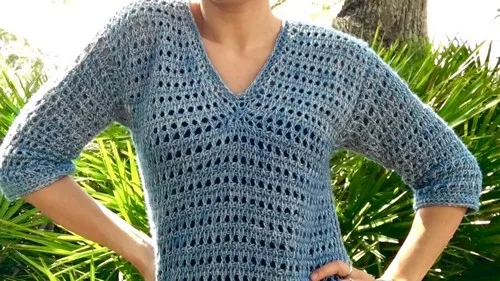
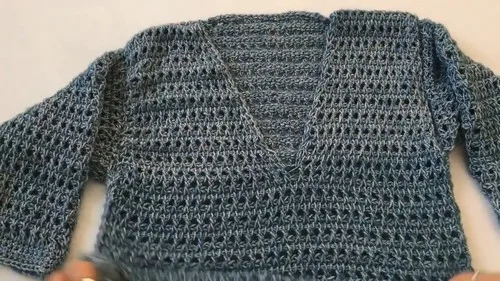
The photographs taken while this was being made
Every one was taken by whoever published the pattern, in the order the source listed them.
FAQs
Questions
What is the difference between Tunisian simple stitch and Tunisian reverse stitch?
Tunisian simple stitch (TSS) is worked on the forward pass and produces a smooth, knit-like front; Tunisian reverse stitch (TRS) is worked into the vertical bars and gives a slightly more textured, purl-like surface. In this pattern, TSS forms row 1 of each panel and TRS forms row 2, and the two rows are repeated together.
Does hdc or dc in the abbreviations list mean something different in the UK?
Yes — the US terms half double crochet (hdc) and double crochet (dc) correspond to UK half treble (htr) and treble (tr). The stitch itself is identical; only the name changes, so UK crocheters should read dc as treble wherever it appears.
How much yarn does the top actually need?
The materials list calls for 2-3 skeins of DK weight yarn, with the exact amount depending on the finished length of the back panel, front panel, and sleeves. Larger sizes or a longer hem will sit toward the higher end of that range.
What hook size should be used for this pattern?
A hook between 3mm and 4mm is specified; the choice within that range depends on how the chosen DK yarn behaves on a swatch. A smaller hook produces a firmer, less curl-prone fabric, while a larger hook gives more drape.
Can the top be made larger or smaller than the sample?
Since each panel starts from a chain in a multiple of four plus one, the width can be adjusted by changing that multiple before working row 1. Length is then worked to the desired measurement rather than to a fixed row count, which the pattern already builds in by instruction.
These answers came from whoever first published the pattern, kept word for word.