 EVERY CROCHET
Garments 14 rounds No account, no download
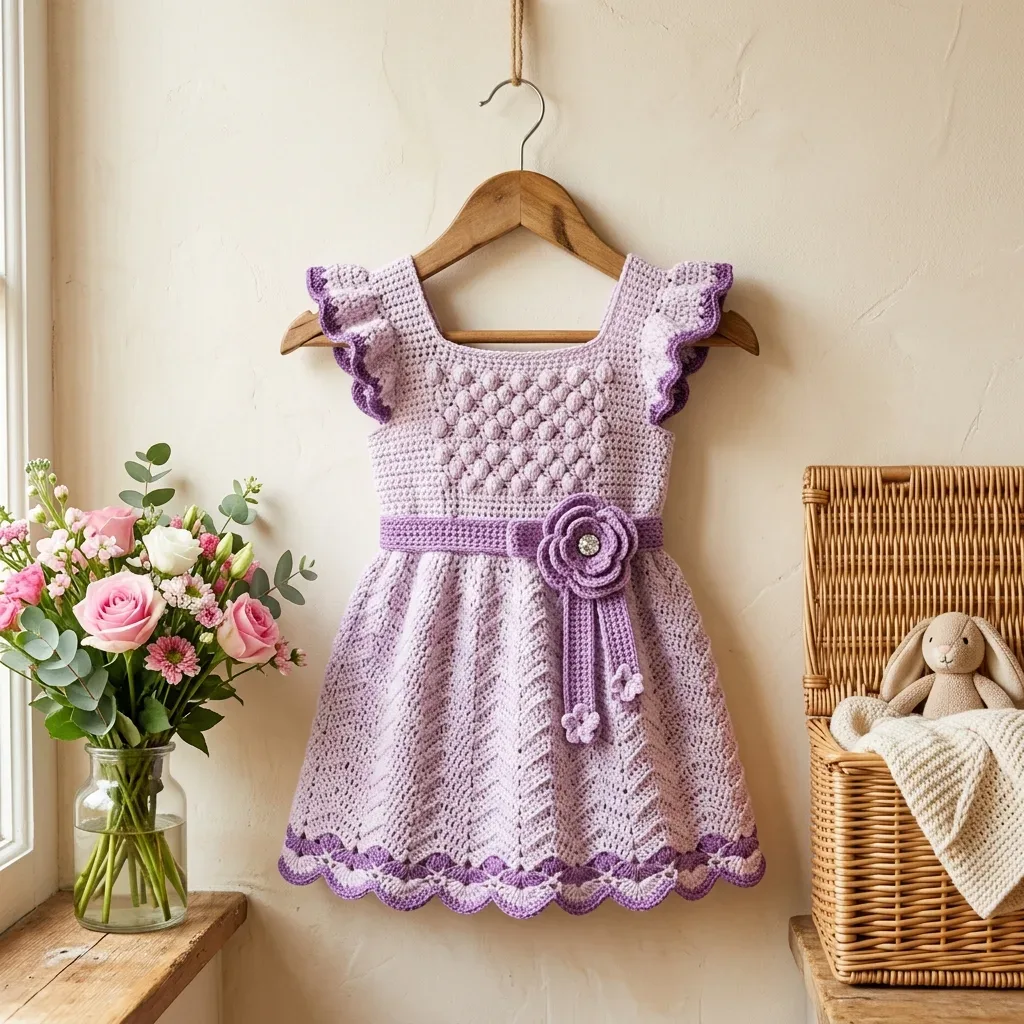
Lavender and lilac bobble bodice baby dress
Bobble-stitch baby dress pattern worked in single crochet (UK double crochet); US and UK stitch names given.
- Skill
- Intermediate
- Time
- 6-9 hours
- Yarn weight
- DK (Light Worsted)
- Hook
- 3.5 mm
Intermediate
What the original write-up called it. Nothing here is graded again.
DK (Light Worsted)
What the sample was worked in. Any weight works; the size moves with it.
6-9 hours
What the original page reckoned. Your own pace is the one that matters.
About this pattern
This is an intermediate baby dress pattern combining a bobble-stitch bodice, a chevron lace skirt, and crocheted flower embellishments, worked in DK weight yarn across three hook sizes. The bodice front alone runs 15 rows and measures about 3.5 inches once the lower bobble section is complete. Construction is entirely flat panels seamed together, with ruffles picked up directly at the armholes rather than set in separately.
This lavender and lilac baby dress combines a textured bobble bodice with a lace skirt, built from a single crochet (UK: double crochet) base fabric. The bobbles are raised clusters of five incomplete stitches drawn through together and locked with a closing chain, arranged in a staggered diamond grid across the bodice front and back. This bobble-grid technique belongs to the same textured-stitch family as popcorn and puff stitches, giving the bodice body and dimension without added bulk or extra yarn.
The dress is built in separate flat pieces rather than in the round. Bodice front and back panels are worked flat and seamed at the sides; the skirt is worked as two flat panels seamed to match; the waistband is a separate strip sewn on at the empire waist join; and the flutter sleeve ruffles are crocheted directly around each armhole rather than made and attached separately.
Materials
- Lion Brand Pound of Love works beautifully here. It is a DK/worsted blend in 100% acrylic with excellent stitch definition for bobbles. Look for Pastel Lavender and Purple colorways.
- Paintbox Yarns Simply DK offers consistent tension, crisp stitch definition, and a budget-friendly price. Try Dusty Lilac for the main color and Wisteria Purple for the contrast.
- Drops Safran adds a slight sheen and lovely drape, with 50% Egyptian cotton and 50% acrylic for breathability. Perfect for a baby dress that needs to be comfortable.
- When substituting yarn, choose any DK weight (weight 3) with good stitch definition. Avoid fuzzy or halo yarns as they will obscure the bobble and lace textures.
Yarn
- Main Color (MC): Soft lavender, approximately 350 yards of DK weight yarn (weight 3)
- Contrast Color (CC): Deep purple, approximately 100 yards of DK weight yarn (weight 3)
Hooks
- US size E-4 (3.5 mm) for the bobble bodice and waistband
- US size F-5 (3.75 mm) for the chevron lace skirt and edgings
- US size D-3 (3.25 mm) for the flower embellishments and ties
Notions
- Tapestry needle for seaming and weaving ends
- Stitch markers (at least 6)
- Sewing needle and thread
- Scissors
- Rust-proof pins for blocking
The list is the pattern's own wording.
Instructions
Every round is printed as the pattern wrote it, brackets and all. Open the key beside a round to see only the short forms that round uses.
Bodice Front
After Row 22, the bodice front measures approximately 3.5 inches from foundation. You have completed the lower bobble section.
Bobble (bo): Yarn over, insert hook into the indicated stitch, yarn over and pull up a loop, yarn over and pull through 2 loops (one incomplete double crochet). Repeat this step 4 more times in the same stitch, giving 5 incomplete double crochets with 6 loops on the hook. Yarn over and pull through all 6 loops. Chain 1 to close and lock the bobble. Count the bobble plus its closing chain as one stitch unit.
Diamond Bobble Grid: Bobbles are placed in a staggered checkerboard arrangement. Odd rows place bobbles in odd-numbered stitch positions. Even rows place bobbles in even-numbered stitch positions. Each bobble is separated by 1 single crochet on either side.
Foundation chain: With MC and E-4 hook, chain 54.
- Round 1
(RS): Sc in 2nd ch from hook and in each ch across. Turn. (53 sc)
Key3
- ch
- chain: wrap yarn over hook and pull through loop on hook
- sc
- single crochet: insert hook, yarn over, pull up loop, yarn over, pull through both loops
- RS
- right side (the side that faces outward when worn)
- Round 2
(WS): Ch 1, sc in each st across. Turn. (53 sc)
Key3
- ch
- chain: wrap yarn over hook and pull through loop on hook
- sc
- single crochet: insert hook, yarn over, pull up loop, yarn over, pull through both loops
- WS
- wrong side
- Round 3
RS, begin bobble grid Ch 1, sc in first 2 sts. Bo in next st, sc in next st; rep from * across to last 3 sts, sc in last 3 sts. Turn. (53 sts)
Key5
- rep
- repeat
- ch
- chain: wrap yarn over hook and pull through loop on hook
- sc
- single crochet: insert hook, yarn over, pull up loop, yarn over, pull through both loops
- RS
- right side (the side that faces outward when worn)
- bo
- bobble (see Special Stitches)
- Round 4
(WS): Ch 1, sc in each st across. Turn. (53 sc)
Key3
- ch
- chain: wrap yarn over hook and pull through loop on hook
- sc
- single crochet: insert hook, yarn over, pull up loop, yarn over, pull through both loops
- WS
- wrong side
- Round 5
RS, offset bobble row Ch 1, sc in first 3 sts. Bo in next st, sc in next st; rep from * across to last 2 sts, sc in last 2 sts. Turn. (53 sts)
Key5
- rep
- repeat
- ch
- chain: wrap yarn over hook and pull through loop on hook
- sc
- single crochet: insert hook, yarn over, pull up loop, yarn over, pull through both loops
- RS
- right side (the side that faces outward when worn)
- bo
- bobble (see Special Stitches)
- Round 6
Ch 1, sc in each st across. Turn. (53 sc)
Key2
- ch
- chain: wrap yarn over hook and pull through loop on hook
- sc
- single crochet: insert hook, yarn over, pull up loop, yarn over, pull through both loops
- (53)Round 7
through 22: Repeat Rows 3 through 6 four more times, then repeat Rows 3 and 4 once more. (53 sts throughout)
- Round 23
RS, Armhole Shaping Ch 1, sl st across first 4 sts (armhole edge), ch 1, sc across next 45 sts, leave last 4 sts unworked (armhole edge). Turn. (45 sc)
Key4
- sl st
- slip stitch: insert hook, yarn over, pull through stitch and loop on hook
- ch
- chain: wrap yarn over hook and pull through loop on hook
- sc
- single crochet: insert hook, yarn over, pull up loop, yarn over, pull through both loops
- RS
- right side (the side that faces outward when worn)
- Round 24
Ch 1, sc2tog over first 2 sts, sc across to last 2 sts, sc2tog. Turn. (43 sc)
Key3
- sc2tog
- single crochet two together (a decrease): insert hook in next st, pull up loop, insert hook in following st, pull up loop, yarn over, pull through all 3 loops
- ch
- chain: wrap yarn over hook and pull through loop on hook
- sc
- single crochet: insert hook, yarn over, pull up loop, yarn over, pull through both loops
- Round 25
Bobble row Ch 1, sc2tog, sc in next 1 st. Bo in next st, sc in next st; rep from * to last 4 sts, sc in next 1 st, sc2tog. Turn. (41 sts)
Key5
- sc2tog
- single crochet two together (a decrease): insert hook in next st, pull up loop, insert hook in following st, pull up loop, yarn over, pull through all 3 loops
- rep
- repeat
- ch
- chain: wrap yarn over hook and pull through loop on hook
- sc
- single crochet: insert hook, yarn over, pull up loop, yarn over, pull through both loops
- bo
- bobble (see Special Stitches)
- Round 26
Ch 1, sc2tog, sc across to last 2 sts, sc2tog. Turn. (39 sc)
Key3
- sc2tog
- single crochet two together (a decrease): insert hook in next st, pull up loop, insert hook in following st, pull up loop, yarn over, pull through all 3 loops
- ch
- chain: wrap yarn over hook and pull through loop on hook
- sc
- single crochet: insert hook, yarn over, pull up loop, yarn over, pull through both loops
- Round 27
Bobble offset Ch 1, sc2tog, sc in next 2 sts. Bo in next st, sc in next st; rep from * to last 3 sts, sc in 1 st, sc2tog. Turn. (37 sts)
Key5
- sc2tog
- single crochet two together (a decrease): insert hook in next st, pull up loop, insert hook in following st, pull up loop, yarn over, pull through all 3 loops
- rep
- repeat
- ch
- chain: wrap yarn over hook and pull through loop on hook
- sc
- single crochet: insert hook, yarn over, pull up loop, yarn over, pull through both loops
- bo
- bobble (see Special Stitches)
- Round 28
Ch 1, sc in each st across. Turn. (37 sc)
Key2
- ch
- chain: wrap yarn over hook and pull through loop on hook
- sc
- single crochet: insert hook, yarn over, pull up loop, yarn over, pull through both loops
- Round 29
through 32: Repeat Rows 27 a
Making up
- Step 1Weave in all yarn ends securely, running ends through at least 1 inch of stitches in two directions.
- Step 2Wet blocking gives the best results. Soak the completed dress in cool water with gentle wool wash for 15 minutes. Press out excess water in a clean towel. Lay flat on a blocking mat. Pin the chevron hem points to emphasize the scallops. Pin ruffle sleeves flat and open. Allow to dry completely.
- Step 3For acrylic yarn , steam blocking works as an alternative. Hold a steam iron 1 inch above the fabric without pressing directly onto the crochet.
Notes from the pattern
- Three hook sizes are used across the dress: E-4 (3.5mm) for the bobble bodice and waistband, F-5 (3.75mm) for the chevron lace skirt and edgings, and D-3 (3.25mm) for the flower and ties. Keep each hook labelled by section rather than relying on memory.
- least 6 stitch markers are listed, which matter most for tracking the diamond bobble grid, since odd rows place bobbles in odd-numbered stitch positions and even rows shift them to even-numbered positions.
- The bobble clusters pull the fabric in slightly compared with the plain single crochet rows either side of them, so the bodice front measures only about 3.5 inches after the lower bobble section despite the row count; check against this measurement rather than row count alone.
- MC runs to roughly 350 yards and CC to about 100 yards, so CC is the limited colour; reserve it for the contrast sections rather than testing swatches in it, and weave all ends securely since the bodice fabric is a single layer with no lining.
- The bodice front and bodice back are worked flat separately, then seamed at the sides.
- The skirt is worked as two separate flat panels, then seamed at the sides to match the bodice construction.
- Sleeves are not separate pieces. The flutter ruffle is picked up and crocheted directly around each armhole opening.
- The waistband is worked as a separate strip and sewn onto the dress at the empire waist join.
- Do not count the turning chain as a stitch in single crochet rows. In double crochet rows, the turning chain 3 counts as one dc.
- All turning chains: sc rows use ch 1; dc rows use ch 3.
- Join new colors by pulling the new color through the final yarn-over of the last stitch before the join row.
- Right side of work faces you on odd-numbered rows.
- Gauge - Bobble section (E-4 / 3.5 mm hook): 22 single crochet stitches = 4 inches; 24 rows = 4 inches.
- Gauge - Chevron lace section (F-5 / 3.75 mm hook): 18 stitches = 4 inches; 10 rows = 4 inches.
- Always swatch before starting. If your swatch is too large, go down one hook size. If too small, go up one hook size.
- Chevron Lace Repeat (multiple of 12 + 3): sc2tog over 2 stitches, sc in next 2 stitches, (dc, ch 1, dc) in next stitch (V-stitch peak), sc in next 2 stitches, sc2tog over 2 stitches (valley). Each 12-stitch repeat is worked across the row. The stitch count stays constant because each sc2tog removes one stitch and each V-stitch peak adds one stitch.
- Scallop Edging: Worked in CC. Slip stitch into first stitch, (chain 3, 3 dc) in same stitch, skip 2 stitches, sl st in next stitch, skip 2 stitches, (3 dc, chain 3, sl st) in next stitch. Repeat across. Each scallop consumes 6 stitches.
- Crochet Flower - Large flower: With CC and D-3 hook, ch 5, sl st to join ring. (Ch 3, 2 dc, ch 3, sl st) 5 times into ring to create 5 petals. Fasten off, leaving tail for sewing.
- Crochet Flower - Tiny flower (make 2): With CC and D-3 hook, ch 4, sl st to join ring. (Ch 2, dc, ch 2, sl st) 4 times into ring to create 4 petals. Fasten off, leaving tail.
The essentials
- Rounds
- 14
- Level
- Intermediate
- Time
- 6-9 hours
- Hook
- 3.5 mm
- Yarn
- DK (Light Worsted)
Stitches you will use
- Bobble (popcorn-family) stitch Used throughout the bodice front and back in a staggered diamond grid; watch that the closing chain is counted as part of the stitch unit so row counts don't drift.
- Working across three hook sizes E-4 (3.5mm) for the bobble bodice and waistband, F-5 (3.75mm) for the chevron lace skirt and edgings, D-3 (3.25mm) for the flower and ties; watch for swapping the correct hook back in after each section.
- Flat-panel seaming Bodice and skirt pieces are each worked flat and seamed at the sides; watch that paired panels match row for row before seaming so the empire waist join sits level.
Troubleshooting
The bobble grid looks lopsided rather than a staggered diamond.
Odd-row and even-row bobble positions have been mixed up; recount from the edge of the row before placing each bobble, since odd rows use odd stitch positions and even rows use even ones.
The bodice front puckers or cups instead of lying flat.
The bobbles were pulled too tight on the final yarn-over-and-pull-through, or the closing chain was skipped; keep that last pull-through loose and always chain 1 to close and lock each bobble.
The side seams between bodice and skirt panels don't line up evenly.
The two matching panels were worked to slightly different lengths; lay them flat together before seaming, match row for row, and hold with rust-proof pins first.
Substituting yarn
- Cotton, DK (weight 3)
- Gives firmer stitch definition for the bobble grid and chevron lace but less drape in the skirt; the same E-4, F-5 and D-3 hooks still suit the weight.
- Acrylic, DK (weight 3)
- Softer and machine-washable for baby wear, though bobbles sit slightly flatter than with a wool-blend yarn; hook sizes stay unchanged.
- Wool-blend, DK, or a fingering-weight alternative
- Wool-blend gives the most pronounced bobble texture at the stated hook sizes; if substituting true fingering weight, drop down one hook size on each of the three hooks to avoid a loose, overly drapey skirt.
Washing and care
- The yarn's own label specifies fibre content, which matters before washing since DK weight covers everything from wool to cotton and acrylic blends, each with different care needs.
- Reshape the chevron lace skirt and flower embellishment while still damp, holding the points with rust-proof pins, and dry the dress flat rather than on a hanger so the empire waist seam doesn't stretch; store flat or loosely folded.
FAQs
Questions
What is a bobble (bo) in this pattern?
A bobble is five incomplete double crochets worked into the same stitch, drawn through together, then locked with a chain 1. The closing chain counts as part of the same stitch unit, so stitch counts stay consistent across rows.
Why are three different hook sizes needed?
Each hook suits its section: the E-4 (3.5mm) keeps the bobble bodice and waistband dense, the F-5 (3.75mm) opens up the chevron lace skirt and edgings, and the D-3 (3.25mm) keeps the flower and ties firm. One hook throughout would either loosen the bobbles or stiffen the lace.
Can the bodice and skirt be worked in the round instead of flat?
As written, the bodice front and back, and the two skirt panels, are each worked flat and then seamed at the sides to match. This keeps the bobble grid and chevron lace easier to track row by row.
How much contrast colour (CC) is actually needed?
The pattern calls for about 100 yards of CC against roughly 350 yards of MC, so CC is the smaller allowance. Reserve it for the contrast sections rather than test swatches, since there is little margin to spare.
Do the sleeves need to be made separately and sewn on?
No. The flutter ruffle forming each sleeve is picked up and crocheted directly around the armhole opening once the bodice is seamed, rather than worked as a separate piece and attached afterward.
These answers came from whoever first published the pattern, kept word for word.