 EVERY CROCHET
 Hats 12 rounds No account, no download
Baby hat pattern with a ribbed ribbon brim
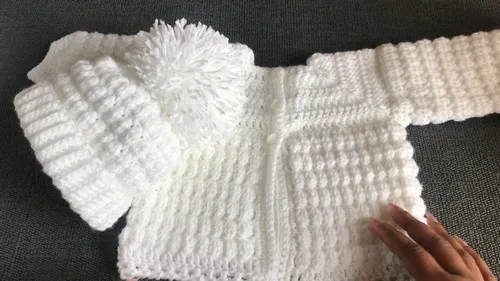
Double crochet (UK treble) baby hat with a ribbed ribbon brim; US and UK stitch terms given throughout.
- Skill
- Intermediate
- Time
- 4-6 hours
- Yarn weight
- DK
- Hook
- 4 mm

Intermediate
What the original write-up called it. Nothing here is graded again.

DK
What the sample was worked in. Any weight works; the size moves with it.

4-6 hours
What the original page reckoned. Your own pace is the one that matters.
About this pattern
This is a crocheted baby hat for a 0-3 month head, made with double-knitting yarn and a 4 mm hook. It combines a ribbed ribbon-style brim worked in single crochet (UK double crochet) with a clustered crown built from groups of four double crochets (UK treble). The hat is worked flat in three main parts, then seamed, gathered closed, and finished with an optional pom-pom.
This baby hat belongs to the cluster-stitch family: groups of four double crochets (UK treble) are drawn through one loop to raise a puffed, textured fabric across the crown. The ribbon in the name refers to a narrow ribbed strip worked first, using the back loop only of each single crochet, which gives the brim its knit-like horizontal lines. Together the two textures make a hat with a soft, structured edge and a lightly bobbled crown, sized for a 0-3 month head and worked in double-knitting yarn on a 4 mm hook.
Construction is flat throughout: the ribbon strip is worked first as a short rectangle, then the main panel of clustered stitches is built upward from one long edge of the ribbon. Four rows of straightforward single crochet and double crochet shape the sides, before four decrease rows pair up the chain spaces to taper the crown. The piece is seamed up the back, the top is gathered closed with the yarn tail, and the ribbon ends are joined last to complete the brim.
Materials
- Double-knitting (DK) weight yarn
- 4 mm crochet hook
- Yarn/tapestry needle, for sewing seams and closing the top
- A piece of cardboard, for wrapping the pom-pom yarn
The list is the pattern's own wording.
Instructions
Every round is printed as the pattern wrote it, brackets and all. Open the key beside a round to see only the short forms that round uses.
Hat Ribbon Section
Starting Chain: Begin with a slip knot and nine chains for all hat sizes.
- Round 1
Skip the first chain and single crochet into the second chain. Continue with single crochet in each chain until you have a total of nine single crochets.Repeat Rows 2 & 3:
- Round 2
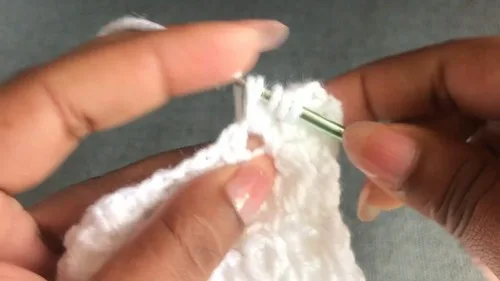
Chain one, turn your work, and single crochet in the back loop of each stitch until the last stitch.For the final stitch, use both loops.
- Round 3
Chain one, turn your work, and single crochet in the back loop of each stitch until the last stitch.For the final stitch, use both loops.Continue: Repeat these two rows to create the hat ribbon.A 0-3 month size requires 60 rows.
Main Pattern
- Round 1
Start with a chain of three, which counts as the first stitch.
- Round 2
Skip one row and into the next, create four double crochets with the last loop on the hook. Go through all five loops on the hook and then chain one.Go through all five loops on the hook and then chain one.Continue this pattern to the end, finishing with a double crochet into the first of the nine starting chains.
- Round 3
Chain one and turn your work. Single crochet in the space between the first double crochet and the next stitch, then chain one.Repeat this pattern, finishing with a single crochet into the third chain of the starting chain-three.Repeat Rows 4 & 5:
- Round 4
Start with a chain of three and turn your work. Skip the first single crochet and in the next chain space, make four double crochets with the last loop on the hook.Go through all five loops and then chain one.Repeat in each chain space to the end.The last stitch is a double crochet into the last single crochet of the previous row.
- Round 5
Chain one, turn your work, single crochet between the first double crochet and stitch, and then chain one.Repeat this pattern to the end of the row, finishing with a single crochet into the third chain of the previous row's chain-three.Continue: Repeat rows four and five for the body of the hat.A 0-3 month size uses 10 rows of this repeat.
Reducing Stitches for the Hat Top
- Round 11
Start with a chain of three and turn your work. Use the first two chain spaces to make four double crochets with the last loop on the hook.Go through all five loops and chain one.Repeat this, combining two chain spaces into one stitch, until the end of the row.Finish with a double crochet in the last single crochet.
- Round 12
Chain one, turn your work, single crochet, and then chain one between each stitch.Finish with a single crochet in the top of the third chain.
- Round 13
Start with a chain of three and turn your work. Again, combine two chain spaces into one stitch, making four double crochets with the last loop on the hook, and chain one.Repeat this pattern to the end.
- Round 14
Chain one, turn your work, and single crochet between each stitch. You should have eight single crochets.Cut the yarn at the end of this row.
Making up
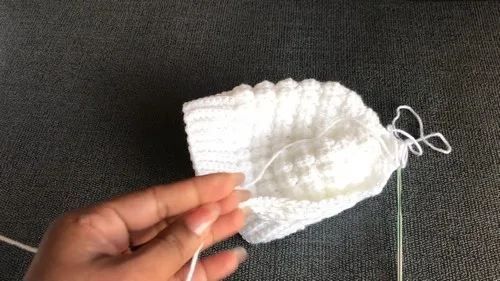
- Step 1Close the Top : Use the long yarn tail and a needle to sew through the eight single crochets at the top of the hat to close it tightly.
- Step 2Seam the Side : Use the same yarn to sew the side seam of the hat from the top down to the ribbon section.
- Step 3Join the Ribbon : Join the two ends of the ribbon by sewing through the single crochet stitches on each side.
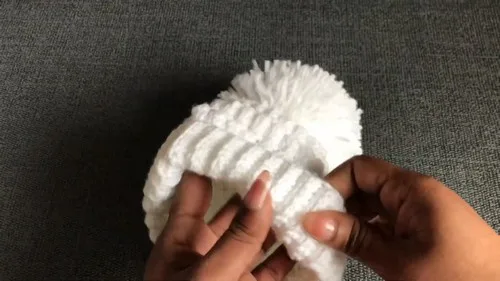
- Step 4Pom-Pom : Make a pom-pom by wrapping yarn around a piece of cardboard 250 to 275 times.
- Step 5You can then attach it to the top of the hat.
Notes from the pattern
- Only one hook size, 4 mm, is given for the whole hat; since no finished head measurement is stated, working the ribbon section first and checking it against a 0-3 month head is the only way to confirm fit before continuing.
- No stitch markers are named in the source, but placing one in the first of the nine starting chains at the end of the ribbon section makes it easier to find the stitch that Row 2 of the main pattern finishes into.
- Tension needs to stay even through the back loop rows and the cluster rows alike: a loose back loop row flattens the rib, while loose clusters leave the crown looking saggy rather than lightly bobbled.
- If changing colour partway through, work the change at the start of a row so the join sits in the seam, and weave in all ends before making the pom-pom so none show through the finished loops.
The essentials
- Rounds
- 12
- Parts
- 3
- Level
- Intermediate
- Time
- 4-6 hours
- Hook
- 4 mm
- Yarn
- DK
Stitches you will use
- Back loop only single crochet Used throughout the ribbon section to build the rib texture; every stitch except the last of each row goes into the back loop only, so a missed stitch flattens the ridge.
- Four-stitch cluster with a shared loop Forms every stitch of the main pattern; the last loop of each of the four double crochets is kept on the hook, then all five loops are drawn through together, so losing count changes the cluster's shape.
- Paired decreasing across chain spaces Used in the four reducing rows to taper the crown; two chain spaces are combined into one stitch at a time, and skipping a pair leaves the top too wide to close neatly.
Troubleshooting
The ribbon brim looks smooth instead of ribbed.
A stitch has likely been worked into both loops instead of the back loop only; recheck each row, remembering that only the final stitch of Row 2 uses both loops.
The clustered rows of the main pattern
This usually means the loop count before drawing through was off; count to five loops on the hook every time before pulling through to close the cluster.
The top of the hat stays too wide and
One or more decrease rows likely combined chain spaces unevenly; recount so that every pair of chain spaces becomes a single stitch across each of the four reducing rows.
Substituting yarn
- Acrylic, double-knitting weight
- Keeps the same 4 mm hook and stitch count; the finished rib and clusters sit slightly stiffer and the hat machine-washes more easily, which suits everyday baby wear.
- Cotton, double-knitting weight
- Gives a crisper, less stretchy rib, so going up to a 4.5 mm hook helps the ribbon brim keep the same give as the original; the hat feels cooler against the skin.
- Wool or wool-blend, double-knitting weight
- Softens the drape of the crown and makes a fuller pom-pom at the same wrap count, but the hook size may need to drop slightly if the yarn is thicker than standard DK.
Washing and care
- The pattern does not name a specific fibre, so the yarn band is the best guide; hand washing in cool water is the safest default for a baby hat regardless of fibre chosen.
- Dry flat away from direct heat to stop the ribbed brim and clustered crown from stretching out of shape, and fluff the pom-pom back into a round while it is still slightly damp.
The photographs taken while this was being made
Every one was taken by whoever published the pattern, in the order the source listed them.
FAQs
Questions
What size does this hat fit?
As written, the pattern is sized for a 0-3 month head. The starting chain of nine and the stitch counts throughout are specific to that size, so changes to either would need to be worked out separately.
Can the pom-pom be left off?
Yes. The hat is complete once the top is closed, the side seam is sewn, and the ribbon ends are joined; the pom-pom step is a finishing touch, not a structural part of the hat.
What yarn weight and hook does this pattern call for?
Double-knitting weight yarn with a 4 mm hook, which is the only hook size given for the whole hat, ribbon and crown alike.
How much yarn does the pom-pom use?
The pattern gives this as a wrap count rather than a length: wind yarn around a piece of cardboard 250 to 275 times before tying off and trimming.
Why does the main pattern finish into 'the first of the nine starting chains'?
This refers back to the nine-chain foundation made at the very start of the ribbon section. Row 2 of the main pattern is worked along that same ribbon edge, so it ends by joining into the chain where the ribbon began.
These answers came from whoever first published the pattern, kept word for word.