 EVERY CROCHET
 Garments 4 rounds No account, no download
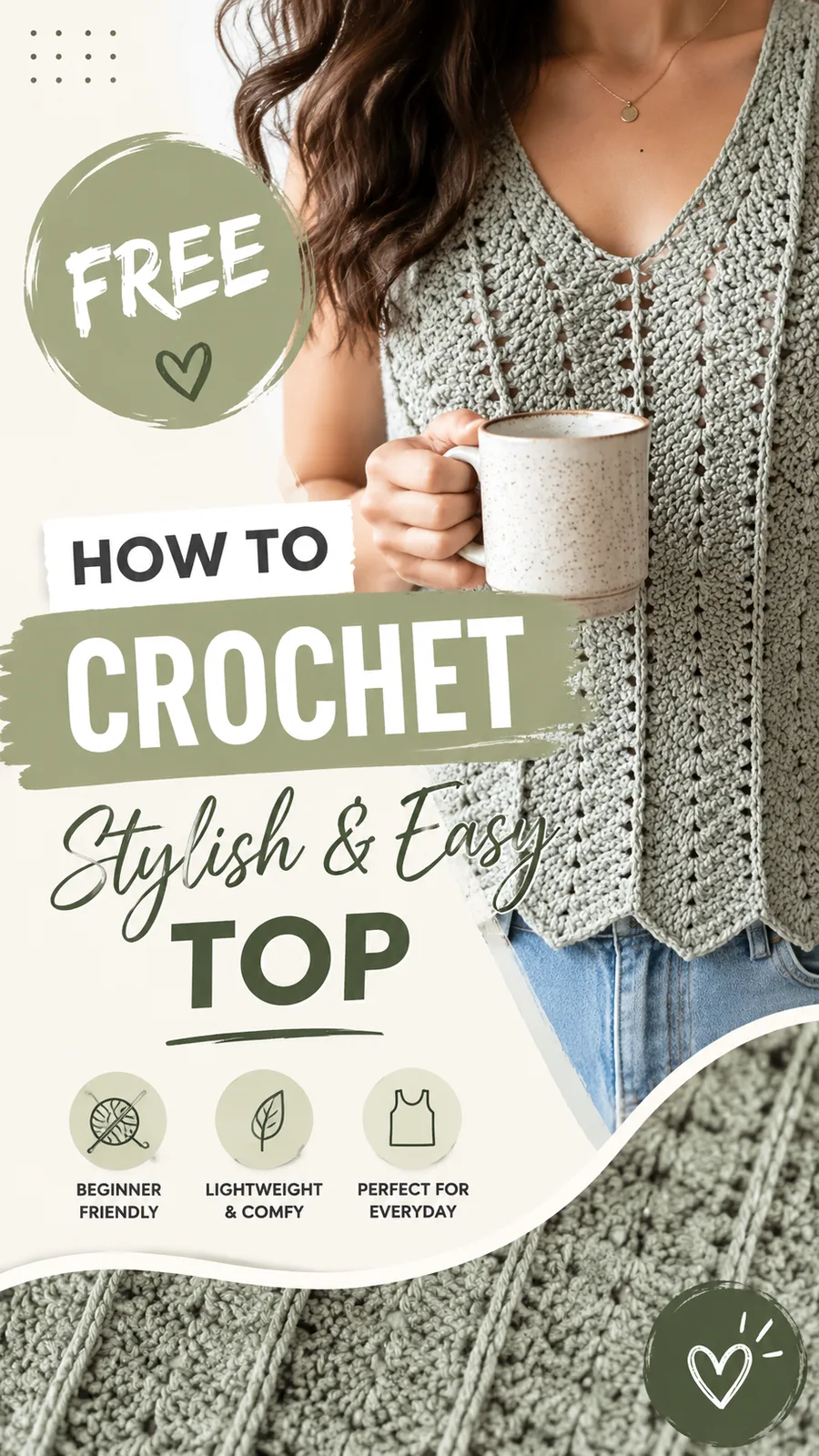
A vertical-texture crochet top for confident beginners
A double crochet (UK: treble crochet) summer top with front post texture columns; pattern notes give both US and UK stitch names.
- Skill
- Confident Beginner
- Time
- 8-12 hours
- Yarn weight
- DK
- Hook
- 4 mm

Confident Beginner
What the original write-up called it. Nothing here is graded again.

DK
What the sample was worked in. Any weight works; the size moves with it.

8-12 hours
What the original page reckoned. Your own pace is the one that matters.
About this pattern
This is a sleeveless, two-panel cotton top built from double crochet (UK: treble crochet) fabric with front post double crochet columns for vertical texture. A front panel and back panel are each worked flat, then joined at the shoulders and sides. It uses roughly 900 yards of DK weight cotton or cotton-blend yarn with a 4 mm hook, and suits confident beginners comfortable with basic shaping and seaming.
This sleeveless top sits firmly within the double crochet (UK: treble crochet) family, the stitch used for almost every row of fabric. Raised front post double crochet stitches are worked over the plain rows below to form the vertical columns that run the length of the garment, giving a structured, textured surface without adding bulk. The result reads as a smart, minimalist fabric that suits both neutral and brighter colourways, and the stitch repeat is simple enough to memorise after a few rows.
Construction is panel-based rather than worked in the round: a front panel and a back panel are each worked flat in rows from a foundation chain, then seamed at the shoulders and sides once both pieces reach the correct length. Working the panels separately makes it straightforward to adjust width by changing the starting chain, or length by crocheting extra repeats of the two-row stitch pattern before shaping the neckline and shoulders ahead of sewing the pieces together.
Neutral shades such as gray, cream, beige, or soft blue highlight the stitch texture, but the design also works beautifully in brighter colors.
Materials
- A cotton or cotton-blend yarn is recommended because it provides breathability, stitch definition, and comfortable wear. A lightweight DK yarn creates enough structure while allowing the top to drape naturally.
Project category
- Wearable crochet garment
Construction
- Two flat panels worked in rows
Main texture
- Double crochet fabric with raised stitch columns
Skill level
- Confident beginner to intermediate
Best season
- Spring, summer, and layering weather
- DK weight cotton or cotton blend yarn: approximately 900 yards (823 meters)
- 4 mm US G-6 crochet hook
- Yarn needle
- Stitch markers
- Scissors
The list is the pattern's own wording.
Instructions
Every round is printed as the pattern wrote it, brackets and all. Open the key beside a round to see only the short forms that round uses.
Front Panel
Ch 86.
- Row 1
Dc in fourth ch from hook and in each ch across. Turn. (84 dc)
Key2
- ch
- chain
- dc
- double crochet
- Row 2
Ch 2, dc in each stitch across. Turn. (84 dc)
Key2
- ch
- chain
- dc
- double crochet
- Row 3
Ch 2, dc in first 3 sts, *fpdc around next stitch from two rows below, dc in next 3 sts, repeat from * across. Turn. (84 sts)
Key3
- fpdc
- front post double crochet
- ch
- chain
- dc
- double crochet
- Row 4
Ch 2, dc across. Turn. (84 dc)Repeat Rows 3 and 4 until the panel measures 15 inches (38 cm).For neckline shaping, work across 28 sts, fasten off, skip 28 center sts, attach yarn, and work remaining 28 sts.Work each shoulder section separately for 3 rows.
Key2
- ch
- chain
- dc
- double crochet
Special Stitch
Textured Column: Work 3 dc stitches, then work 1 fpdc around the dc stitch from two rows below. This creates a raised vertical line. Keep tension relaxed so the fabric remains flexible.
Back Panel
Repeat the front panel instructions until the piece measures 18 inches (46 cm).
Work straight across for the back neckline without deep shaping.
Fasten off after reaching the same shoulder height as the front panel.
Edging
Attach yarn at the neckline and work one round of single crochet evenly around the opening. Repeat around the armholes and bottom edge for a clean finished look. Join with a slip stitch and fasten off.
Making up
- Step 1Block both panels lightly to match measurements.
- Step 2Place panels with right sides facing together.
- Step 3Join shoulder seams using mattress stitch or slip stitch seam.
- Step 4Sew side seams from the bottom upward, leaving approximately 8 inches (20 cm) open for armholes.
- Step 5Weave in all yarn ends securely.
Notes from the pattern
- A 4 mm (US G-6) hook is suggested for the DK weight cotton or cotton-blend yarn; swatch first, since cotton has little give and a slightly larger hook can soften a dense fabric.
- Place stitch markers at the first and last stitch every few rows and count stitches at the same time, catching any drift in the 84-stitch count before it shows at the edge.
- Gauge is 18 double crochet stitches by 10 rows = 4 x 4 inches (10 x 10 cm); check gauge over the stitch pattern before adjusting the width (starting chain) or length (panel measurement), since cotton DK yarn varies more between brands than wool does.
- Cotton has minimal stretch and tends to relax slightly after wear or washing, so block gently rather than stretching the panels aggressively to size.
- The stitch pattern works best when the starting chain remains a multiple of 4 plus 2 stitches: add chains in groups of 4 for a wider bust, work extra pattern rows for a longer tunic style, reduce rows before neckline shaping for a cropped style, and make wider front and back panels using the same stitch repeat for larger sizes.
- Handmade garments depend heavily on accurate measurements: compare your panel width with your own body measurements before joining the seams.
The essentials
- Rounds
- 4
- Parts
- 4
- Level
- Confident Beginner
- Time
- 8-12 hours
- Hook
- 4 mm
- Yarn
- DK
Stitches you will use
- Front post double crochet (fpdc) Worked around the stitch two rows below from Row 3 onward to create the vertical columns; take care to work around the post, not into the top loops, and keep tension relaxed so the column doesn't pull the fabric tight.
- Row-based stitch counting with turning chains Each row is checked against a fixed count (84 dc); turning chains don't count as stitches and slip stitches are used only for joining, so miscounting either will shift the stitch total.
- Measuring panels to length rather than row count The front panel is worked until it measures 15 inches (38 cm) and the back panel until 18 inches (46 cm); re-measure every few repeats since gauge, not row number, determines when to stop.
Troubleshooting
The side edges drift in or out instead of staying straight.
The stitch count has crept up or down between rows; count stitches after every few rows and place markers at the first and last stitch to catch the drift early.
The fabric feels stiff rather than soft and drapey.
Tension is too tight for the hook size being used; move up a hook size or consciously loosen tension, particularly around the fpdc columns.
The finished top doesn't match the
Gauge differs from the pattern's gauge; check gauge over the stitch pattern before making any width or length adjustments to the panels.
The neckline or shoulders don't line up evenly.
Measure both shoulder sections before assembly to confirm they match before seaming, since uneven shoulder measurements are a common cause of a crooked neckline.
Substituting yarn
- Cotton-linen blend, DK weight
- Gives similar stitch definition and crisp vertical columns but slightly less elasticity than pure cotton; keep tension loose and the same hook size can usually stay.
- Acrylic or acrylic-cotton blend, DK weight
- Lighter and more budget-friendly with more stretch, though the raised fpdc columns read less sharply and blocking has less effect than it does on cotton.
- Bamboo or bamboo-blend, light DK or sport weight
- Adds sheen and extra drape, so the finished top hangs softer and slightly looser; sizing down the hook slightly can help the fabric keep its structure.
Washing and care
- Hand wash or use a gentle machine cycle suited to cotton, since cotton fibre can relax or stretch under heat and agitation.
- Lay the top flat to dry and store it folded rather than hung, which keeps the two panels and their seams from stretching out of shape over time.
FAQs
Questions
What size does this pattern make?
As written, the top finishes at a Small/Medium bust of 38 inches (96.5 cm) with a shoulder-to-hem length of 22 inches (56 cm), an armhole depth of about 8 inches (20 cm), and a recommended positive ease of 2 to 4 inches (5 to 10 cm). Width and length can be adjusted by changing the starting chain or the number of pattern repeats.
How much yarn is needed?
The pattern calls for approximately 900 yards (823 metres) of DK weight cotton or cotton-blend yarn, worked on a 4 mm (US G-6) hook. Both panels are worked from the same amount, so weigh or measure leftover yarn before starting the second panel.
Is this pattern suitable for a beginner?
It's aimed at confident beginners to intermediate crocheters, since it only uses double crochet (UK: treble crochet) and front post double crochet. Working two matching panels to the correct length and seaming them does ask for a bit more patience than a single-piece project.
What causes the raised vertical lines in the fabric?
They come from working a front post double crochet around the stitch two rows below, repeated every few stitches across the row. This raised stitch column is the main textural feature of the top.
Why is the panel measured in inches rather than counted in rows?
The front panel is worked to 15 inches (38 cm) and the back panel to 18 inches (46 cm) rather than to a fixed row count, because gauge varies between crocheters. Measuring the panel as it grows keeps both pieces consistent before the neckline and shoulders are shaped.
These answers came from whoever first published the pattern, kept word for word.